

NAP consistency means your business Name, Address, and Phone number appear identically everywhere online, from your Google Business Profile to the smallest local directory. When you add your website, that’s called NAP+W. It matters because search engines use matching NAP data as a trust signal for local rankings, and customers hang up or bounce when the details don’t match what they see on the map. Your next move: pull up your Google Business Profile, your website footer, and your top ten directory listings, and compare them line by line today.
TL;DR:
- Maintaining consistent NAP data across Google, directories, and your website ensures better local search rankings and builds trust with potential customers.
- Common issues include abbreviation mismatches, inconsistent suite or unit numbers, duplicate listings, outdated phone numbers, and virtual office addresses.
- Regular quarterly audits with a central canonical record prevent future errors and coordinate updates across multiple locations or rebranding efforts.
- Tracking numbers used for marketing campaigns must be carefully managed to avoid leaking into public listings and breaking trust signals.
- A one-day, prioritized audit can quickly identify and fix high-impact NAP issues, especially those caused by outdated or duplicate listings.
Table of Contents
- What is NAP consistency: components and how search engines use citation data
- Why NAP consistency matters for local SEO and customer trust
- How to audit NAP consistency: step-by-step process and tools
- Common NAP problems and concrete fixes (with examples)
- Governance and best practice: keep NAP consistent as your business changes
- Call tracking and DNI: avoid breaking your public NAP signals
- Quick action checklist: a one-day plan to audit and fix the top issues
- What client audits actually reveal
- Get your listings audited properly
- Sources
What is NAP consistency: components and how search engines use citation data
Name, Address, and Phone number sound simple until you try to match them across 40 different listings. Name means your exact registered trading name, not “Smith’s Plumbing Pty Ltd” in one place and “Smith Plumbing” in another. Address means your street number, suite, and suburb formatted the same way everywhere, right down to whether “Street” is abbreviated to “St.” Phone means one number, formatted consistently, whether that’s with spaces, dashes, or brackets around the area code. Some businesses add the website URL to this trio, creating NAP+W, which is increasingly common practice for citation accuracy.
Search engines pull this data from two places: structured citations (directories like Yellow Pages or Yelp that store your details in labelled fields) and unstructured mentions (a news article that names your business and suburb in a sentence). Both types feed into how confident Google feels about your location and legitimacy. That confidence directly improves the likelihood of appearing in local results and maps. Punctuation and formatting quirks matter more than most owners expect, because automated systems match strings, not intentions.
Why NAP consistency matters for local SEO and customer trust
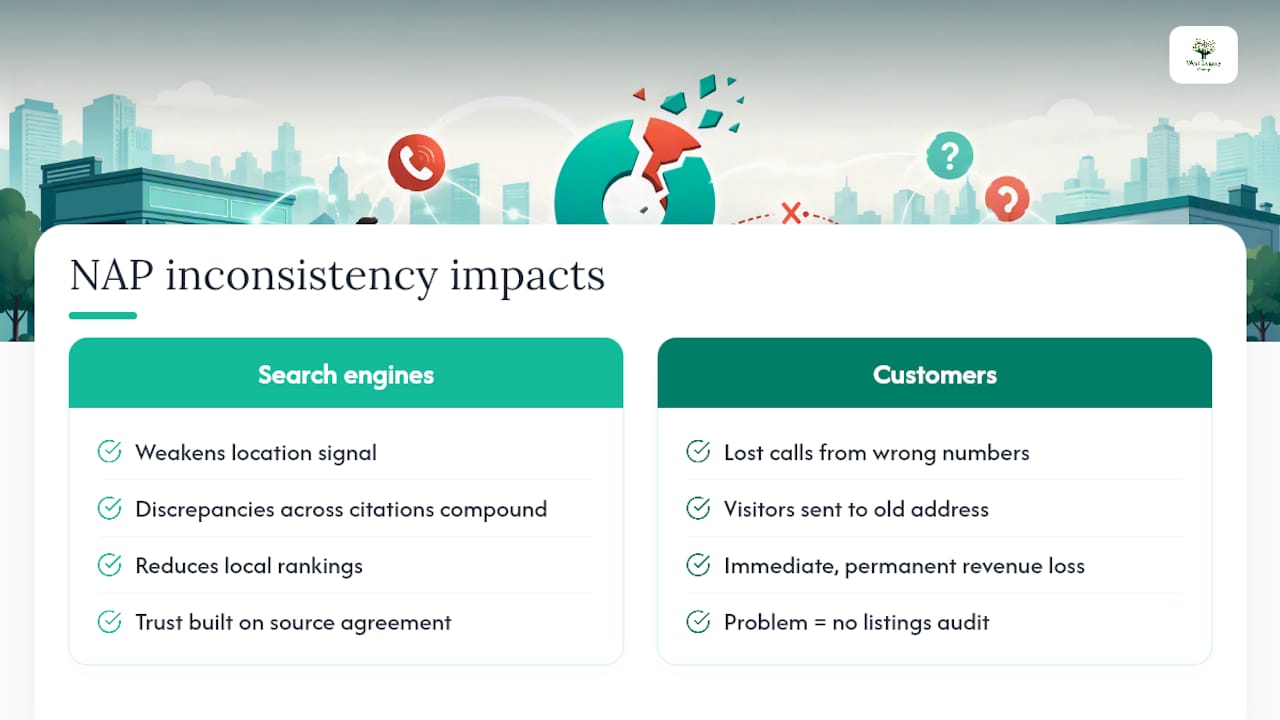
Search engines treat mismatched NAP data as a red flag. If your Google Business Profile lists one phone number and a directory lists another, that discrepancy weakens the location signal search engines rely on to decide whether you’re a real, stable business worth ranking. The effect compounds across dozens of citations, and it’s one of the quieter reasons a competitor with a scrappier website still outranks you locally.
The customer-facing damage is more immediate. A tradie whose old number still shows on three directories loses every call from those listings, permanently, without ever knowing it happened. A café that moved premises six months ago but still has the old address indexed on a review site sends first-time visitors to an empty shopfront. These aren’t hypothetical edge cases. They’re the default outcome of never auditing your listings.
Consistent NAP data also supports voice search results and referral traffic, because voice assistants and map apps pull from the same citation pool search engines trust. When someone asks their phone for “a plumber near me open now,” the answer comes from whichever listing the algorithm trusts most, and trust is built on agreement across sources, not on any single accurate listing.
How to audit NAP consistency: step-by-step process and tools
Before you touch a single listing, decide what “correct” looks like. That single reference point is your canonical NAP, and every other piece of this process measures against it.
- Write down your canonical NAP. Exact legal or trading name, full address with suite number if applicable, one phone number, formatted one way. Store it somewhere everyone on your team can find it.
- Build a spreadsheet of every listing you can find. Columns for the platform, the listed name, address, phone, last checked date, and status (matches, needs fixing, disputed).
- Search your business by name and by old addresses or phone numbers you’ve used previously, since outdated listings often surface under discontinued details.
- Check Google Business Profile first, then your website, then your top ten directories, then any aggregator dashboards you have access to.
- Normalise phone formatting before comparing. “(03) 5443 1234” and “03 5443 1234” read as different strings to automated matching tools even though a human reads them as identical.
- Document any deliberate exceptions, such as a suite number that only appears on Australia Post-facing listings.
Manual checks work fine for a single-location business with under 30 listings. Beyond that, tools built for canonicalising a single source of truth and flagging duplicates save real hours, and an agency audit makes sense once you’re managing multiple locations or a franchise network.
Pro Tip: Search your phone number in quotation marks in Google before you search your business name. It surfaces old listings and scraped citations your name search misses entirely.
Common NAP problems and concrete fixes (with examples)
Most NAP errors fall into a handful of repeatable categories, which is good news, because it means fixing them is a checklist, not a mystery.
- Abbreviation mismatches. “123 Smith St” on one listing and “123 Smith Street” on another look identical to a customer but read as different addresses to matching systems. Fix: pick one format (we recommend spelling street types in full) and apply it everywhere.
- Suite and unit number inconsistencies. “Suite 4, 22 High St” versus “22 High St, Unit 4” versus no suite number at all. Fix: match the format your Australia Post-registered address uses.
- Duplicate or partial listings. Old locations, rebrands, or a well-meaning employee creating a second Google Business Profile all create duplicates that split your reviews and confuse ranking signals. Fix: request a merge through the platform, or flag the outdated one for removal.
- Phone number conflicts. Old landlines still listed after a switch to mobile, or a call-tracking number accidentally left as the permanent public listing.
- PO boxes and virtual offices. Google Business Profile guidelines generally require a physical location for service-area businesses, and a PO box substituted for a street address will get a listing suspended or unverified.
Merging duplicates and cleaning aggregator-sourced errors typically delivers more ranking improvement than adding new directory listings. Quality of existing citations beats quantity of new ones, every time.
Governance and best practice: keep NAP consistent as your business changes
An audit fixes today’s problems. Governance stops tomorrow’s from happening. The simplest fix most small businesses skip is writing down who’s allowed to change the NAP record and where that master copy lives.
- Set one canonical NAP document stored somewhere central, not in someone’s inbox or a sticky note on a monitor.
- Name one person as the approver for any change to name, address, or phone across listings, even a punctuation tweak.
- Run a quarterly audit rather than waiting until a customer complaint tells you something’s wrong.
- Use a change template whenever you move premises, rebrand, or swap phone providers, listing every platform that needs updating in one pass instead of remembering as you go.
This discipline scales particularly well for businesses managing more than one location, where one uncoordinated change at head office can quietly break listings across every branch. A canonical record and repeated quarterly checks are genuinely the whole strategy for most small teams. There’s no advanced trick beyond doing this consistently.
Pro Tip: Set a calendar reminder for the first Monday of each quarter labelled “NAP check”, and treat it with the same seriousness as your BAS lodgement. It takes twenty minutes and it’s the cheapest insurance your local visibility gets.
Call tracking and DNI: avoid breaking your public NAP signals
Call tracking and dynamic number insertion (DNI) swap in temporary numbers to measure which campaigns generate calls, and that’s genuinely useful for marketing attribution. The risk is letting a tracking number leak into a permanent public listing like your Google Business Profile or a directory citation, which creates the exact mismatch that erodes citation trust. Keep your canonical number on public-facing citations, document tracking numbers in an internal spreadsheet rather than pushing them to directories, and set tracking numbers to forward transparently to your main line.
Quick action checklist: a one-day plan to audit and fix the top issues
You can fix the highest-impact NAP problems in a single working day if you follow this order.
- Morning, 30 minutes: Write your canonical NAP and get sign-off from whoever owns the business decision.
- Morning, 45 minutes: Update Google Business Profile to match exactly.
- Late morning, 1 hour: Fix your website footer, contact page, and schema markup.
- Afternoon, 2 hours: Work through your top ten directories, correcting each against your canonical record.
- Afternoon, 30 minutes: Check tracking numbers haven’t leaked into any public listing.
- End of day, 15 minutes: Set a quarterly calendar reminder for the follow-up audit.
Build your tracking spreadsheet with columns for platform, listed NAP, canonical match (yes/no), date checked, and owner. One person can run this alone; a marketer and an office admin working in parallel will finish faster.
What client audits actually reveal
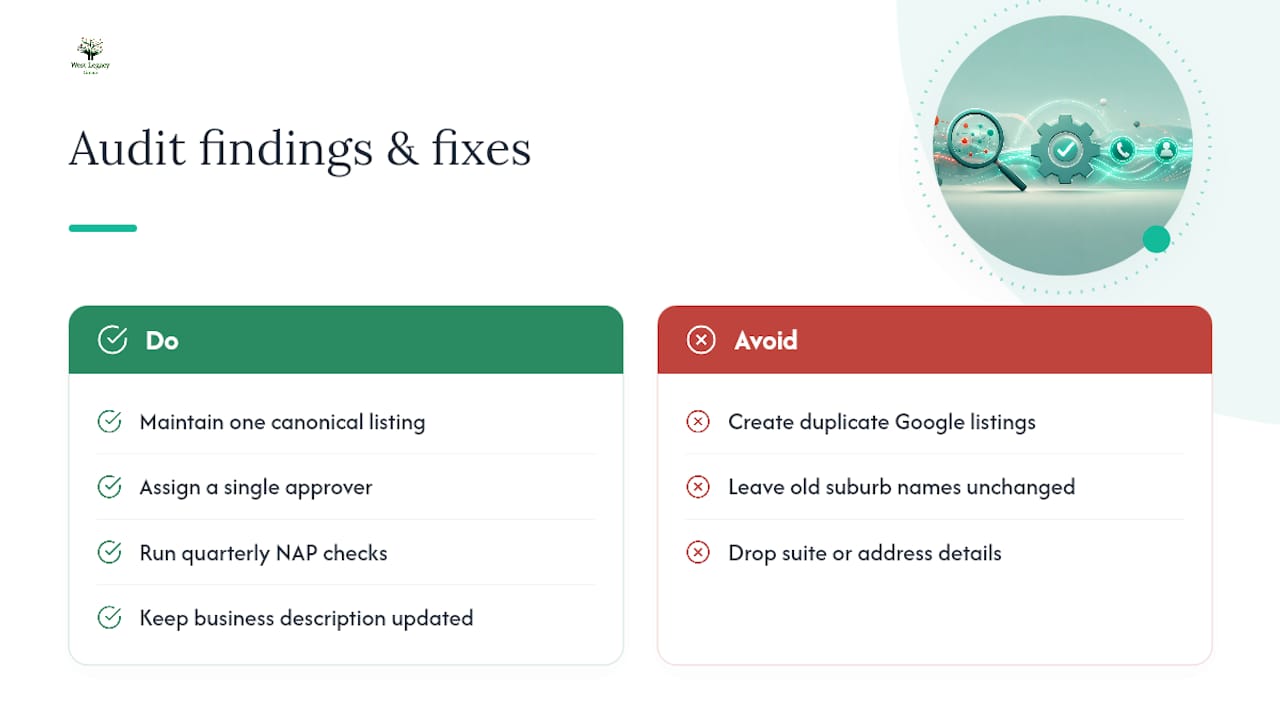
Most NAP errors West Legacy Group finds during a listings audit aren’t dramatic. They’re old suburb names left over after a council boundary change, a suite number dropped when a business card was redesigned, or three separate Google Business Profile listings created over the years by different staff members trying to “help.” The fix is rarely technical. It’s almost always governance: one canonical record, one approver, one quarterly check.
The clients who stay consistent long term are the ones who treat their business description with the same care as their contact details, because clear, accurate copy builds the same trust signal that correct NAP data does. Get both right and local search stops working against you.
— Christopher
Get your listings audited properly
An alternative to guessing your way through directory corrections one listing at a time is available. A comprehensive NAP audit service builds your canonical record, checks it against your Google Business Profile, website, and top directories, and provides a prioritised fix list with aggregator-sourced errors flagged first, since those tend to cause the most silent damage.
If you’d rather have this managed ongoing rather than fixed once and forgotten, our affordable local SEO services fold quarterly listing checks into a broader local visibility plan. Prefer to run the audit yourself with our templates first? Start with our small business website packages to get your contact details locked down at the source, then reach out for a quote on the full listings clean-up.
Sources
Not every listing carries equal weight, and chasing every directory on the internet wastes time you don’t have. Prioritise by control and impact.
- What is NAP Consistency? How Does NAP Affect Local …
- What is NAP in Local SEO?
- What is NAP and why is NAP consistency important?
The key distinction is between profiles you own and can edit directly, and third-party mentions you can only request corrections for. Fixing your Google Business Profile takes minutes. Fixing an aggregator error can take weeks to propagate through, which is exactly why it belongs early on your audit list, not late.