

An ecommerce content marketing strategy is the structured system of creating and distributing targeted content that drives online sales and customer retention. Unlike SaaS or service businesses, ecommerce content must work fast, look good, and push buyers toward a purchase decision quickly. The stakes are real: 70.19% of online retail orders are abandoned before purchase, largely because of content gaps like unclear value propositions and missing trust signals. That single figure tells you content is not a nice-to-have. It is the difference between a sale and an empty cart.
What is an ecommerce content marketing strategy and why does it matter?
A content marketing strategy for ecommerce operates on two layers: acquisition and retention. Acquisition content pulls new buyers in through search engines and social media. Retention content keeps existing customers engaged through email, on-site guides, and social proof. Balancing both layers is what separates high-performing stores from those that plateau after their first wave of paid traffic.
Most ecommerce owners treat content as an afterthought. They publish a few product descriptions, run some ads, and wonder why organic growth stalls. The answer is almost always the same: they have built the transactional layer but ignored the informational layer entirely. Without informational content, your store has no organic entry points beyond branded search.

What are the core content layers and how do they support the buyer journey?
Every ecommerce store needs two distinct content layers working together. The transactional layer covers product pages, category pages, and collection pages. These are the pages that close sales. The informational layer covers blog posts, buying guides, how-to articles, and product comparisons. These are the pages that attract buyers before they know exactly what they want.
Many ecommerce brands neglect informational content, which limits organic traffic growth. Informational content typically targets higher search volumes with less competition than product pages. A buyer searching “best running shoes for flat feet” is not yet on your product page. A well-written buying guide captures that search and routes the buyer toward your product catalogue.
Mapping content to the buyer journey is the practical way to plan this. The table below shows how each content type fits a stage.
| Buyer journey stage | Content type | Purpose |
|---|---|---|
| Awareness | Blog posts, how-to guides, tutorials | Attract new visitors via organic search |
| Consideration | Buying guides, product comparisons, reviews | Build trust and educate buyers |
| Decision | Product pages, collection pages, FAQs | Convert intent into purchase |
| Retention | Email sequences, loyalty content, UGC | Drive repeat orders and referrals |
Internal linking from informational to transactional content is what ties the two layers together. A buying guide that links directly to your product pages passes both traffic and authority to the pages that generate revenue.
Pro Tip: Build your informational content in topic clusters. Write one pillar guide on a broad topic, then create three to five supporting articles on related subtopics. Each supporting article links back to the pillar and to relevant product pages. This structure builds topical authority faster than isolated blog posts.
Which content formats generate the highest ROI for ecommerce?
Three core formats deliver the majority of ecommerce content marketing results: buyer-intent SEO posts, product education emails, and short-form social proof content. These three formats account for 80% of ecommerce content marketing results when executed consistently.
Here is how to prioritise and schedule each format:
- Buyer-intent SEO posts: Publish one per week. Target phrases like “best X for Y” or “how to choose X.” These posts take time to rank but compound in value. SEO-driven content takes 4–9 months to generate consistent traffic, so start immediately.
- Product education emails: Send one per week. Explain how a product works, who it suits, and why it solves a specific problem. Klaviyo benchmarks show abandoned cart email flows generate an average of $3.65 per recipient. The top 10% of senders earn $28.89 per recipient from the same flow.
- Social proof content: Post three times per week across Instagram or TikTok. Use customer photos, short video reviews, and before-and-after results. Visual social proof drives fast purchase decisions in ecommerce more than any written testimonial.
- User-generated content (UGC): Repurpose customer reviews, unboxing videos, and tagged photos. UGC costs almost nothing to collect and converts at a higher rate than brand-produced content because buyers trust other buyers.
Pro Tip: Audit your abandoned cart email flow every quarter. Check open rates, click rates, and revenue per recipient. If the sequence has not been updated in six months, rewrite the subject lines and test a new offer in the second email.
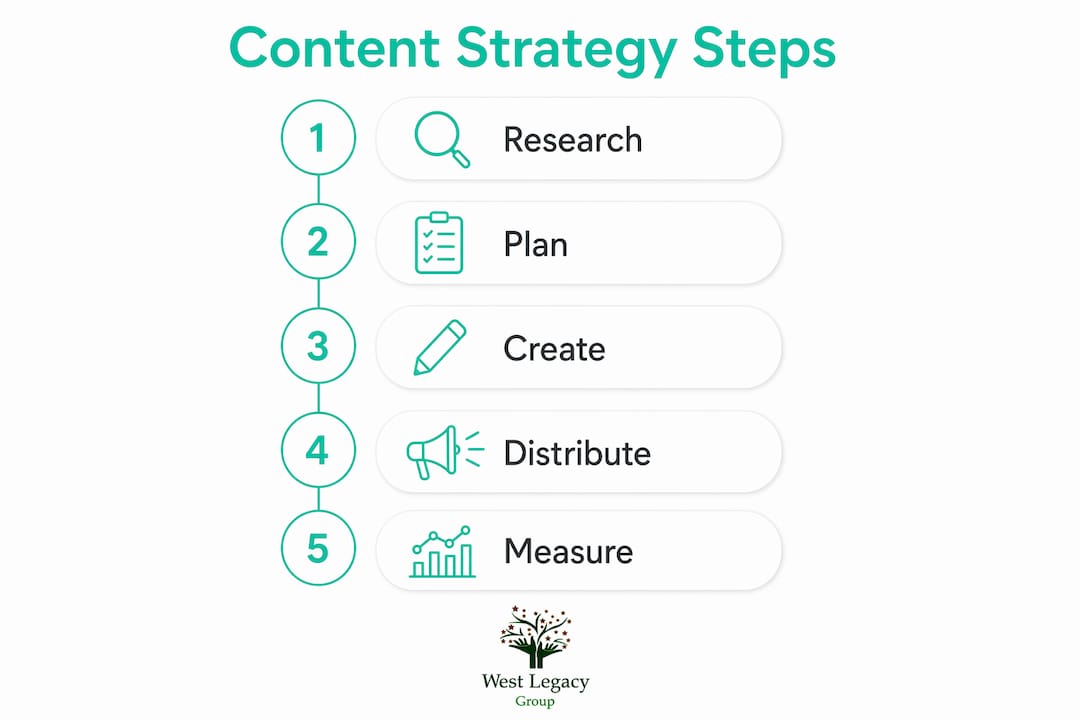
How to build and execute a systematic content marketing plan
Planning starts with keyword research focused on buyer intent. Search for phrases that signal purchase readiness: “buy X online,” “X vs Y,” “best X under $100,” and “X review.” These phrases attract visitors who are close to a decision, not just browsing. Tools like Google Search Console show you which queries already bring traffic to your site, which is the fastest place to find new content opportunities.
Execution follows a weekly rhythm. One SEO article, one product education email, and three social proof posts per week is the recommended publishing schedule for ecommerce brands. That cadence is manageable for a small team and consistent enough to build momentum over time.
Distribution is where most ecommerce owners leave money on the table. Creating content is only half the job. Integrating email, SMS, and social channels into a multi-channel distribution system is what maximises the return on every piece of content you produce. A single blog post can become an email, three social captions, and an SMS teaser with minimal extra effort.
The table below outlines a repeatable weekly execution process.
| Step | Activity | Timing |
|---|---|---|
| 1. Plan | Select keyword and content angle | Monday |
| 2. Create | Write SEO article or email draft | Tuesday to Wednesday |
| 3. Distribute | Publish article, schedule email, post social content | Thursday |
| 4. Repurpose | Convert article into social captions and SMS teaser | Friday |
| 5. Review | Check last week’s performance metrics | Friday |
Pro Tip: Batch your content creation. Write four SEO articles in one sitting at the start of each month. Schedule them to publish weekly. This removes the weekly pressure of starting from scratch and keeps your publishing cadence consistent even during busy periods.
The most common planning mistake is choosing topics based on what you find interesting rather than what buyers are actually searching for. Every content decision should start with a search query, not an idea. If no one is searching for it, no one will find it.
How to measure and maintain your ecommerce content marketing strategy
Measurement tells you what is working and what to cut. The four metrics that matter most for ecommerce content are organic traffic, email revenue per recipient, conversion rate on content pages, and social engagement rate. Track these weekly, not monthly. Monthly reporting hides problems that compound quickly.
Content that does not contribute to acquisition or retention within 90 days is inefficient and should be removed or repurposed. This 90-day rule is a practical filter. If a blog post has received fewer than 100 organic visits in three months and has no internal links driving traffic to product pages, rewrite it with a stronger keyword focus or redirect it to a more relevant page.
Quarterly audits keep your content system healthy. Each quarter, review the following:
- Which SEO articles are ranking on page one and which have dropped below position 20?
- Which email flows are generating revenue and which have low open rates?
- Which social posts drove traffic to your website versus those that only generated likes?
- Are there content gaps in the buyer journey where visitors drop off before reaching a product page?
Use Google Search Console for organic traffic data and your email platform’s built-in reporting for email performance. For tracking content performance across channels, a simple shared spreadsheet updated weekly is often more useful than a complex dashboard that nobody checks.
Pro Tip: Assign one person to own the weekly content review. Shared responsibility means no responsibility. One person checks the numbers, flags underperformers, and brings a short list of changes to the next planning session.
Key takeaways
A successful ecommerce content marketing strategy requires both informational and transactional content working together, distributed consistently across SEO, email, and social channels to drive acquisition and repeat purchases.
| Point | Details |
|---|---|
| Two content layers are required | Transactional pages close sales; informational content attracts buyers before they are ready to purchase. |
| Three formats drive 80% of results | Buyer-intent SEO posts, product education emails, and social proof content deliver the highest return. |
| Distribution multiplies content value | Publishing across email, SMS, and social channels from a single piece of content maximises ROI. |
| SEO takes time; email works fast | SEO content takes 4–9 months to generate traffic; email and social can impact revenue within 30 days. |
| Apply the 90-day rule | Remove or repurpose any content that has not contributed to acquisition or retention within 90 days. |
What I have learned from watching ecommerce content strategies succeed and fail
The most common mistake I see ecommerce owners make is treating content as a volume game. They publish 20 thin blog posts in a month, see no results, and conclude that content marketing does not work for their store. The problem is never the quantity. It is the absence of a clear buyer intent behind each piece.
The stores that grow consistently are the ones that publish less but distribute more. One well-researched buying guide, sent to an email list, shared across social channels, and linked from three product pages, outperforms ten isolated posts every time. Content creation is only a third of the job. Distribution and internal linking do the rest.
I have also noticed that visual social proof is underused by most small ecommerce operators. A single customer photo posted on Instagram with a genuine caption converts better than a polished brand image. Buyers want to see the product in real life, on a real person, in a real setting. That kind of content costs nothing to collect if you simply ask your customers for it after purchase.
The other thing worth saying plainly: do not wait until your content system is perfect before you start. A simple weekly rhythm of one article, one email, and three social posts is enough to build real momentum over six months. Consistency beats perfection every time. If you want to see how sustainable SEO content compounds over time, the evidence is clear: small, steady effort outperforms sporadic bursts.
— Christopher
West Legacy Group and your ecommerce content marketing
West Legacy Group has spent over 20 years helping small businesses build content systems that generate real results. The team works with ecommerce owners on SEO planning, email marketing setup, and content strategy development, all structured to be affordable for businesses at every stage.
If you are ready to build a content plan that actually drives traffic and sales, build your own SEO plan with West Legacy Group and get a clear, structured starting point tailored to your store. For broader digital marketing support including content strategy, email flows, and reporting, the West Legacy Group team is ready to help you put the right system in place.
FAQ
What is content marketing for ecommerce?
Content marketing for ecommerce is the practice of creating and distributing targeted content, including blog posts, emails, and social proof, to attract new buyers and retain existing customers. It differs from SaaS content marketing because it must support fast purchase decisions and repeat orders.
Why do ecommerce stores need a content strategy?
Without a content strategy, most ecommerce stores rely entirely on paid ads for traffic. A content strategy builds organic search visibility, email revenue, and social proof that compound in value over time without ongoing ad spend.
How long does ecommerce content marketing take to work?
SEO-driven content typically takes 4–9 months to generate consistent organic traffic. Email and social content can impact revenue within 30 days when automated flows like abandoned cart sequences are in place.
What is the best content format for ecommerce?
Buyer-intent SEO posts, product education emails, and short-form social proof content deliver the highest return for ecommerce brands. Publishing one of each per week, plus three social proof posts, is the recommended starting cadence.
How do I know if my ecommerce content is working?
Track organic traffic, email revenue per recipient, conversion rates on content pages, and social engagement weekly. Any content that has not contributed to acquisition or retention within 90 days should be rewritten or redirected to a stronger page.