

Your logo is the primary visual identifier of your business on every page of your website. The role of logo website design goes well beyond aesthetics. It shapes first impressions, communicates professionalism, and acts as a trust signal that visitors assess within seconds of landing on your site. Research from Machado et al. confirms that well-designed logos generate stronger consumer brand attitudes and higher willingness to pay. For small business owners building an online presence, your logo is not decoration. It is brand infrastructure.
How does logo design establish brand identity on a website?
Your logo functions as a cognitive shortcut. Visitors process visual information faster than text, so your logo communicates your brand’s values and personality before a single word is read. This is sometimes called the halo effect in brand judgements. A polished, consistent logo primes visitors to view your entire business more favourably.
Visual consistency is the mechanism behind brand recognition. When your logo appears in the same position, at the same size, and in the same colour across every page, your brand meaning compounds over time. Visitors who see your logo repeatedly begin to associate it with reliability. That association is the foundation of customer trust.

A professional logo system is not a single file. Responsive logo systems typically include a full lockup version, a primary mark, a simplified mark, and a favicon, each available in colour, reversed, and monochrome variants. That is at least 12 distinct assets covering different sizes and contexts. Each version serves a specific purpose depending on where it appears on your site.
Your logo also anchors the broader visual identity of your website. Colour palettes, typography, and spacing all take their cues from the logo. When these elements align, your site feels considered and professional. When they clash, visitors notice, even if they cannot articulate why.
- Full lockup: Horizontal or stacked version with your business name, used in the main header.
- Primary mark: Icon or symbol alone, used in compact spaces like mobile headers.
- Simplified mark: A stripped-back version for very small placements.
- Favicon: Square format, typically 16×16 pixels, used in browser tabs and bookmarks.
Pro Tip: Design your logo in vector format from the start. A vector file scales to any size without losing quality, which means you can use the same source file for a website header, a business card, and a billboard.
What technical considerations in website logo design enhance user trust and site performance?
Technical execution determines whether your logo builds trust or quietly undermines it. A logo that loads slowly, appears blurry on a high-resolution screen, or breaks on mobile sends a signal that your business does not pay attention to detail. That signal costs you customers.
File format and size
SVG is the preferred file format for website logos. SVG files are vector-based, meaning they scale to any resolution without pixelation. They also tend to be small in file size, which supports faster page load times. PNG is an acceptable fallback for situations where SVG is not supported.
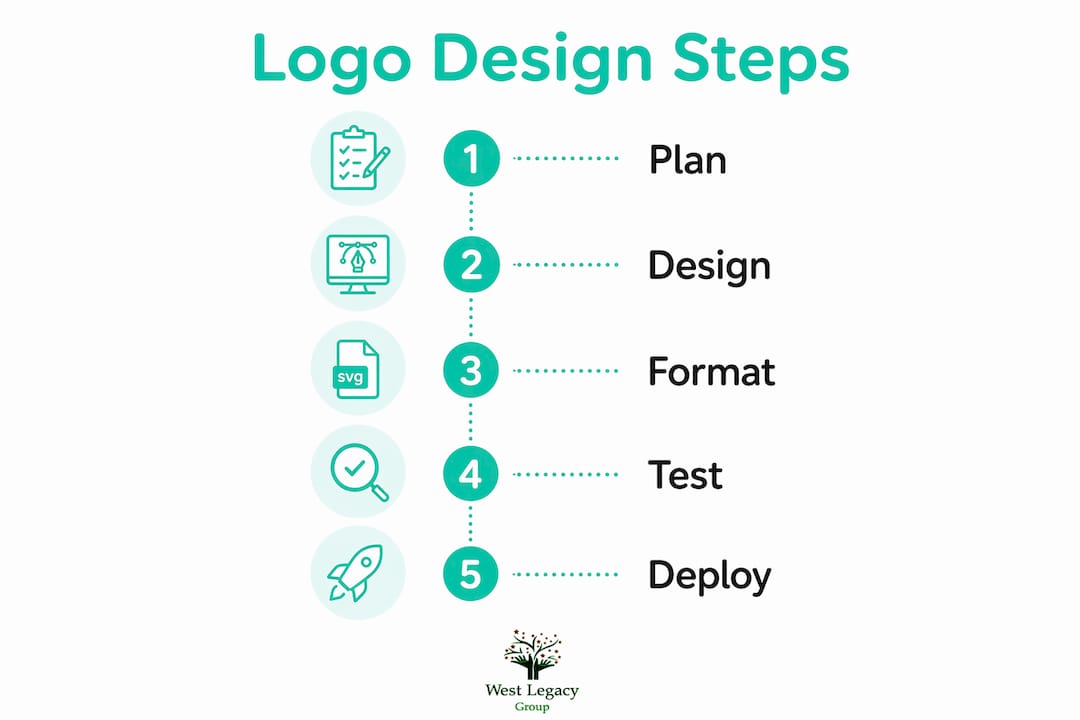
File size discipline matters. Header logo files should stay under 50 KB, and footer logos under 30 KB. Oversized image files slow your page down, and page speed is a confirmed Google ranking factor. A slow site loses both visitors and search visibility.
Recommended dimensions
- Header logos: 250×60 to 400×100 pixels is the standard range for desktop header placement.
- Favicons: Square formats at 16×16, 32×32, and 180×180 pixels cover browser tabs, bookmarks, and Apple touch icons.
- Retina displays: Upload logos at 2x resolution to maintain sharpness on high-density screens without significantly increasing file size.
- Mobile headers: A simplified mark or primary icon version works better than a full lockup at small widths.
- Open Graph images: Include a version of your logo within a 1200×630 pixel image for social sharing previews.
Dark mode and CSS control
Modern websites need to account for dark mode. Inline SVG logos in frameworks like React or Next.js allow colour inheritance, automatic dark mode colour flips via CSS, and zero extra HTTP requests. This approach gives you full control over how your logo appears across visual themes without relying on JavaScript toggles, which are slower and less reliable.
Pro Tip: Ask your web developer to implement your logo as an inline SVG component rather than a static image tag. You gain CSS control, better accessibility attributes, and improved performance in one move.
| Logo placement | Recommended dimensions | Preferred format |
|---|---|---|
| Desktop header | 250×60 to 400×100 px | SVG or PNG |
| Mobile header | 120×40 to 200×60 px | SVG or PNG |
| Favicon | 16×16, 32×32, 180×180 px | ICO or PNG |
| Footer | Match header or smaller | SVG or PNG |
| Open Graph preview | 1200×630 px (logo within) | PNG |
What impact does logo quality have on business success and customer behaviour?
Logo quality has a direct, measurable effect on purchase behaviour. Research by Machado et al. shows that higher logo design quality increases purchase intentions and willingness to pay price premiums, even when the underlying product is identical. That finding has a clear implication: your logo affects your revenue, not just your reputation.
“A polished logo acts as a visual handshake, signalling professionalism and legitimacy to every visitor who lands on your website. For small businesses without an established reputation, it is often the single most powerful trust signal available.”
Poor logo design creates what practitioners call trust leakage. Weak logos undermine brand equity at every customer touchpoint, which forces businesses to spend more on advertising and sales activity to compensate. You end up paying more to acquire customers who should have converted on first impression. That is a compounding cost that grows as your business scales.
For small businesses and startups, the stakes are higher than for established brands. A well-known brand can survive a dated logo because customers already have positive associations. A new business has no such buffer. Your logo is often the first thing a potential customer sees, and a professional logo differentiates a legitimate business from one that does not inspire confidence.
- Trust signals: A professional logo tells visitors your business is real, credible, and worth their time.
- Brand equity: Consistent, quality logo use builds cumulative recognition that reduces future marketing costs.
- Conversion rates: Visitors who trust your brand are more likely to enquire, purchase, or return.
- Price positioning: A high-quality logo supports premium pricing by signalling higher perceived value.
How can small business owners apply best practices to integrate logos effectively?
Effective logo integration requires a system, not a single file upload. The goal is consistent, high-quality logo presentation across every device, page, and context your customers encounter. The logo design for user experience principles that support search rankings also support brand recognition.
- Build a full logo system. Commission at least a full lockup, a primary mark, a simplified mark, and a favicon. Request each in colour, reversed, and monochrome. This gives you the right asset for every context.
- Standardise placement. Your logo should appear in the top-left corner of your header on every page. This is where visitors look first, and consistency reinforces recognition.
- Prepare for dark mode. Provide both light and dark versions of your logo. Use CSS to control which version displays rather than relying on separate image swaps.
- Compress without cutting quality. Use SVG for all scalable placements and keep PNG files optimised. Run images through a compression tool before uploading.
- Align logo with brand identity. Your logo colours, typeface, and style should match your website’s colour palette and typography. Misalignment signals a disconnected brand.
Pro Tip: Before launching or relaunching your website, view your logo on a mobile phone, a tablet, a desktop, and a high-resolution screen. If it looks blurry or cramped on any device, fix it before going live. First impressions do not offer a second chance.
Working with a professional designer and a web developer who understands brand systems saves you from costly revisions later. The West Legacy Group blog covers web standards and logo placement strategies that apply directly to small business websites. Getting the technical and design elements right from the start means your logo works for you from day one.
Key takeaways
Your logo is brand infrastructure, and its quality, technical execution, and consistent placement directly determine how much trust and revenue your website generates.
| Point | Details |
|---|---|
| Logo as brand infrastructure | Treat your logo as a long-term asset, not a one-time design task. |
| Build a responsive logo system | Create at least 12 assets covering sizes, colours, and contexts for every placement. |
| Use SVG for performance | SVG files scale without quality loss and keep file sizes under the recommended 50 KB limit. |
| Logo quality affects revenue | Research confirms higher logo quality increases purchase intentions and willingness to pay premiums. |
| Consistency builds trust | Placing your logo consistently across every page compounds brand recognition over time. |
Why I think small businesses underestimate their logo
Working with small business owners over the years, I have seen the same pattern repeat. A business owner spends months building a website, writing content, and setting up their services, then uploads a logo file they had made quickly and cheaply at the start. The logo is low resolution, does not have a dark mode version, and breaks on mobile. Everything else on the site is well considered. The logo undoes it.
The uncomfortable truth is that visitors make trust judgements in seconds. Your logo is the first thing they process. A weak logo does not just look unprofessional. It actively signals that the business behind it may not be worth trusting. That signal is hard to overcome with good copy or a well-structured page.
The businesses I have seen grow fastest online treat their logo as the starting point for everything else. They build a proper system with multiple variants, they implement it technically with SVG and CSS, and they maintain consistency across their site and their marketing. That discipline pays off in lower customer acquisition costs and stronger conversion rates.
The other thing I have noticed is that a proper logo system makes every future design decision easier. When your colours, your mark, and your typography are locked in and consistent, you spend less time second-guessing new pages, new campaigns, and new content. Your brand identity becomes a foundation rather than a recurring problem to solve.
If you are planning a website redesign or building your first site, get the logo right before anything else. The local SEO checklist for small businesses reinforces this point. Brand signals, including your logo, contribute to how search engines assess your site’s credibility.
— Christopher
West Legacy Group can help you get your branding right
Your logo and your website work together to build the first impression your customers form about your business. Getting that combination right requires both design expertise and technical knowledge.
West Legacy Group has supported small businesses and startups for over 20 years with web design and digital marketing services built to be affordable and practical. From professional logo integration to full website builds and SEO, the team at West Legacy Group understands what small businesses need to compete online. If you want your website to build trust from the first second a visitor arrives, West Legacy Group is ready to help you get there.
FAQ
What is the role of logo website design for small businesses?
The role of logo website design is to establish brand identity, communicate professionalism, and build visitor trust instantly. Research confirms that higher logo quality directly increases purchase intentions and willingness to pay.
What file format should I use for my website logo?
SVG is the preferred format for website logos because it scales to any size without quality loss and keeps file sizes small. PNG is an acceptable fallback where SVG is not supported.
What size should a website header logo be?
Header logos should fall between 250×60 and 400×100 pixels for desktop display. Upload at 2x the intended display resolution to maintain sharpness on Retina screens.
How many logo versions does a small business website need?
A professional logo system includes at least 12 distinct assets: a full lockup, primary mark, simplified mark, and favicon, each in colour, reversed, and monochrome variants.
Does a poor logo affect my website’s SEO?
A poor logo does not directly affect SEO rankings, but it increases bounce rates and reduces conversions by undermining visitor trust. Oversized logo files also slow page load times, which is a confirmed Google ranking factor.