

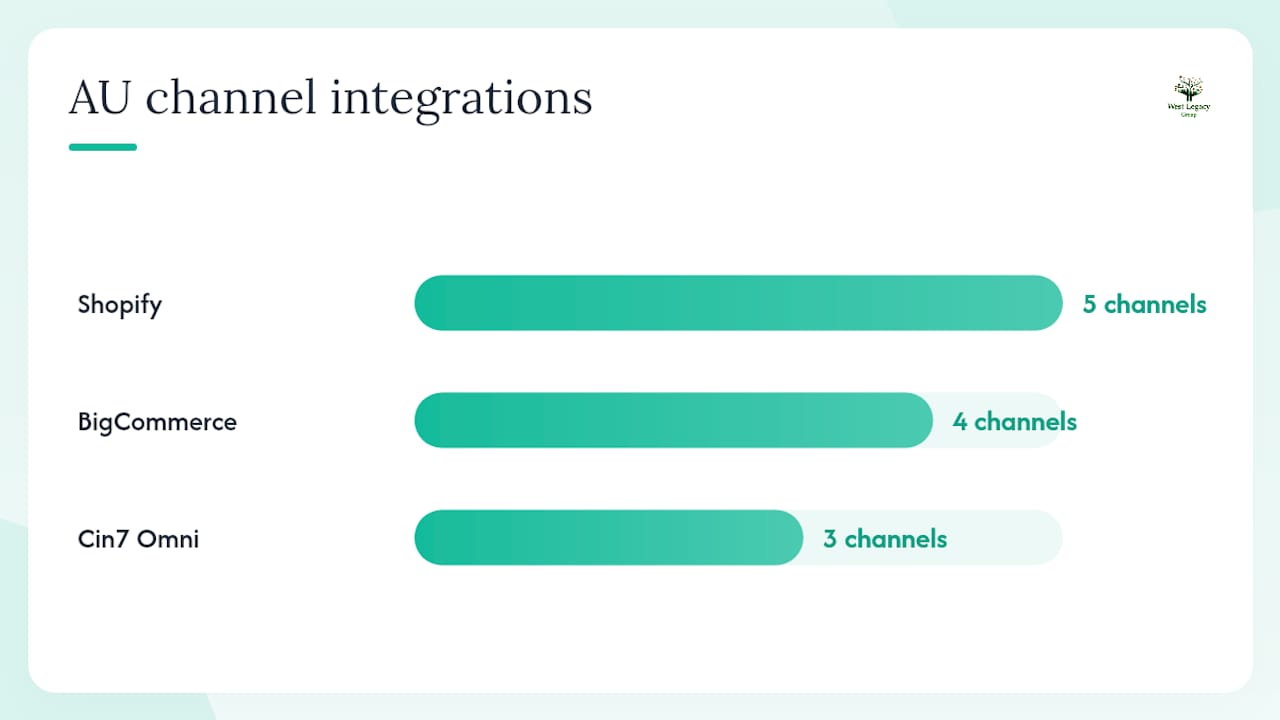
For most Australian merchants in 2026, Shopify, BigCommerce, and Cin7 Omni cover the widest range of needs, from fast-growing DTC brands to omnichannel retailers managing wholesale and in-store alongside online. If you only have time to trial one, Shopify is the strongest starting point for small-to-scaling stores, with native integrations across eBay Australia, Amazon.au, Meta, and Google Shopping built in from day one.
Australian-specific factors matter here. GST invoicing, Australia Post and Sendle fulfilment connectors, and local marketplace coverage (Catch, Amazon.au, TikTok Shop AU) vary significantly between platforms, and assuming a global integration covers your local needs is one of the most common and costly mistakes AU merchants make.
Top 3 picks at a glance:
- Shopify — Best for small-to-scaling DTC brands: native social and marketplace integrations, strong POS, and the largest app ecosystem available to Australian merchants.
- BigCommerce — Best for mid-market and B2B brands; more built-in multichannel features than Shopify with fewer paid apps required.
- Cin7 Omni — Best for omnichannel retailers selling online, wholesale, and in-store; unified inventory and order management with built-in POS and B2B portals.
| Top pick | Best for | Starting price shape |
|---|---|---|
| Shopify | Small-to-scaling DTC and retail | — |
Table of Contents
- What are the best multichannel selling platforms for 2026?
- Platform profiles: what each option delivers for Australian merchants
- How do you choose the right multichannel platform for your store?
- Which marketplaces and local services should your platform integrate with?
- Why native integrations outperform bolt-on connectors
- How we selected and evaluated platforms for this 2026 list
- Key takeaways
- An Australian advisor’s perspective on multichannel platform selection
- West Legacy Group helps you pick and implement the right multichannel stack
- Sources and further reading
What are the best multichannel selling platforms for 2026?
The table below compares the core platforms and tools Australian merchants evaluate most often. Pricing is in USD unless otherwise noted, as most vendors price globally; confirm AUD billing and GST invoicing directly with each vendor.
| Platform | Best for | Pricing shape | Key AU channels | Native vs connector | Inventory/OMS | AU fulfilment integrations | Scalability |
|---|---|---|---|---|---|---|---|
| Shopify | Small-to-scaling DTC and retail | — | eBay AU, Amazon.au, Meta, TikTok, Google | Strong native | Good; multi-location | Australia Post, Sendle, 3PLs via apps | High |
| BigCommerce | Mid-market and B2B | — | eBay AU, Amazon.au, Google, Meta | Strong native | Good; multi-storefront | Australia Post, Sendle via apps | High |
| Cin7 Omni | Omnichannel retail + wholesale | Custom/mid-tier | eBay AU, Amazon.au, Catch | Native OMS + POS | Excellent; multi-warehouse | Australia Post, 3PLs | High |
| ChannelAdvisor | Enterprise marketplace sellers | Enterprise/custom | Amazon.au, eBay AU, Google, Meta | Native enterprise | Strong OMS | Major 3PLs | Enterprise |
| ChannelEngine | Marketplace-first, global scale | Mid-tier/custom | Amazon.au, eBay AU, Catch, Google | Native feed control | Good | 3PLs via connectors | High |
| Brightpearl | Mid-to-large multichannel retail | Mid-tier/custom | eBay AU, Amazon.au, Catch | Native retail OS | Excellent; demand planning | Australia Post, 3PLs | High |
| Linnworks | High-volume order operations | Mid-tier/custom | eBay AU, Amazon.au, Catch, Google | Native; 100+ channels | Excellent; real-time sync | Australia Post, Sendle, 3PLs | Enterprise |
| Veeqo | Shipping and fulfilment focus | Free (Amazon-owned) | eBay AU, Amazon.au, Shopify | Connector-reliant | Good; multi-warehouse | Australia Post, Sendle | Mid |
| WooCommerce | WordPress merchants | Free plugin; hosting extra | eBay AU, Amazon.au via plugins | Connector-reliant | Via plugins | Australia Post via plugins | Mid-High |
| NetSuite | Large enterprise ERP | Enterprise/custom | Major marketplaces via connectors | Connector-reliant | ERP-grade | Major 3PLs | Enterprise |
| Feedonomics | Feed management and optimisation | Custom/managed | Amazon.au, eBay AU, Google, Meta | Managed feed service | Feed-level only | N/A (feed layer) | High |
| Channable | Feed rules and PPC automation | — | Google, Meta, Amazon, eBay | Rule-based connector | Feed-level only | N/A | Mid-High |
| Sellbrite | SMB marketplace listings | From ~$19/mo | eBay AU, Amazon.au, Etsy | Connector-reliant | Basic sync | Limited | Low-Mid |
| ShipStation | Shipping automation | From ~$9.99/mo | Shopify, eBay AU, Amazon.au | Connector-reliant | Shipping-layer only | Australia Post, Sendle | Mid |
| Zoho Commerce | Budget-conscious small sellers | — | Google, Meta; limited AU marketplaces | Connector-reliant | Basic; Zoho ecosystem | Limited | Low-Mid |
| Wix | Visual/design-led small stores | — | Meta, Google; limited AU marketplaces | Connector-reliant | Basic | Limited | Low |
| Finale Inventory | Precise multi-warehouse stock | Mid-tier | Limited marketplace native | Connector-reliant | Excellent accuracy | Via connectors | Mid |
| GeekSeller | Marketplace compliance | Mid-tier | Amazon, eBay, Walmart | Connector-reliant | Basic | Limited | Mid |
| CedCommerce | Broad connector catalogue | Varies by app | Amazon.au, eBay AU, Catch, TikTok | Connector-reliant | Via connectors | Via connectors | Mid |
| LitCommerce / LitExtension | Platform migration + sync | From ~$15/mo | eBay AU, Amazon.au, Etsy, TikTok | Connector-reliant | Basic sync | Limited | Low-Mid |
| EasyChannel | Marketplace listing management | Mid-tier | eBay AU, Amazon.au, Etsy | Connector-reliant | Basic | Limited | Low-Mid |
| Embed360 | Social and web channel expansion | Varies | Social + niche marketplaces | Connector-reliant | Limited | Limited | Low-Mid |
| DataFeedWatch | Feed management | From ~$64/mo | Google, Meta, Amazon, eBay | Rule-based connector | Feed-level only | N/A | Mid |
| SellerChamp | Multi-marketplace listing | Mid-tier | Amazon, eBay, Walmart | Connector-reliant | Basic | Limited | Low-Mid |
| Webkul Extensions | Platform-specific extensions | Varies | Platform-dependent | Connector-reliant | Via extensions | Via extensions | Mid |
Three quick shortlist rules: Prioritise platforms with native channel integrations over those requiring multiple paid middleware apps. Confirm real-time inventory sync rather than scheduled polling, especially if you run promotions or flash sales. Verify Australia-specific channel coverage for Amazon.au, eBay Australia, Catch, and TikTok Shop AU before committing to any platform.
Total cost of ownership includes your base subscription, transaction fees, paid connectors, and migration or agency hours. These costs vary widely across tiers and vendors, so build a full TCO estimate before signing.
Platform profiles: what each option delivers for Australian merchants
Shopify
Shopify is the default recommendation for Australian DTC brands and retailers that want fast time-to-market. Native integrations cover eBay Australia, Amazon.au, Meta Shops, TikTok Shop AU, and Google Shopping, with POS built in for physical retail. The app ecosystem is the largest available, which is both a strength and a cost risk: adding apps for returns management, advanced reporting, and marketplace connectors adds up quickly. Australia Post and Sendle are both available via apps and some native carrier integrations.
- Con: — App dependency grows with complexity; transaction fees apply unless you use Shopify Payments.
BigCommerce
BigCommerce suits mid-market brands and B2B sellers who want more built-in functionality without paying for a stack of apps. Multi-storefront support is native, and channel integrations for eBay Australia, Amazon.au, Google, and Meta ship without additional middleware. Expert evaluations consistently note that platforms with strong native sales functionality outperform those reliant on bolt-on apps, and BigCommerce’s architecture reflects that.
- Con: — Smaller app ecosystem than Shopify; some AU-specific integrations still require third-party connectors.
Cin7 Omni
Cin7 Omni is the strongest pick for retailers managing online, wholesale, and physical stores from a single system. Built-in POS, B2B portals, and inventory orchestration across multiple warehouses make it the operational backbone for omnichannel AU retailers. Catch, eBay Australia, and Amazon.au integrations are available natively or via close connectors. Pricing is mid-tier to custom; budget for an implementation partner.
- Pro: — Unified inventory, POS, and B2B in one platform; strong AU market presence.
ChannelAdvisor
ChannelAdvisor is built for large brands and enterprise sellers distributing across many global marketplaces. Its reporting and marketplace orchestration capabilities are enterprise-grade, covering Amazon.au, eBay Australia, Google, and Meta. Not suited to SMBs; pricing is enterprise and custom.
ChannelEngine
ChannelEngine gives marketplace-first sellers granular control over product feeds and per-channel rules. It handles Amazon.au, eBay Australia, Catch, and Google, with strong international distribution. Best for sellers who need to customise listings and pricing rules per channel at scale.
Brightpearl
Brightpearl functions as a retail operating system, combining inventory, order management, accounting, and demand planning in one platform. Mid-to-large multichannel retailers benefit from its integrated retail accounting, which removes the need for a separate accounting tool. AU fulfilment integrations include Australia Post and major 3PLs.

Linnworks
Real-time, event-driven inventory sync is critical for high-volume sellers, and Linnworks delivers it across 100+ channel integrations. For operations processing large daily order volumes, Linnworks’ event-driven architecture reduces the oversell risk that scheduled polling creates. Australia Post and Sendle are both supported.
Veeqo
Veeqo (now Amazon-owned and free for Amazon sellers) centralises shipping and fulfilment workflows across channels. It supports Australia Post and Sendle, making it a practical shipping layer for AU merchants. Inventory management is adequate for mid-volume sellers; it is not a full OMS replacement.
WooCommerce
WooCommerce gives WordPress merchants full ownership and customisability, but multichannel capability depends entirely on plugins. LitCommerce, CedCommerce connectors, and similar tools extend listings to eBay Australia, Amazon.au, and Catch. Developer resources are a prerequisite; without them, maintenance overhead is high.
Feed managers and specialist tools
Feedonomics and Channable sit at the feed management layer, not the store layer. Feedonomics is a managed service that optimises product feeds for Amazon.au, eBay Australia, Google Shopping, and Meta. Channable uses a rule-based engine for feed transformation and PPC automation. Both work alongside your primary platform rather than replacing it.
DataFeedWatch offers similar rule-based feed management from around $64/month, suited to merchants who want self-serve feed control across Google, Meta, Amazon, and eBay.
Pro Tip: Feed managers are most valuable when your product catalogue is large or your attribute data is inconsistent across channels. If you have fewer than 500 SKUs and clean data, your primary platform’s native feed tools may be sufficient.
Shipping-layer tools
ShipStation handles carrier integrations, label purchasing, and packing workflows across channels. Australia Post and Sendle are both supported. It is a shipping orchestration layer, not an inventory or OMS platform. Starting from around $9.99/month, it suits merchants whose primary pain is carrier rate-shopping and label automation.
SMB and budget options
Sellbrite (from ~$19/month) is a lightweight listing and inventory sync tool for small sellers on eBay Australia, Amazon.au, and Etsy. Setup is simple; it does not scale to high-volume operations.
Zoho Commerce integrates tightly with the Zoho ecosystem (CRM, accounting) and suits budget-conscious small sellers. AU marketplace coverage is limited compared to Shopify or BigCommerce.
Wix is appropriate for design-led small stores with simple multichannel needs, primarily Meta and Google. AU marketplace depth is shallow.
Connectors, extensions, and migration tools
CedCommerce provides a broad catalogue of marketplace connector apps for Amazon.au, eBay Australia, Catch, and TikTok Shop AU. LitCommerce and LitExtension handle platform migrations and multichannel sync from around $15/month. EasyChannel manages marketplace listings across eBay Australia, Amazon.au, and Etsy. Webkul Multichannel Extensions are platform-specific add-ons for Magento and similar systems. SellerChamp and Embed360 cover multi-marketplace listing management and social/web channel expansion respectively. These tools are most useful as specialist additions to a primary platform rather than standalone solutions.
Inventory and ERP platforms
Finale Inventory is purpose-built for precise multi-warehouse stock control and SKU management. It is not a full multichannel platform but excels as an inventory accuracy layer.
NetSuite is an ERP with commerce and order management modules for large enterprises. Implementation costs are significant; it suits organisations that need unified finance, commerce, and fulfilment at scale.
GeekSeller handles marketplace compliance and complex listing requirements across Amazon, eBay, and Walmart. It is a niche tool for sellers dealing with detailed marketplace compliance rules.
How do you choose the right multichannel platform for your store?
Decision checklist, ordered by impact
- Sync reliability — Ask vendors directly: is inventory sync real-time and event-driven, or scheduled polling? For flash sales or high-volume days, polling intervals of 15–60 minutes create real oversell risk.
Vendor questions to ask in demos
- How does your platform handle returns per marketplace, including eBay Australia’s returns policy requirements?
- What triggers an inventory reconciliation, and how quickly does a sale on one channel reduce available stock on others?
- What happens to orders during a sync outage or API downtime?
- Are Australia Post and Sendle natively integrated, or do they require a third-party shipping app?
- How is GST calculated and reported across channels?
Onboarding timeline and cost expectations
| Phase | Typical duration (AU) | Rough cost band |
|---|---|---|
| Discovery and scoping | 1–2 weeks | Included in agency quote or vendor onboarding |
| Platform configuration | 1–3 weeks | — |
| Listings migration and SKU mapping | 1–4 weeks | — |
| Integration testing | 1–2 weeks | Included in agency scope or self-managed |
| Go-live and monitoring | 1 week | Ongoing retainer or self-managed |
Red flags that justify pausing a purchase
- No real-time inventory sync; vendor cannot confirm event-driven architecture.
- More than three paid middleware apps required to connect your core channels.
- Opaque pricing for Australian payment gateways or shipping integrations.
- No documented GST invoicing support or AU tax compliance.
- Vendor cannot name a current AU merchant reference or local support contact.
Which marketplaces and local services should your platform integrate with?
Australian merchants need to verify channel depth, not just channel presence. A platform that lists “Amazon” as supported may not cover Amazon.au specifically, and the same applies to Catch and TikTok Shop AU.
High-priority AU channels to confirm:
- Amazon.au — listings, orders, FBA-AU support, returns, and promotions.
- eBay Australia — listings, orders, eBay-managed returns, and promoted listings.
- Catch — listings and order management (Catch has specific seller requirements; confirm connector depth).
- TikTok Shop AU — product catalogue sync, order management, and live shopping support.
- Meta (Facebook and Instagram Shops) — catalogue sync, dynamic ads, and checkout integration.
- Google Merchant Centre — Shopping feed, free listings, and Performance Max campaign support.
AU fulfilment and payments integrations to confirm:
- Australia Post (eParcel and MyPost Business) — native or well-maintained connector.
- Sendle — native or connector; important for SMBs using Sendle’s flat-rate domestic shipping.
- Major 3PLs operating in Australia (StarTrack, Toll, DHL Express AU) — API or EDI connector.
- GST-compliant invoicing output compatible with Xero, MYOB, or QuickBooks.
Native vs bolt-on reality check:
Shopify, BigCommerce, and Cin7 Omni ship native integrations for the most critical AU channels. ChannelAdvisor and Linnworks cover enterprise-scale marketplace depth natively. Most other platforms in this list rely on connectors for AU-specific channels, which means additional cost, an extra point of failure, and a dependency on third-party connector maintenance. Verify AU-specific coverage directly with each vendor before signing.
Why native integrations outperform bolt-on connectors
Platforms with native multichannel functionality show fewer sync errors and simpler fulfilment workflows than those relying on third-party middleware. The operational reason is straightforward: native integrations share a data model with the core platform, so an order placed on eBay Australia updates inventory, triggers fulfilment, and generates a GST invoice within the same system. A bolt-on connector introduces a separate data pipeline, a polling interval, and a dependency on a third-party API that can break independently of your platform.
The consequences show up most clearly during flash sales. If your connector polls inventory every 30 minutes and you sell 50 units in the first 10 minutes of a promotion, you will oversell. Real-time, event-driven sync eliminates that window. For high-volume sellers and large marketplaces, it is the difference between a successful campaign and a wave of cancellations.
Poor SKU mapping is the other common failure point. When a store catalogue uses different variant structures than a marketplace feed expects, connectors frequently mismap products, creating duplicate listings, incorrect stock levels, or failed order imports. Allocate specific vendor or agency hours for SKU normalisation before any migration.
Validation checklist: is this integration truly native?
- Does the platform’s own documentation describe the integration, or does it link to a third-party app?
- Is inventory updated in real time (event-driven) or on a schedule (polling)?
- Are orders from this channel visible in the platform’s native order management screen without a separate login?
- Does the platform generate the channel’s required invoice or tax document natively?
- Can you run a staged test with peak-volume orders before go-live?
Pro Tip: Before committing to a platform, run a staged flash sale test with your expected peak order volume. A test with 10 orders will not reveal the timing and reconciliation issues that 500 simultaneous orders will. Test under load, not just under normal conditions.
How we selected and evaluated platforms for this 2026 list
West Legacy Group evaluated platforms against five core criteria: channel coverage relevant to Australian merchants, inventory sync quality (native vs connector, real-time vs polling), order management capabilities, integration depth for AU payment and shipping providers, and pricing transparency.
Data sources used:
- Industry review platforms including G2 and PCMag editorial reviews, used as trust signals for platform stability and user sentiment.
- Vendor documentation and published pricing pages, reviewed for AU-specific feature claims.
- Guideflow’s multichannel retail software roundup and similar editorial sources for category framing.
- Hands-on evaluation notes from West Legacy Group’s experience supporting Australian small businesses with eCommerce platform selection, website development, and SEO implementation over more than 20 years.
Selection filters applied:
- Market presence in Australia (vendor support, AU payment/shipping integrations, AU merchant references).
- Native channel coverage for at least two of: Amazon.au, eBay Australia, Catch, TikTok Shop AU.
- Documented GST invoicing or AU tax compliance.
- Publicly available pricing or a clear path to a pricing conversation.
This list is reviewed and updated for 2026. If you believe a platform has been missed or a detail has changed, contact West Legacy Group directly via the website.
Key takeaways
Choosing the right platform comes down to matching your primary operational pain (feed control, inventory orchestration, shipping, or marketplace scale) to a platform’s native strengths, not its marketing claims.
| Point | Details |
|---|---|
| Choose native-first | Platforms with native channel integrations reduce sync errors and lower total cost of ownership versus connector-heavy stacks. |
| Confirm AU channel depth | Verify Amazon.au, eBay Australia, Catch, and TikTok Shop AU support specifically, not just global marketplace coverage. |
| Budget for full TCO | Base subscription is rarely the full cost; add connector fees, migration hours, agency setup, and transaction fees to your 12-month estimate. |
| Test sync under load | Run a staged peak-volume test before go-live; small test orders will not reveal the reconciliation issues that flash sales expose. |
| West Legacy Group can help | West Legacy Group supports Australian merchants with platform selection, migration, listings optimisation, and eCommerce SEO to get the right stack in place. |
An Australian advisor’s perspective on multichannel platform selection
The most common mistake Australian merchants make is choosing a platform based on its global feature list and assuming the AU-specific integrations will just work. They often do not, at least not without a connector, an agency, and a few weeks of configuration you did not budget for.
The second most common mistake is underestimating SKU complexity. A catalogue that looks clean in your current system frequently has variant mapping problems the moment you push it to a second marketplace. eBay Australia and Amazon.au both have specific attribute requirements that differ from each other and from your store’s native data structure. If you do not normalise SKUs before migration, you will spend weeks cleaning up duplicate listings and incorrect stock counts after go-live.
The platforms that consistently perform well for AU merchants are the ones that treat Australia as a first-class market, with documented local integrations, AU merchant support contacts, and GST invoicing built in. Shopify and BigCommerce meet that bar for most SMBs. Cin7 Omni meets it for omnichannel retailers. For enterprise operations, ChannelAdvisor and Linnworks have the depth, but the implementation investment is real and should be scoped carefully.
Pro Tip: Test your top 10 SKUs across every target marketplace before running a bulk sync. Catch and eBay Australia in particular have attribute requirements that will reject listings silently if the data does not match their category templates. Fixing 10 SKUs is manageable; fixing 10,000 after a failed bulk upload is not.
West Legacy Group helps you pick and implement the right multichannel stack
Picking a platform from a list is the easy part. Getting it configured correctly for Australian GST, connected to Australia Post and Sendle, synced to Amazon.au and eBay Australia, and optimised for organic search is where most merchants lose time and money.
West Legacy Group has supported Australian small businesses with eCommerce strategy, website development, and digital marketing for over 20 years. The services relevant to multichannel implementation include platform selection audits, migration support, listings optimisation, eCommerce SEO, and performance reporting so you can track what is actually working across channels.
If you are at the shortlist stage and want a second opinion before committing to a platform, or if you need hands-on help with migration and setup, get in touch with West Legacy Group to discuss your store’s specific requirements. A scoped audit takes the guesswork out of platform selection and gives you a clear implementation plan before you spend a dollar on configuration.
Sources and further reading
The following sources were used to compile and verify this guide. Each is linked for direct reference.
- Best Ecommerce Platforms for 2026 (Tested & Ranked)
- Best Ecommerce Platforms 2026: My top picks (G2 Learn)
- The best e-commerce software (PCMag)
- 8 best multichannel retail software for 2026 – Guideflow Blog
- Best Multi-Channel Inventory Management Software for E-Commerce in 2026
- Best Ecommerce Platforms 2026: Top 8 Tools Ranked for Online Stores
- Best multichannel eCommerce platforms, marketplaces and channels (Zoho Inventory Academy)
This guide is reviewed and updated for 2026. Platform pricing, features, and AU integration availability change frequently; always verify current details directly with each vendor. To suggest a platform for inclusion or flag an update, contact West Legacy Group via westlegacygroup.com.au.