

The formula is simple: ROI = (SEO revenue − SEO cost) ÷ SEO cost × 100. A result above 0% means your campaign returned more than it cost; a 300% return means every dollar spent brought back four. Below, you’ll find the worked maths, cost checklists, revenue attribution steps, and a break-even calculator to make that number defensible.
TL;DR:
- Most small businesses undercount their SEO costs, often missing internal hours and opportunity costs that significantly impact true ROI.
- Calculating revenue for SEO involves using actual transaction data for ecommerce or assigning lead values based on customer lifetime value and close rates for lead generation.
- Break-even typically occurs within six to nine months for established sites but can extend to a year or more for newer or less focused campaigns.
- Industry consensus matches the ROI formula of revenue minus costs, divided by costs, once attribution models are adjusted to reflect full customer journeys.
- Raw ROI percentages are less meaningful without pairing them with cumulative net charts and specific focus on the month when the campaign pays for itself.
Table of Contents
- How do you calculate SEO ROI step by step?
- What costs actually belong in your SEO ROI formula?
- How do you calculate revenue from organic search?
- How do you forecast SEO ROI and find your break-even month?
- Does the SEO industry back this ROI method?
- Why raw ROI numbers rarely tell the whole story
- How West Legacy Group turns your numbers into a plan
- Where to find the tools and data yourself
- Sources
- FAQ
How do you calculate SEO ROI step by step?
The Semrush formula breaks down into two numbers you need to nail down first: total revenue attributable to organic search, and total cost of running your SEO program over the same period. Get those two figures right, and the maths takes ten seconds.
Here’s how it plays out with round numbers:
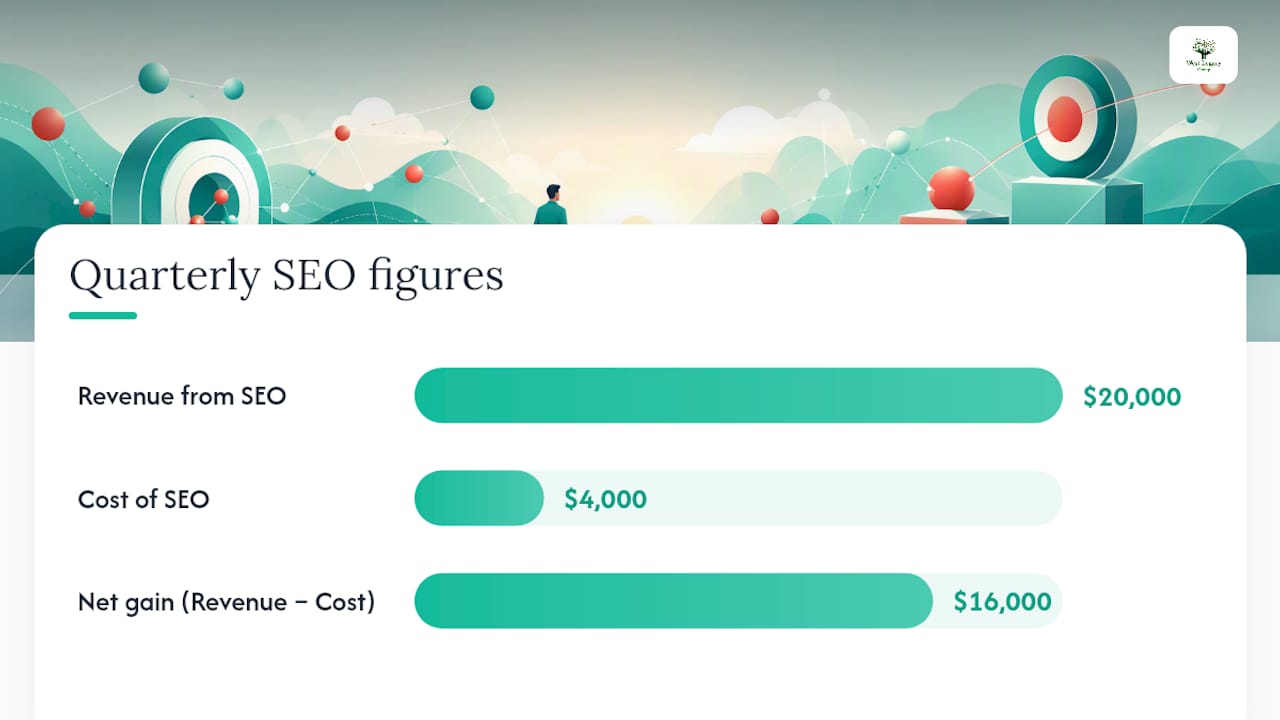
- Revenue from SEO: say your organic channel generated $20,000 in trackable sales this quarter.
- Cost of SEO: your agency retainer, tools, and content production added up to $4,000 for the same quarter.
- Subtract: $20,000 − $4,000 = $16,000 net gain.
- Divide by cost: $16,000 ÷ $4,000 = 4.
- Multiply by 100: 400% ROI, or $4 returned for every dollar spent.
That last step is where most business owners actually start paying attention. A percentage feels abstract; “$4 back for every $1 spent” doesn’t.
One detail trips people up constantly: the time window. Calculate ROI monthly and you’ll see noisy, sometimes negative numbers while content is still indexing. Calculate it over 12 months and the picture smooths out into something you can actually act on. Quarterly is the sweet spot for most small businesses, with an annual review to catch the compounding effect SEO is known for.
What costs actually belong in your SEO ROI formula?
Most small business owners undercount their SEO costs, and it skews every number downstream. Shopify’s research notes that businesses typically spend between $250 and $10,000 a month on SEO, with 63% landing between $500 and $5,000. If your total looks suspiciously low next to that range, you’re probably missing something.
Direct costs to add up:
- Agency retainers or freelancer invoices
- SEO and rank tracking tools (Semrush, Ahrefs, GA4 add ons)
- Content production (writers, editors, designers)
- Link building or PR outreach fees
Indirect costs, the ones people forget:
- In house hours spent on strategy, briefs, and reviews
- Opportunity cost of staff time diverted from other projects
- Distribution and internal promotion of published content
To value in house time, multiply the hours spent per month by that staff member’s fully loaded hourly rate (wages plus overheads, not just wages). A marketing coordinator earning $70,000 a year costs roughly $45 an hour once you account for super and overheads; ten hours a month on SEO tasks adds $450 to your true cost, even if no invoice ever shows it. Our guide on typical small business SEO costs breaks down realistic monthly ranges if you’re building a budget from scratch.
Pro Tip: If you can’t separate SEO hours from general marketing hours, track just one month with a simple time log. That single data point is usually enough to build an honest hourly estimate for the rest of the year.
How do you calculate revenue from organic search?
This is where SEO ROI calculations usually fall apart, because “revenue from organic search” means something different depending on your business model.
For ecommerce, GA4’s ecommerce reporting gives you actual transaction values tied to the organic search channel, provided your purchase events are tagged correctly. Google’s own setup guide walks through configuring conversion events so revenue attributes correctly rather than defaulting to “unassigned.”
For lead generation businesses, there’s no cart total to pull, so you assign a monetary value to each lead:
- Calculate your average customer lifetime value (LTV).
- Multiply LTV by your close rate (the percentage of leads that become paying customers).
- Apply that figure to every organic form submission or call GA4 tracks as a conversion.
A tradie with a $2,400 average job value and a 25% close rate should value each organic lead at $600, not $2,400. Overvaluing leads is the single fastest way to inflate your SEO ROI into fantasy territory.
Then there’s the brand versus non-brand split, which most calculations skip entirely. Pull your query data from Google Search Console and separate branded searches (people already looking for your business by name) from non-branded ones (people searching the problem you solve). If 40% of your organic revenue comes from branded terms, Search Engine Land’s attribution model suggests weighting that portion down, since brand searches often reflect other marketing efforts, not new SEO wins.
Last click attribution also tends to understate SEO’s real contribution, because it ignores every touchpoint before the final conversion. GA4’s data-driven attribution model redistributes credit across the full customer journey, which usually lifts organic’s reported share compared to last click reporting.
How do you forecast SEO ROI and find your break-even month?
Forecasting turns SEO from a leap of faith into a plannable investment, and it only needs five inputs.
- Baseline organic visitors: your current monthly organic traffic.
- Conversion rate: the percentage of visitors who become leads or sales.
- Value per conversion: your average sale value or lead value from the previous section.
- Expected monthly traffic growth: how fast organic traffic compounds month over month.
- Monthly SEO spend: your all-in cost figure from the costs section.
Industry calculators generally use conservative monthly growth assumptions of 5–15% for active campaigns, and that range is a sensible ceiling for a small business rather than a floor.
| Month | Organic visitors | Revenue | Cumulative net |
|---|---|---|---|
| 1 | 2,200 | $6,600 | $4,600 |
| 3 | 2,662 | $7,986 | $16,158 |
| 6 | 3,543 | $10,629 | $37,926 |
| 9 | 4,715 | $14,145 | $66,975 |
Break-even in this model lands well inside month one, because the starting traffic base was already meaningful. A newer site with little existing organic traffic often takes longer, with break-even commonly falling around month 6 to 9 as content matures and rankings climb.
If your model still shows break-even past month 12, don’t panic. It usually means one input needs adjusting: a narrower keyword focus, a higher-value conversion target, or a smaller initial spend while momentum builds.

Does the SEO industry back this ROI method?
Yes. Shopify, Semrush, and Search Engine Land all converge on the same core approach: revenue minus cost, divided by cost, adjusted for realistic attribution rather than raw last-click numbers. Shopify’s guidance is blunt about it too, noting that rankings and sessions only matter once they’re tied back to revenue.
An SEO agency applies this framework when setting up measurement for small business clients, including:
- GA4 conversion configuration so revenue attributes correctly from day one
- Blended attribution modelling for businesses with strong brand recognition
- Break-even forecasting before any retainer is signed, not after
- Performance-based pilot structures for businesses wanting proof before committing long term, detailed in our guide on running a 90 day performance pilot
Why raw ROI numbers rarely tell the whole story
Raw ROI is a useful headline figure, but it misses downstream value: leads that convert on the phone, content republished across email and social, brand recall that shows up in later branded searches. When reporting to stakeholders, pair your ROI percentage with a simple cumulative net chart and highlight the break-even month specifically. If the numbers are close but unclear, propose a small performance-based pilot before committing to a bigger retainer.
— Christopher
How West Legacy Group turns your numbers into a plan
An SEO agency offers SEO reporting that includes GA4 tracking configuration, conversion value modelling based on real business data, and forecasting to show when the investment might pay for itself.
We set up conversion tracking, build blended attribution models for brand-heavy businesses, and run forecasting projections before you sign anything. For content production at the pace rankings actually need, our partners at AmmarAI help scale output without blowing the budget you’ve just calculated. If you’d rather test the waters first, our performance-based pilot structure lets you see real numbers before committing to a long-term arrangement. Ready to see your own break-even month? Build your own SEO plan and get a forecast built around your actual costs and revenue, not industry averages.
Where to find the tools and data yourself
Pull traffic and conversion data from Google Analytics 4 and query splits from Google Search Console. For projections, the Meev SEO ROI calculator is a solid starting model; for assisted-conversion nuance, a data-savvy partner is worth the conversation.
Sources
- The ROI of SEO: How to Measure SEO ROI (with Formulas) — Semrush
- SEO ROI: How to Measure the Return on SEO Efforts — Shopify
- Build a more complete SEO ROI model — Search Engine Land
FAQ
How do you calculate ROI for SEO?
Subtract your total SEO cost from the revenue it generated, then divide that figure by the cost and multiply by 100. A positive percentage means the campaign paid for itself and returned additional profit on top.
What is the 80/20 rule in SEO?
It’s the general marketing principle that roughly 80% of your organic results tend to come from around 20% of your pages or keywords, so prioritising the highest-performing content usually delivers more ROI than spreading effort evenly.
Is a 2% ROI good?
No.
Is 75 a good SEO score?
Site health or SEO scores from third-party tools are diagnostic indicators, not proof of ROI. These scores suggest technical health but say nothing about revenue. Always tie any score back to actual organic revenue and cost using the ROI formula before judging performance.