

Competitor keyword analysis finds the search terms your rivals rank for so you can decide which ones are worth chasing. The immediate next step is simple: list five to ten real competitors, pick one seed keyword you both could plausibly rank for, and check that live SERP for intent. That single check tells you whether the opportunity is real before you spend a single hour writing content.
TL;DR:
- Checking the live SERP for a target keyword reveals the dominant content type and specific competitor capabilities, guiding realistic content creation.
- Prioritize keywords by scoring intent match, conversion potential, topical relevance, and difficulty to avoid pursuing low-value or mismatched search terms.
- Use free tools like Google Search Console and manual checks for initial insights, reserving paid tools for managing multiple competitors and larger clusters.
- Validate keyword opportunities by analyzing whether existing pages can be expanded or updated before creating new content to optimize effort and impact.
- Focus on small, high-potential clusters with demonstrated conversion, rather than large-volume keywords with misaligned intent that often waste resources.
Table of Contents
- How to run a competitor keyword analysis step by step
- Which tools actually help with competitor keyword research?
- How do you prioritise competitor keywords that are actually worth chasing?
- Checking the live SERP before you commit to a keyword
- Measuring results beyond rankings
- West Legacy Group’s take on running this without burning out
- What actually separates useful competitor keyword analysis from busywork
- Get a prioritised keyword list without the guesswork
- Sources
- FAQ
How to run a competitor keyword analysis step by step
Most small business owners overcomplicate this. You need the key stages of collecting, cleaning and clustering, then evaluating the data. Skipping any stage can leave you with a spreadsheet full of numbers that don’t translate into content decisions.
Collect. Pull the ranking keywords for two or three direct competitors, using either a paid gap tool export or manual checks against their top pages. Cross-reference this against your own Google Search Console data so you know what you already rank for, even weakly. Note the exact ranking URL for each competitor keyword. You’ll need it later.
Clean and cluster. Raw exports are full of duplicates and near-identical variants. Group them by topic and intent rather than by exact phrasing. A keyword gap comparison typically sorts these into “missing” (you don’t rank at all) and “weak” (you rank outside the top 20) categories, which gives you a natural priority order. Map each cluster against your existing content so you know whether you’re filling a gap or reinforcing a weak page.
Evaluate. Run each cluster through a feasibility filter: does the intent match what you sell, could the page convert, and how hard would it realistically be to rank given your current authority? This is where most DIY efforts fall apart, because volume looks tempting even when intent is wrong.
- Export competitor rankings and your own Search Console queries.
- Deduplicate and cluster by topic and searcher intent.
- Filter by missing versus weak keyword status.
- Score each surviving cluster for conversion fit and difficulty.
- Decide: update an existing page or brief a new one.
Pro Tip: Before building anything new, check if an existing page on your site already half covers the topic. Expanding a page that ranks position 15 is usually faster than starting from zero.
Which tools actually help with competitor keyword research?
You don’t need an expensive toolkit to do this properly. What matters is understanding which tool type answers which question, then using free options until the workload justifies paying.
- Keyword gap tools compare your ranked keyword set against a competitor’s and flag what they rank for that you don’t. This is the fastest way to build a raw opportunity list, and most platforms let you export it directly to a spreadsheet.
- Domain-level position reports show you a competitor’s overall keyword footprint, useful for spotting which topics they dominate. Page-level exports are better when you want to reverse-engineer a single high-performing article.
- Google Search Console remains your primary source of truth for your own site. It’s free, it shows real click and impression data, and no third-party estimate tool beats it for accuracy on your own domain.
- Manual SERP checks cost nothing but time. Open the top five results for a target keyword and note headings, media use, schema markup, and how recently the page was updated.
- Simple crawlers help you audit your own site’s structure and check for duplicate title tags or missing headers before you compete for new terms.
Free tiers on gap tools generally cover a solo operator’s needs. Paid access becomes worthwhile once you’re tracking multiple competitors across dozens of clusters, because the export limits on free tools start biting fast. Tools that check AI-generated answers are also worth a look, since AI features in Search can surface different pages than the traditional ten blue links, without replacing the need for genuinely useful, crawlable content.
How do you prioritise competitor keywords that are actually worth chasing?
Score every keyword on key factors: intent match, conversion value, topical fit, and personal keyword difficulty. A term may have solid search volume, but it can still be less valuable if the searcher’s intent does not align with purchasing or engagement.
- Intent match: does the query signal someone ready to act, or just browsing?
- Conversion value: if you ranked first tomorrow, would that traffic plausibly become an enquiry or sale?
- Topical fit: does this sit naturally within what your business already does?
- Personal keyword difficulty: given your current domain authority and content depth, is ranking realistic in six to twelve months?
A practical approach for small sites is to rate each factor on a scale and prioritise high-scoring keywords for content development, while setting aside low-priority terms.
One warning worth repeating: a high-volume keyword with mismatched intent is one of the most common false positives in this whole process. A tradie searching “how to fix a leaking tap” isn’t hiring a plumber that day. Chasing that term to build a service page wastes effort that would be better spent on “emergency plumber [suburb]”.
Where competitors hold an entire cluster of related terms, and you only partially cover the topic, prioritising the whole hub usually beats picking off individual keywords one at a time. Filling the gaps across five related pages tends to lift all of them together, because Google reads topical depth as a trust signal.
Checking the live SERP before you commit to a keyword
Never brief a page from a spreadsheet alone; tools like Konvuno help validate whether a keyword maps to an actionable prompt or onsite experience before you commit. Open the actual search results and look at what’s really ranking, because the keyword list only tells you half the story.
- Identify the dominant result type: is it a local pack, product listings, a featured snippet or video results. Each demands a different content format.
- Check whether competitors have a capability you don’t, like a booking tool, calculator, or marketplace listing that’s driving their ranking.
- Note how many results are informational versus transactional; if eight of the top ten are blog posts, a product page won’t compete.
- Decide whether to target the exact phrase or a related, more answerable question instead.
- Look at headings, media, and freshness on the top three results, since manual inspection often reveals why a page outranks its competitors even when the keyword data looks similar.
If a term is dominated by a business type or feature you can’t replicate, drop it and look for the adjacent question instead.
Measuring results beyond rankings
Rank position tells you almost nothing on its own. Track impressions, clicks, click-through rate, and conversions where you can attach them, because Google’s own guidance is explicit that outcomes matter more than position alone.
- Pull monthly Search Console exports for impressions, clicks and average position.
- Layer in a lightweight rank tracker for the 20 to 50 keywords that matter most, following a routine like the one outlined in keyword ranking tracking for small business.
- Record the tool, country, device and date alongside each check, since third-party rank data is always an estimate rather than gospel.
- Tie ranking pages back to analytics conversions monthly, not just traffic volume.
Pro Tip: Set a recurring 30-minute slot on the same day each month to re-score your keyword list. Momentum drops fast once this becomes an occasional task rather than a routine one.
West Legacy Group’s take on running this without burning out
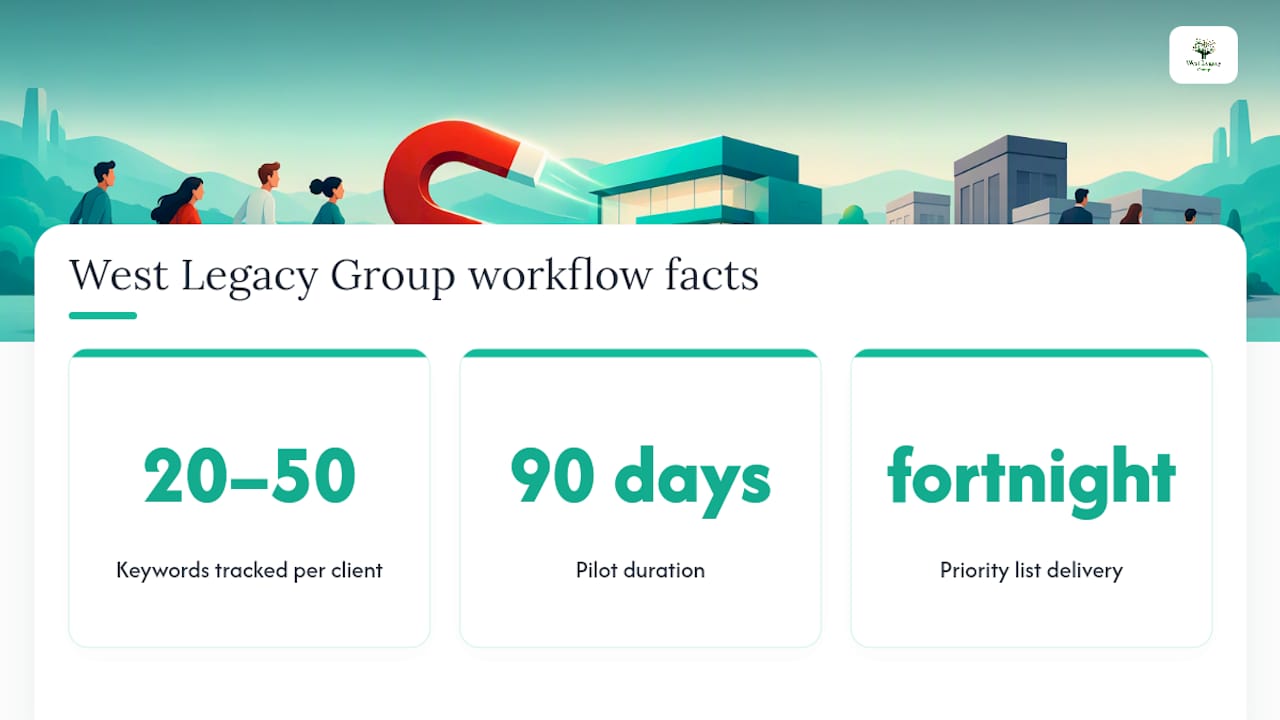
Christopher has spent over two decades building small businesses under the West Legacy Group umbrella, which means this workflow gets tested against real budgets, not theoretical ones. West Legacy Group typically tracks 20 to 50 keywords per client and runs 90-day pilots to see which clusters actually move before recommending a bigger content investment.
If you’re time-poor and the spreadsheet keeps slipping to next week, that’s the signal to bring in help. A properly scoped engagement should give you a prioritised list within the first fortnight, not a vague promise of “improved visibility” six months down the track.
What actually separates useful competitor keyword analysis from busywork
The conventional advice treats keyword volume as the finish line. It isn’t. A term with 2,000 monthly searches and wrong intent is worth less than one with 90 searches from people ready to buy, and most small business owners learn this the expensive way, after months chasing rankings that never convert.
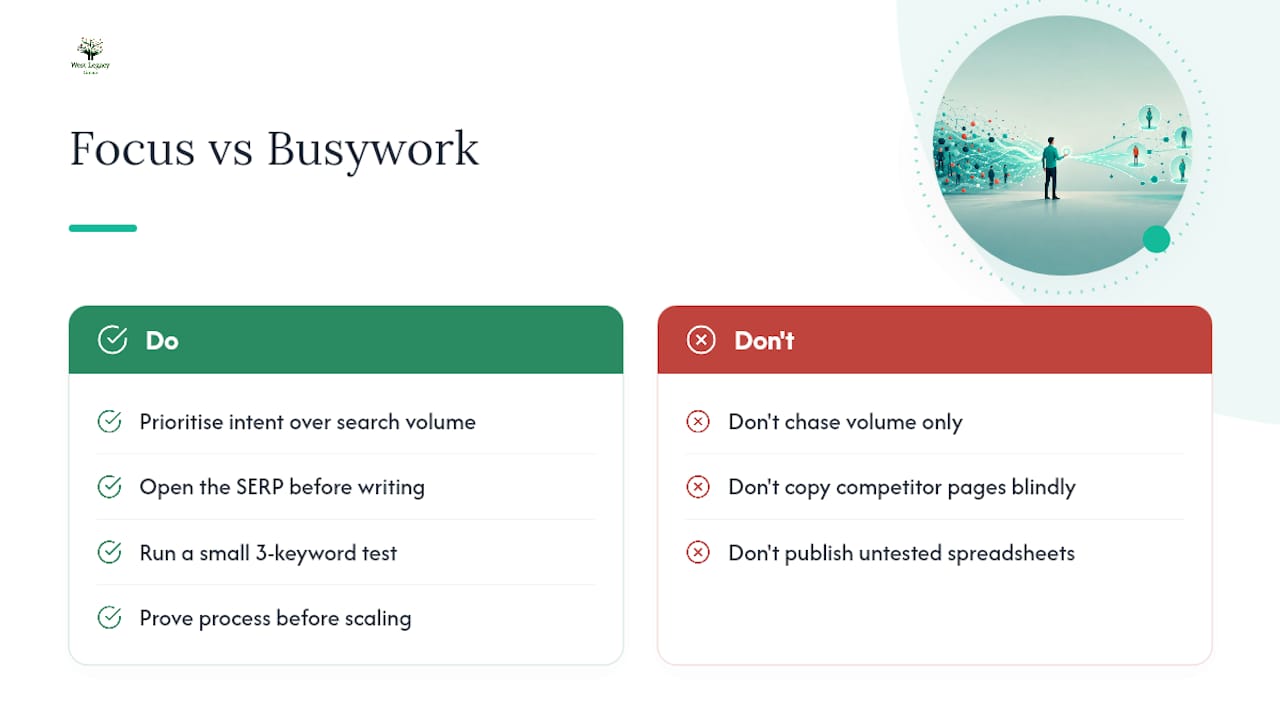
Where the standard advice really falls short is validation. Plenty of guides tell you to export a gap report and start writing. Almost none of them insist you open the actual SERP first and ask whether you can honestly deliver what’s ranking. Copying a competitor’s page structure without checking whether your business matches their offer is how a lot of content briefs go straight into a drawer.
If there’s one thing to prioritise first, it’s this: pick the smallest, most winnable cluster on your list and prove the process works before scaling it. A tight three-keyword test that converts is worth more than a hundred-keyword spreadsheet that never leaves the file.
— Christopher
Get a prioritised keyword list without the guesswork
Competitor keyword analysis is often included as a standard part of ongoing SEO engagements rather than as a separate add-on you pay extra for. Where a solo operator might spend a weekend wrestling with exports, our Legacy Foundations, Legacy Growth and Legacy Authority plans build the collection, clustering and prioritisation work directly into monthly reporting, so you see exactly which clusters are worth chasing and why.
If your business runs on Bendigo-based digital marketing, the Sapling, Oak and Redwood plans start from a smaller monthly commitment and scale as your content calendar grows. For eCommerce operators specifically, our Shopify eCommerce SEO service applies this same workflow to product and category pages, where competitor gaps often hide in plain sight. Get in touch to see what a 90-day pilot looks like for your industry.
Sources
- How to do an SEO competitor analysis
- Keyword Gap: Find New Ideas From Competitor Keywords
- How AI features work in Search
FAQ
How do you analyse a competitor’s keywords?
Export their ranking keywords using a gap tool or manual SERP checks, then compare that list against your own Search Console data to find what they rank for and you don’t. Cluster the results by topic and intent, then score each cluster for conversion fit and difficulty before deciding what to build or update.
Is there a free tool for competitor keyword analysis?
Google Search Console is free and gives you accurate data on your own site’s clicks and impressions, though it won’t show competitor data directly. Most paid gap tools, including the Semrush Keyword Gap report, offer limited free exports that cover a solo operator’s needs before you need to upgrade.
What should a competitor analysis actually include?
A solid competitor keyword analysis includes the keywords they rank for that you don’t, the page types and SERP features dominating those results, and a manual check of their headings, media and content freshness. West Legacy Group builds this directly into its SEO plans as part of ongoing monthly reporting rather than a one-off report.
What’s the best tool for SEO competitor analysis?
There’s no single best tool because different tools answer different questions: gap tools reveal missing keywords, Search Console shows your real performance, and manual SERP checks reveal why a page ranks. Combining a keyword gap export with a manual review of the top-ranking pages usually beats relying on any one tool alone.
How much does competitor keyword analysis cost with West Legacy Group?
Competitor keyword analysis is included as part of West Legacy Group’s ongoing SEO plans rather than sold separately, with current plan pricing listed on the West Legacy Group site. Bendigo-based small businesses can also start with the Sapling Plan, which includes this workflow from the first month.