

Yes, you can optimise for Google AI Overviews, but the starting point is not a special trick. It’s standard technical SEO plus content built to be quoted. If your page isn’t indexed and snippet-eligible, none of the rest matters.
Before anything else, check three things in Search Console: indexing status, snippet eligibility, and crawl errors. Then work through this quick list.
- Confirm technical eligibility (indexed, no noindex/nosnippet, crawlable).
- Rewrite your key sections to answer the question in the first sentence.
- Back claims with a credible, citable source or first-party data point.
- Add schema markup only where it matches what’s actually on the page.
- Technical eligibility comes first, always.
- Answer-first formatting beats clever framing.
- Credible sourcing improves how the model weighs your page.
- Schema helps but won’t rescue a page that fails the basics.
Key Takeaways
Google AI Overviews reward pages that are technically eligible, answer-first in structure, and backed by credible, specific sourcing, not pages built around AI-specific tricks.
| Point | Details |
|---|---|
| Technical eligibility comes first | Confirm indexing, crawlability, and snippet eligibility before rewriting any copy. |
| Write answers, not intros | Lead each H2/H3 with a direct one to two sentence answer that reads well as a quote. |
| Organic rank still correlates with citation | Pages ranking in the top 10 organically get cited far more often, per Search Engine Land. |
| Skip the fake AI files | No llms.txt or chunking is required; accurate schema and clean structure do the real work. |
| Measure with more than one tool | Combine Search Console’s Generative AI performance report with third-party AEO tracking for a fuller picture. |
| West Legacy Group applies this page by page | Its build-your-own SEO plan and small business website packages turn this checklist into a workable, affordable process. |
Table of Contents
- What is a Google AI Overview and how is it different?
- How does Google generate an AI Overview?
- Which search queries trigger an AI Overview?
- What makes a page eligible to be cited?
- How should you format content for AI extraction?
- Can you measure AI Overview performance in Search Console?
- What’s the fastest way to apply this to one page?
- Why does this matter more for small businesses right now?
- How West Legacy Group can help you get cited
- Where to read more on this topic
- Sources
What is a Google AI Overview and how is it different?
An AI Overview is a Gemini-generated summary that sits above traditional results, built from a handful of retrieved web pages and displayed with inline citations. It’s not a rewritten featured snippet. A featured snippet pulls one passage from one page; an AI Overview synthesises multiple sources into a single answer and can cite several pages at once.
The practical difference for you: getting cited in an AI Overview means competing for a slot among several sources, not the single top spot. Three entities matter here:
- Gemini — the model doing the synthesis and citation selection.
- Google Search Central — the official guidance on eligibility and best practice.
- Search Console — where you’ll check indexing status and, later, measure performance.
Google itself frames generative features as an extension of core Search, not a separate ranking system, which is why Semrush’s coverage of the announcement treats it as standard SEO work with a new output format.
How does Google generate an AI Overview?
AI Overviews run on retrieval-augmented generation, or RAG. Gemini doesn’t answer from memory alone. It retrieves a set of ranked pages, grounds its response in what those pages actually say, and attaches citations back to them. That grounding step is why organic ranking still matters. If your page never surfaces in retrieval, it can’t be cited.
The more overlooked mechanic is query fan-out. A single search often gets decomposed into three to five sub-questions before the answer is assembled, as Search Engine Land’s optimisation guide explains. Search “best way to waterproof a deck” and Gemini might quietly ask itself: what sealant types exist, how often should you reapply, what’s the cost, and does climate change the answer.
- Each sub-question pulls from whichever page answers it most cleanly.
- A page doesn’t need to win the whole query. It needs to win one sub-answer.
- This is why comprehensive pages that cover several angles often out-cite thin, single-purpose pages.
Which search queries trigger an AI Overview?
AI Overviews cluster around informational queries, typically three to five words, sitting at low-to-medium search volume rather than the biggest head terms. Think “how does compound interest work” or “signs of underwatered succulents” rather than a branded product search.
They’re far less common on sensitive or YMYL topics (health diagnoses, legal advice, financial products) where Google is more cautious, and on high-CPC commercial terms where shopping ads and product listings still dominate the layout.
If you’re prioritising which pages to optimise first, look for:
- Genuine “how,” “why,” or “what” questions with a clear factual answer.
- Topics where your page already ranks in the top 10 organically.
- Queries without heavy commercial or transactional intent.
- Subject matter where you hold real first-hand expertise, not scraped generalisations.
What makes a page eligible to be cited?
Two separate things decide whether you show up: whether Google trusts the page, and whether Google can technically retrieve it. Skip either one and you’re out of the running.
On the trust side, Search Engine Land’s research points to a strong correlation between organic ranking position and AI Overview citation. Pages that already sit high on page one get cited far more often than pages buried on page two. Brand authority and E-E-A-T signals (author expertise, verifiable credentials, a track record of accurate content) shape which sources Gemini treats as reliable enough to quote. Backlinks still play a supporting role, reinforcing the same authority signals they’ve always reinforced.
On the technical side, run through this checklist before touching a word of copy:
- Page is indexed in Google (check Search Console coverage report).
- No
noindexornosnippettag blocking snippet eligibility. - Page is crawlable, with no accidental robots.txt block.
- Canonical tag is stable and points to the correct URL.
- Core page experience basics are met (mobile usability, reasonable load speed).
Now the mythbusting, because a lot of noise circulates here. There’s no special file you need to create for AI crawlers. The idea of an llms.txt boosting your Google visibility doesn’t hold up; Google doesn’t use it, and the actual advantage comes from clean, human-readable structure. Chunking your content into artificially short blocks isn’t required either. Google’s own guidance confirms that standard SEO fundamentals still apply, and structured data helps extraction without being mandatory.
Pro Tip: Before rewriting a page, search the seed query yourself and read the current AI Overview closely. Note which sub-question it answers weakly or skips entirely. That’s the gap your rewrite should target first.
How should you format content for AI extraction?

Lead every section with the answer, not the windup. Practitioner guides consistently recommend a 40 to 60 word definitional sentence at the top of each H2 or H3, something clean enough to lift as a direct quote. Save your context, caveats, and examples for the sentences after it.
Structure headings as questions where it feels natural, mirroring the sub-questions a fan-out process would generate. If your seed topic is “email deliverability,” your H2s might ask “What causes emails to land in spam?” and “How long does it take to warm up a new domain?” That structure does double duty: it reads well for humans and matches how Gemini decomposes the original query.
Use schema deliberately rather than reflexively. Article, FAQPage, and BreadcrumbList schema all help when they match what’s actually visible on the page. HubSpot’s guidance and industry testing both point to a citation uplift when schema is accurate and validated, and a visibility penalty when it’s mismatched or stuffed with content nobody can see.
A few things reliably attract citations:
- A specific, sourced statistic rather than a vague claim.
- First-party data or an original finding nobody else has published.
- Clear attribution when you reference someone else’s research.
- Concrete detail over generic advice (“apply two coats, 24 hours apart” beats “apply as needed”).
Pro Tip: If you’re citing a third-party stat, link the primary source, not a roundup article. Gemini favours pages that point to primary facts it can attribute cleanly.
For a deeper walkthrough of this exact structure, our guide to content cited by AI search breaks it down page section by page section.
Can you measure AI Overview performance in Search Console?
Not cleanly, no. Search Console’s Generative AI performance report is the only official measurement point Google provides, but it bundles AI feature clicks and impressions in with regular web results rather than isolating them, a limitation Google’s own documentation acknowledges.
Watch for shifts in impressions without matching click growth, which often signals AI Overview exposure without the traffic follow-through. That pattern matters more now that Pew Research found users click fewer links when a summary appears above the results.
To fill the gap, triangulate:
- Search Console’s Generative AI performance report for baseline signal.
- Manual citation snapshots (search your priority queries and log who’s cited).
- Third-party AEO tools such as Semrush’s AI visibility tracking, Cited, or HubSpot’s AEO features to estimate share of answer over time.
What’s the fastest way to apply this to one page?
Pick a priority page and work through it in order:
- Audit technical eligibility (indexed, crawlable, no blocking tags).
- Fix anything failing that check before touching the copy.
- Rewrite the top section of each H2 into a direct, quotable answer.
- Add FAQPage or Article schema only where it matches visible content.
- Publish and request recrawl via Search Console.
- Monitor citation snapshots and the Generative AI performance report over the following weeks.
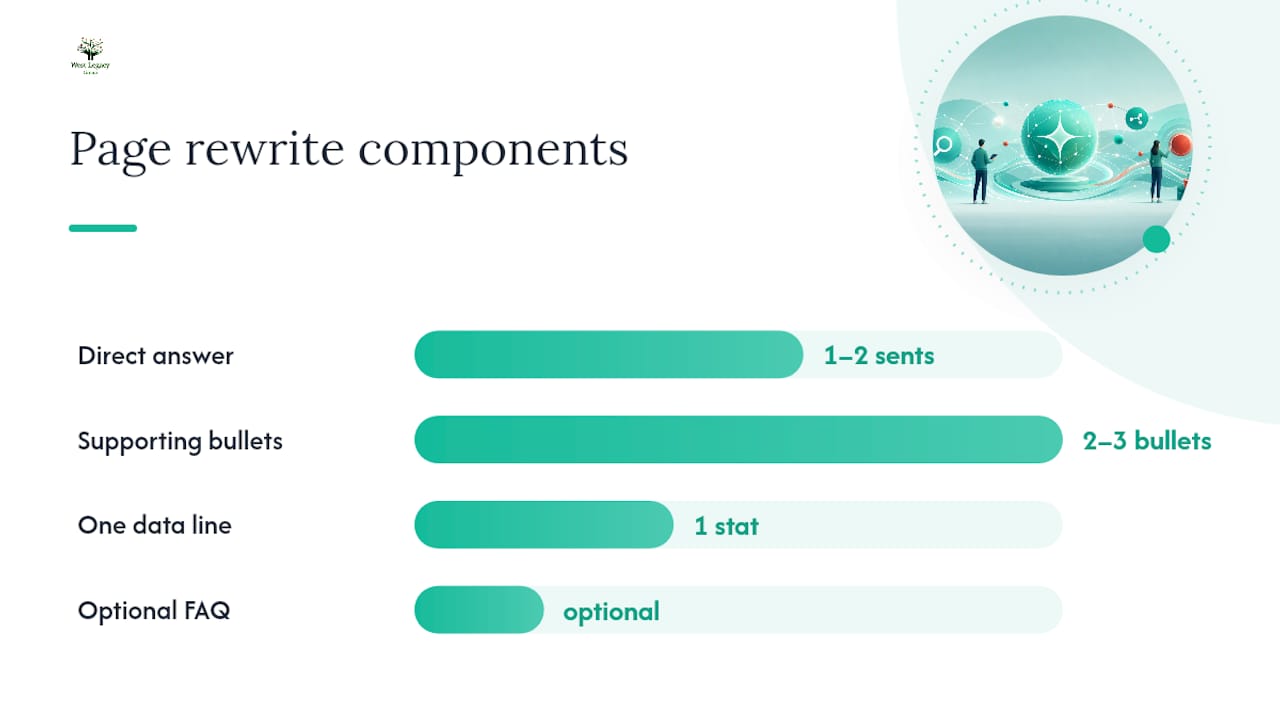
For the actual rewrite, use this shape:
Direct answer (1 to 2 sentences, quotable on its own).
Supporting detail (2 to 3 bullet points expanding the answer).
One sourced statistic or first-party data line.
Optional FAQ entry addressing a related sub-question.
Pro Tip: Search your target query and read the live AI Overview before you rewrite anything. Find the sub-answer it handles worst and build your strongest section around exactly that gap, not the parts it already covers well.
Why does this matter more for small businesses right now?
Small operators often assume AI Overviews are a big-brand game. They’re not. Gartner’s forecast on shifting search volume tells us visibility inside AI answers will only matter more. A tradie’s page answering one question precisely can out-cite a national brand’s vague overview. Getting the basics right costs nothing extra.
How West Legacy Group can help you get cited
If you’ve read this far, you already know the fix isn’t exotic: fix the technical basics, rewrite for extraction, add schema where it earns its place. The part most small businesses struggle with isn’t understanding the checklist, it’s finding the hours to run it across a whole site while still running a business.
West Legacy Group builds this work into affordable, small-business-sized packages rather than a lengthy agency proposal. If your site itself is holding you back (slow pages, no clean heading structure, missing schema foundations), our small business website design packages fix the technical base this whole approach depends on. If your site’s in reasonable shape and you just need the content and structure work, the build-your-own SEO plan lets you apply this checklist page by page without committing to a full retainer. For a broader push combining local SEO with this kind of content work, our Bendigo digital marketing service covers both. Get in touch for a free audit of your priority page and we’ll tell you exactly where it’s losing its shot at citation.
Where to read more on this topic
- Google’s official generative AI optimisation guide for the technical eligibility checklist.
- Search Engine Land’s AI Overviews guide for query fan-out detail.
- HubSpot’s AI Overviews playbook for schema and formatting tactics.
- Cited’s content optimisation guide for measurement approaches.
- Pew Research’s clickthrough study for the traffic impact context.
Sources
- Google’s Guide to Optimizing for Generative AI Features on Google Search
- AI Overviews optimization guide: How to rank in generated results
- Google publishes guide to generative AI search
- Google users are less likely to click on links when an AI summary appears in the results