

Product descriptions are the primary text signals search engines use to determine what your product pages are about and where they rank. Get them right, and you gain search visibility, qualified traffic, and sales. Get them wrong, and Google ignores your pages entirely. Understanding why product descriptions affect SEO is the first step to fixing one of the most overlooked problems in e-commerce. Well-optimised product pages convert 3.2 times better than poorly optimised ones, and missing this optimisation costs the average e-commerce site $89,000 annually.
Why do product descriptions affect SEO rankings?
Product descriptions give search engines the context they need to match your pages to buyer queries. Without enough text, Google cannot determine relevance, and your pages default to lower rankings. With unique, well-structured descriptions, you signal topical authority and keyword relevance at the same time.
Optimising unique product descriptions alongside title tags and schema markup can improve search rankings by 15–25% within 6–8 weeks. That is a measurable return from a content change that costs far less than paid advertising. The SEO benefits of detailed product descriptions compound over time as pages build authority and attract backlinks.

Descriptions also serve double duty. They help buyers understand what they are purchasing, and they provide keyword variations that help Google understand context and relevance. A description that answers real buyer questions ranks better and converts better than one written purely for search engines.
What makes a product description effective for SEO?
Five characteristics separate high-performing descriptions from ones that drag your rankings down.
- Uniqueness. Google ignores product pages using duplicate manufacturer descriptions. Every description must be written from scratch, in your own words, for your specific audience.
- Keyword integration. Overusing keywords beyond five mentions in 300 words can trigger a Google penalty. Use your primary keyword naturally, then support it with related terms and synonyms.
- Content depth. Descriptions under 300 words often lack the depth search engines need to rank a page well. Aim for benefit-driven content that covers materials, dimensions, use cases, and compatibility.
- Structured headings. Use H3 subheadings like Overview, Key Features, Compatibility, and Specifications. This structure helps search engines parse your content and rank you on long-tail, high-intent queries.
- Schema markup. Structured data with complete JSON-LD including stock availability and shipping cost helps AI crawlers index and recommend your products.
Pro Tip: Write your description for the buyer first, then check that your primary keyword appears naturally in the first 100 words. If it reads awkwardly, rewrite the sentence until it flows. Forced keyword placement hurts both rankings and conversions.
Semantic density matters more than length alone. Content rich in precise nouns, materials, and specifications improves AI model understanding and buyer confidence better than vague marketing copy padded to hit a word count.
How AI and semantic search are changing product description optimisation
Search engines no longer count keywords. They read for meaning. This shift changes how you need to write every product description on your site.
- Write for semantic understanding. AI search engines prioritise semantic understanding over keyword frequency. Concrete technical specifications outperform keyword-stuffed text every time.
- Answer conversational queries. Buyers search in full sentences, especially on mobile and voice. Your descriptions need to answer questions like “Is this compatible with X?” or “What material is this made from?”
- Use precise technical language. Vague marketing copy yields poorer visibility compared to precise technical details. Name the material, the weight, the dimensions, and the compatibility. Specificity is what AI models reward.
- Incorporate social proof. Integrating customer reviews and real user quotes directly into product descriptions helps AI models trust and cite your product recommendations over others.
- Refresh content regularly. Regular content refreshment aligned with AI search update cycles is key to maintaining product visibility and conversions as search algorithms evolve.
“AI search engines read product descriptions for semantic relationships. Vague marketing copy yields poorer visibility compared to precise technical details and conversational content that answers buyer questions directly.”
This shift rewards e-commerce businesses that treat product descriptions as genuine buyer resources, not just SEO placeholders. If your descriptions read like a brochure, they will rank like one.
Common mistakes that harm product description SEO
Most e-commerce sites make the same errors. Knowing what they are helps you avoid them before they cost you rankings.
- Using manufacturer descriptions. 68–78% of e-commerce sites still use manufacturer-provided descriptions. Search engines treat this as duplicate content and penalise or ignore those pages.
- Thin content. Short descriptions without sufficient detail fail to rank. Search engines need enough text to understand what the product is, who it suits, and how it works.
- Keyword stuffing. Repeating your target keyword more than five times in 300 words signals manipulation to Google. It also reads poorly to buyers and reduces trust.
- Missing schema markup. Skipping structured data means AI crawlers cannot easily index your product details. You lose eligibility for rich results in Google Search.
- Identical descriptions across variants. Selling the same product in three colours with identical descriptions creates duplicate content across your own site. Each variant needs at least a differentiated paragraph covering its specific attributes.
Pro Tip: Run a quick audit of your top 20 product pages. Check whether the descriptions are unique, over 300 words, and include schema markup. These three factors alone account for the majority of product page SEO problems. West Legacy Group covers the full list of common e-commerce SEO mistakes worth fixing in 2026.
Practical steps to optimise product descriptions for search and conversions
Follow this process for every product page you write or rewrite.
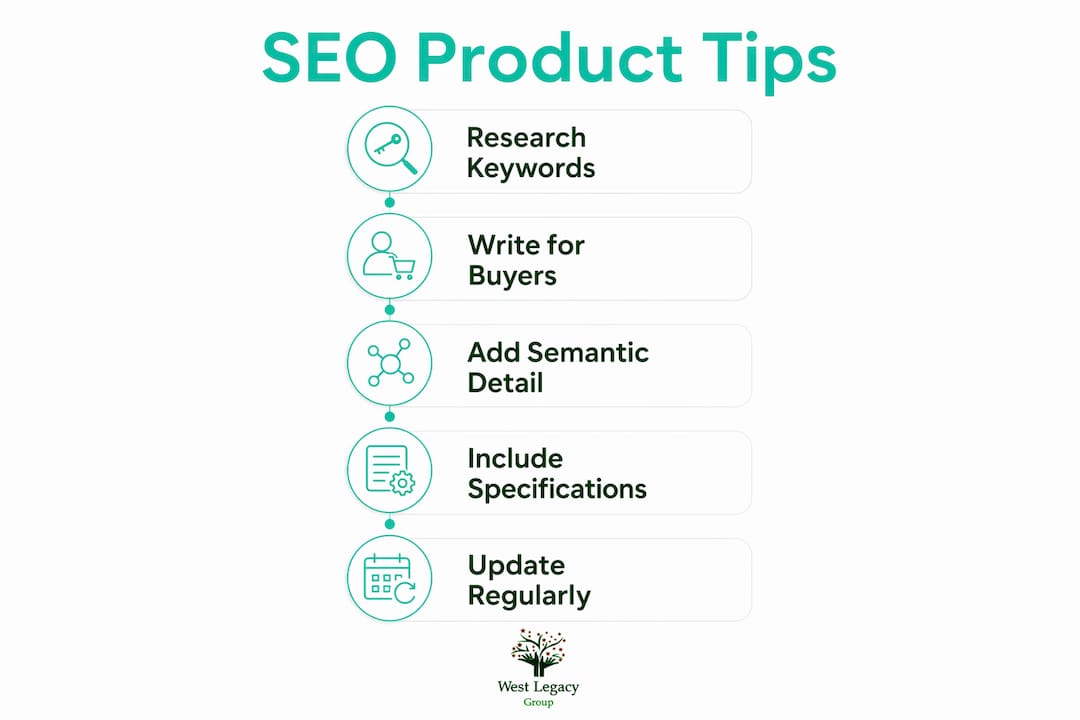
- Research one primary keyword plus related variations. Use your primary term in the title, first paragraph, and at least one H3 heading. Weave in related terms naturally throughout the body.
- Apply the Problem-Solution-Proof framework. Open with the problem the product solves, explain how it solves it, then back the claim with specifications or customer results.
- Structure with H3 headings. Use Overview, Key Features, Compatibility, and Specifications as your standard subheadings. This clear header structure enables ranking on long-tail, high-purchase-intent queries.
- Implement schema markup correctly. Add complete JSON-LD structured data including price, availability, and shipping details. Incomplete schema is almost as bad as no schema.
- Use bullet points and tables for scannability. Buyers scan before they read. A table comparing specifications or a bullet list of key features improves both user experience and time on page.
- Write a custom meta description. A well-crafted meta description lifts click-through rates from search results. Read the West Legacy Group guide on the role of meta descriptions for a practical breakdown.
- Audit and update regularly. Review performance data every quarter. Pages that drop in rankings often need a content refresh, not a complete rewrite.
Here is a quick reference for description structure:
| Element | Purpose |
|---|---|
| Overview paragraph | Introduces the product and primary keyword in the first 100 words |
| Key Features (H3) | Bullet list of benefits and specifications for scannability |
| Compatibility (H3) | Answers “will this work with X?” queries directly |
| Specifications (H3) | Precise technical data: dimensions, materials, weight, certifications |
| Schema markup | Structured JSON-LD for rich results and AI crawler indexing |
| Meta description | Custom 150–160 character summary to improve click-through rate |
Key takeaways
Product descriptions directly determine how search engines rank your product pages, and unique, structured, data-rich descriptions are the single most effective change most e-commerce businesses can make to improve search visibility and sales.
| Point | Details |
|---|---|
| Unique content is non-negotiable | Duplicate manufacturer descriptions cause Google to ignore your pages entirely. |
| Depth beats length | Descriptions need precise technical details and benefit-driven language, not just word count. |
| Schema markup is required | Complete JSON-LD structured data helps AI crawlers index and recommend your products. |
| Semantic search rewards specificity | AI search engines prioritise concrete specifications over keyword repetition. |
| Regular audits protect rankings | Quarterly content reviews keep descriptions aligned with evolving search algorithms. |
My honest view on product descriptions and long-term SEO success
Most e-commerce business owners I speak with treat product descriptions as a box to tick. They copy the manufacturer text, add a few keywords, and move on. The results are predictable: low organic traffic, poor conversion rates, and a growing gap between their site and competitors who have invested in proper content.
The part that surprises people is how quickly this changes when you fix it. Applying unique descriptions with proper structure and schema markup produces measurable ranking improvements within weeks, not months. The 15–25% ranking improvement figure is not a ceiling. For sites starting from a low base with widespread duplicate content, the gains can be significantly larger.
What I find most underestimated is the AI dimension. Search engines in 2026 read your descriptions the way a knowledgeable buyer would. They look for specific materials, precise dimensions, compatibility details, and social proof. Vague copy that sounds good in a boardroom presentation performs poorly in search. The businesses winning in organic search right now are the ones writing descriptions that genuinely help buyers make decisions.
The practical challenge is time. Rewriting hundreds of product descriptions is a real commitment. My advice is to start with your top 20 revenue-generating pages, apply the Problem-Solution-Proof framework, add schema markup, and measure the results. That data will make the case for doing the rest of your catalogue.
— Christopher
West Legacy Group can help with your product page SEO
Your product descriptions are working for or against your search rankings right now. West Legacy Group helps small e-commerce businesses fix this with affordable, practical SEO services built around content, structure, and technical implementation.
Whether you need a full site audit, help implementing schema markup, or a content plan for rewriting your product catalogue, West Legacy Group has a service to match your budget and goals. Explore our small business website packages or build your own SEO plan to get started with a strategy tailored to your store. Every package is designed to be affordable for small businesses, with no lock-in contracts.
FAQ
Why do product descriptions matter for SEO?
Product descriptions are the primary text search engines use to understand what your product pages are about. Unique, detailed descriptions improve rankings, while duplicate or thin content causes Google to ignore your pages.
How long should a product description be for good SEO?
Descriptions under 300 words often lack the depth search engines need to rank a page well. Aim for enough content to cover benefits, specifications, compatibility, and use cases thoroughly.
What is schema markup and why does it matter for product pages?
Schema markup is structured data code, typically JSON-LD, that tells search engines the specific details of your product including price, availability, and shipping. Complete schema markup makes your pages eligible for rich results and helps AI crawlers index your products accurately.
How often should I update my product descriptions?
Regular content refreshment aligned with AI search update cycles is key to maintaining visibility. A quarterly audit of your top-performing pages is a practical starting point.
Does keyword stuffing in product descriptions hurt rankings?
Overusing a keyword beyond five mentions in 300 words can trigger a Google penalty. Use your primary keyword naturally and support it with related terms and synonyms throughout the description.