

Meta descriptions are concise HTML summaries that appear beneath your page title in Google search results, and their role in driving sales is far greater than most small business owners realise. A well-written meta description acts as mini ad copy, filtering the right buyers before they ever reach your website. CTR can lift by 10–30% with a strong description versus a weak or missing one. That kind of uplift translates directly into more qualified visitors, more enquiries, and more sales. West Legacy Group works with small businesses every day who overlook this single, high-leverage element of their SEO strategy.
How do meta descriptions influence sales conversions?
Meta descriptions function as the first sales touchpoint in organic search. Before a buyer clicks, they read your description and decide whether your page is worth their time. That decision happens in seconds, and it shapes the quality of traffic you receive.
Writing for buyers, not algorithms, significantly improves lead quality and conversion rates. A description that speaks to a specific pain point or outcome attracts visitors who are already primed to buy. A generic description attracts everyone and converts almost no one.
The mechanisms that connect meta descriptions to sales outcomes include:
- Buyer filtering: A description that names your product, price range, or audience pre-qualifies the click. You get fewer tyre-kickers and more ready buyers.
- Perceived relevance: When your description matches what the searcher typed, they feel confident your page has the answer. That confidence carries into the visit.
- Engagement signals: Visitors who arrive with clear expectations spend more time on your page and bounce less. Search engines read those signals as quality indicators.
- Conversion alignment: A description that mirrors your page’s headline and offer creates a consistent experience. Consistency reduces friction and increases the chance of a sale.
Pro Tip: Treat every meta description like a Google Ads headline. If you wouldn’t pay to run it as an ad, rewrite it before publishing.
The indirect SEO benefit is real too. Higher click-through rates send positive engagement signals to Google, which can gradually improve your page’s visibility. Meta descriptions and sales performance are more tightly linked than most marketers acknowledge.
What makes an effective meta description that boosts sales?
Effective meta descriptions share four qualities: clarity, specificity, a clear benefit, and a reason to act now. Vague descriptions lose clicks. Specific ones earn them.
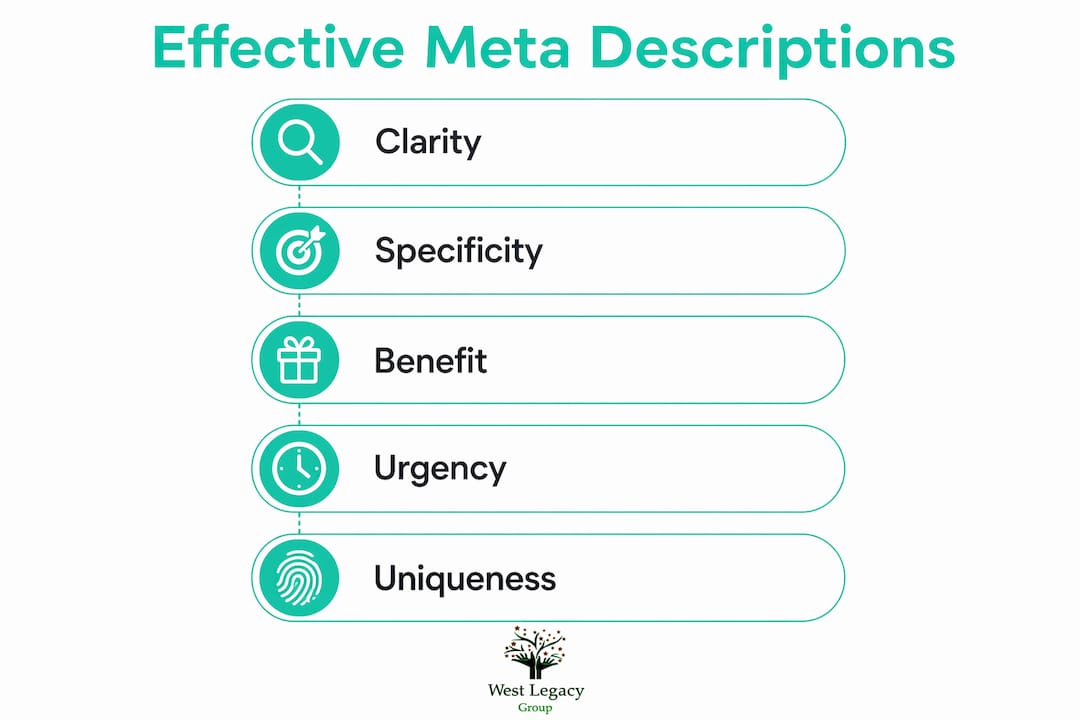
Clarity and specificity
Your description should tell the reader exactly what the page delivers. “We offer great services” tells nobody anything. “Affordable SEO packages for Australian small businesses, starting from $99 per month” tells the reader who you serve, what you offer, and what it costs. Specificity builds trust before the click.

Keyword alignment with search intent
Place your primary keyword naturally within the first half of the description. Google bolds matching terms in search results, which draws the eye and signals relevance. Descriptions that match search intent lift CTR by about 5.8% compared to auto-generated snippets. That is a measurable gain from a single sentence.
Length and truncation
Google typically displays 150–160 characters of a meta description on desktop. Write your most important claim within the first 120 characters so it survives truncation on mobile. Longer, descriptive meta descriptions statistically improve organic traffic, as Etsy’s large-scale SEO testing confirmed. The key is packing detail into a tight space, not padding with filler.
Uniqueness per page
Every page on your site needs its own description. Duplicate descriptions across product pages, service pages, and blog posts confuse both searchers and search engines. Unique descriptions prevent cannibalisation, where two of your own pages compete for the same click.
Pro Tip: For ecommerce pages, include the product name, a key benefit, and a call to action in every description. “Buy [Product] online. Free shipping over $50. Shop now.” outperforms a paragraph of marketing speak every time.
The table below shows the difference between weak and strong descriptions for the same page:
| Element | Weak description | Strong description |
|---|---|---|
| Specificity | “We sell quality products online.” | “Shop handmade leather wallets for men. Free AU shipping on orders over $75.” |
| Keyword use | None present | Matches buyer search terms naturally |
| Call to action | Missing | “Shop now”, “Get a free quote”, “Book today” |
| Benefit | Vague | Concrete: free shipping, price point, outcome |
| Length | Under 80 characters | 140–155 characters, fills SERP real estate |
How does Google handle meta descriptions?
Google does not use meta descriptions as a ranking factor since 2009, and John Mueller reaffirmed this position as recently as 2026. That fact surprises many small business owners who assume better descriptions equal higher rankings. The relationship is more indirect than that.
Google decides whether to display your written description or generate its own snippet from page content. Google often rewrites meta descriptions when it judges that page content better suits the query. This happens frequently, particularly for pages with thin or mismatched descriptions.
The practical implication is clear: write descriptions that closely match your page content and the queries you want to rank for. The closer the match, the more likely Google uses your version. Your version, written with sales intent, outperforms a machine-generated snippet almost every time.
Strategies that increase the likelihood Google displays your description:
- Write descriptions that directly answer the query your page targets.
- Keep descriptions factually consistent with your page’s headline and body content.
- Avoid keyword stuffing, which triggers Google to override your description.
- Update descriptions when you update page content, so they stay aligned.
- Use structured, benefit-led sentences rather than lists or fragments.
A sharper, longer description also takes up more space in the search results page, increasing perceived authority and boosting CTR. More real estate in search results means more visual weight, and visual weight drives clicks.
How can you measure and improve the sales impact of meta descriptions?
Measuring the impact of meta descriptions on sales requires tracking the right metrics at the right level. Most small businesses look at overall traffic and miss the page-level signals that reveal what is actually working.
Follow this process to measure and refine your descriptions:
-
Audit current CTR by page. Open Google Search Console and sort pages by impressions. Pages with high impressions but low CTR are your highest-priority targets. A low CTR on a high-impression page means your description is failing to convert searchers into visitors.
-
Check bounce rate and time on page. A high CTR paired with a high bounce rate signals a mismatch between your description and your page content. Fix the description or fix the page, but address the gap.
-
Track conversion rate by landing page. Use Google Analytics 4 to connect organic landing pages to goal completions. If a page drives traffic but no conversions, your description may be attracting the wrong audience.
-
Run A/B tests on high-value pages. Change one element at a time: the call to action, the benefit statement, or the keyword placement. Give each version at least four weeks of data before drawing conclusions.
-
Prioritise product and service pages first. Blog posts matter, but your money pages drive revenue. Optimise descriptions for pages where a click has the highest commercial value.
-
Adapt to search trends continuously. Meta description optimisation is a continuous process of testing, tracking, and adapting to buyer needs and search trends. Set a quarterly review cycle and treat descriptions as living copy, not a one-time task.
The local SEO checklist for small business published by West Legacy Group covers how meta description optimisation fits within a broader local search strategy, which is particularly relevant for businesses targeting customers in a specific region.
Key takeaways
Meta descriptions are the most underused sales tool in organic search. Writing them with buyer intent, specificity, and a clear call to action directly increases click-through rates and the quality of traffic that reaches your site.
| Point | Details |
|---|---|
| Meta descriptions drive sales indirectly | Strong descriptions lift CTR by 10–30%, sending more qualified buyers to your pages. |
| Write for buyers, not algorithms | Buyer-focused descriptions filter out poor-fit traffic and improve lead quality before the click. |
| Google may rewrite your description | Keep descriptions aligned with page content and search intent to maximise the chance Google uses yours. |
| Measure CTR and conversion together | High CTR with low conversion signals a mismatch between your description and your page offer. |
| Optimisation is ongoing | Review and update descriptions quarterly as search trends and buyer behaviour shift. |
Why I treat meta descriptions as sales copy, not SEO housekeeping
Most marketers I speak with treat meta descriptions as a checkbox. They write something, publish it, and never look at it again. That approach leaves real money on the table.
What I have observed working with small businesses is that the pages generating the most qualified leads almost always have descriptions written with a specific buyer in mind. Not a broad audience. One person, with one problem, looking for one solution. When you write that precisely, the right people click and the wrong people scroll past. That is not a bug. That is the filter working exactly as it should.
The common pitfall is generic copy. “We are a leading provider of…” tells the searcher nothing useful. It wastes the one sentence you have to earn a click from someone who has never heard of your business.
The future of snippet presentation is moving toward richer, more contextual results. AI-generated overviews are changing how searchers interact with results pages. In that environment, a well-written, specific, and authoritative description becomes even more valuable because it signals to both Google and the reader that your page is the definitive answer. Businesses that treat meta descriptions as sales copy now will be better positioned as search behaviour continues to shift.
Keep testing. Keep refining. The businesses that win in organic search are the ones that treat every element of their listing as an opportunity to earn the click.
— Christopher
West Legacy Group and your meta description strategy
If you are ready to treat your meta descriptions as the sales tools they are, West Legacy Group can help you build a plan around them.
Our SEO plan builder lets you create a tailored strategy that includes meta description audits, keyword alignment, and ongoing performance tracking. Every plan is built to be affordable for small businesses and focused on measurable outcomes. You can also explore our digital marketing services if you want expert support applying these principles across your entire online presence. The West Legacy Group blog also covers practical SEO topics you can act on straight away.
FAQ
Do meta descriptions directly affect Google rankings?
Meta descriptions are not a Google ranking factor. They influence click-through rates and user behaviour, which indirectly supports SEO performance over time.
How long should a meta description be for sales pages?
Aim for 140–155 characters. This length fills available SERP real estate on desktop and reduces the risk of truncation on mobile devices.
How often should I update my meta descriptions?
Review and update meta descriptions at least quarterly. Search trends and buyer language shift, and descriptions that matched intent six months ago may underperform today.
What is the difference between a meta description and a meta tag?
A meta description is one type of meta tag. Meta tags are HTML elements that provide page information to search engines. The meta description tag specifically controls the summary text shown in search results.
Can a better meta description increase my ecommerce sales?
A well-written ecommerce meta description attracts buyers who are already close to purchasing. By filtering for the right audience before the click, it improves both traffic quality and conversion rates on product pages.