

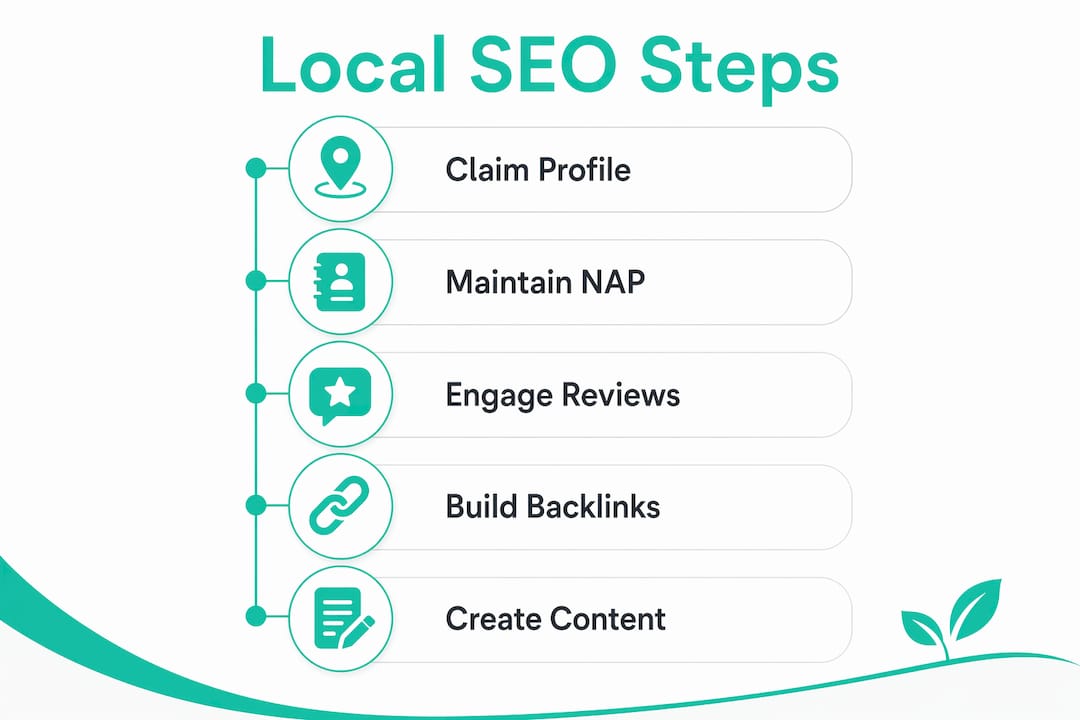
Local search rankings determine where your business appears when nearby customers search for products or services you offer. 84% of consumers search for local businesses online daily, and 53% leave immediately when they find inaccurate listing information. That single statistic explains why small businesses that neglect their online presence lose customers before those customers ever walk through the door. To improve local search rankings, you need to work across several connected signals: your Google Business Profile, citation consistency, customer reviews, local backlinks, and location-specific website content.
How to improve local search rankings with Google Business Profile
Google Business Profile (GBP) is the anchor of local search visibility. It is the listing that appears in Google Maps and the local pack, which is the group of three businesses shown at the top of location-based search results. Businesses with complete GBP information are favoured in search and lose fewer customers to competitors. Completing every field is not optional if you want to rank.
Follow these steps to get the most from your GBP:
- Claim and verify your listing. Go to Google Business Profile and verify ownership of your business. Unverified listings cannot be fully managed and rank poorly.
- Complete every profile field. Fill in your business name, address, phone number, website, trading hours, and business categories. Missing fields signal an incomplete and less trustworthy listing.
- Choose the right primary category. Your primary category tells Google what your business does. A plumber in Brisbane should select “Plumber,” not “Home Services,” for the most precise match.
- Add photos regularly. Listings with photos receive significantly more direction requests and website clicks than those without. Upload images of your premises, team, and products.
- Write a keyword-rich description. Include your suburb, city, and the services you offer. A sentence like “We are a family-owned bakery in Fitzroy, Melbourne, specialising in sourdough and custom celebration cakes” works harder than a generic blurb.
- Post updates and offers. Use the Posts feature to share news, promotions, and events. Regular posts signal an active business to Google.
- Respond to every review. Replying to reviews, both positive and negative, shows Google and potential customers that you are engaged and professional.
Pro Tip: Set a recurring calendar reminder every fortnight to check your GBP for suggested edits from the public. Google allows anyone to suggest changes to your listing, and those changes can go live without your approval if you do not review them.
Why consistent business information across directories matters

NAP stands for name, address, and phone number. It is the foundation of local SEO trust. Google cross-checks your business details across the web, and inconsistent hours or contact information lower your trust score in the algorithm. A business listed as “Smith’s Plumbing” on Google but “Smiths Plumbing PTY LTD” on Yellow Pages creates a discrepancy that confuses both search engines and customers.
Auditing and standardising your listings across directories takes time, but the payoff is real. Here is where to focus:
- Google Business Profile. Your primary listing. Every other directory should mirror it exactly.
- Yellow Pages Australia. A high-authority local directory that Google references frequently.
- True Local. A widely used Australian business directory with strong local relevance.
- Yelp. Relevant for hospitality, retail, and service businesses with a national presence.
- Facebook Business Page. Social profiles are treated as citations. Keep your address and phone number current.
- Apple Maps. Many Australians use iPhones. Claim your Apple Maps listing through Apple Business Connect.
- Industry-specific directories. A tradie should be listed on platforms like ServiceSeeking. A restaurant should appear on Zomato.
Search your business name on Google and note every listing that appears. Check each one for accuracy. Prioritise fixing the highest-authority directories first, then work down the list.
Pro Tip: Create a simple spreadsheet with columns for directory name, URL, current NAP details, and status. Update it every six months. This single habit prevents the silent ranking damage that comes from outdated listings.
What role do customer reviews play in local SEO?
Reviews are one of the strongest signals in the local ranking algorithm. Review quantity, quality, and recency all correlate with local pack rankings. A business with 200 reviews and a 4.6-star rating will consistently outrank a competitor with 12 reviews and a 4.9-star rating, because recency and volume carry significant weight. Search engines also value authenticity signals like user-submitted photos and detailed written responses, not just the star count.
Managing reviews well requires a consistent process. Follow these steps:
- Ask every satisfied customer for a review. The most effective method is a direct, personal request immediately after a positive experience. Send a follow-up SMS or email with a direct link to your Google review page.
- Make it easy. Create a short URL using Google’s review link generator and include it in your email signature, on receipts, and on a small card at your counter.
- Respond to every review within 48 hours. Thank positive reviewers by name and mention a specific detail from their feedback. Address negative reviews calmly and offer to resolve the issue offline.
- Never buy or incentivise reviews. Google’s guidelines prohibit offering discounts or gifts in exchange for reviews. Fake reviews can result in penalties that remove your listing from local results entirely.
- Encourage photo uploads. Customers who upload photos with their reviews provide additional content signals. A café that has 50 customer photos of its dishes ranks more prominently than one with none.
Search engines highly value authenticity signals like user photos and genuine review engagement. Volume matters, but depth of engagement matters more than most business owners realise.
Why local backlinks and citations matter for ranking
Backlinks are links from other websites to yours. Local backlinks with geographic anchor text increase your prominence and relevance in location-based searches. A link from the Geelong Chamber of Commerce website to your plumbing business carries far more local SEO weight than a generic link from an overseas directory.
Local citations complement backlinks by reinforcing your NAP consistency across the web. The two work together to build your site’s authority in a specific geographic area.
Strong sources of local backlinks include:
- Local chambers of commerce. Most Australian chambers offer member directory listings with a link to your website.
- Community sponsorships. Sponsoring a local footy club, school fete, or charity event often earns a link from the organisation’s website.
- Local media. A mention in a regional newspaper or suburb-based blog typically includes a link.
- Business associations. Industry bodies like the Master Builders Association or the Australian Retailers Association maintain member directories.
- Supplier and partner websites. Ask suppliers you work with to list you as a stockist or partner.
| Source type | Local SEO value | Effort required |
|---|---|---|
| Chamber of commerce listing | High | Low |
| Community sponsorship | High | Medium |
| Local media mention | Very high | Medium to high |
| Industry association directory | Medium to high | Low |
| Supplier or partner listing | Medium | Low |
Avoid low-quality or spammy backlinks from overseas link farms or irrelevant directories. These can trigger a Google penalty and actively harm your rankings rather than help them.
How to create location-specific website content
Location-specific pages are dedicated web pages built around a single suburb, city, or service area. Separate pages per location with LocalBusiness schema help Google connect local queries to your offerings. A cleaning business that serves Melbourne, Geelong, and Ballarat should have three distinct pages, each with unique content addressing that specific area.
Each location page should include the suburb or city name in the page title, the H1 heading, the meta description, and naturally throughout the body text. Avoid copying the same content across pages and simply swapping the suburb name. Google treats this as thin content and ranks it poorly. Instead, write genuinely useful information for each location: mention local landmarks, describe the specific services available in that area, and include a locally relevant testimonial if possible.
Structured data also plays a direct role here. Adding LocalBusiness schema markup to your location pages tells Google your business name, address, phone number, and trading hours in a machine-readable format. This increases the chance of your business appearing in rich results and the local pack. Link each location page directly to your Google Business Profile to reinforce the connection between your website and your GBP listing.
Pro Tip: Use Google Search Console to identify which location-based queries are already sending traffic to your site. Build or expand pages around those terms first, since you already have some relevance established.
Key takeaways
Consistent effort across Google Business Profile, NAP accuracy, reviews, backlinks, and location-specific content is the most reliable way to build and hold local search rankings.
| Point | Details |
|---|---|
| Google Business Profile completeness | Fill every field and post updates regularly to signal an active, trustworthy business. |
| NAP consistency across directories | Match your name, address, and phone number exactly across Google, Yellow Pages, and social profiles. |
| Review quantity and recency | Collect frequent, genuine reviews and respond to every one within 48 hours. |
| Local backlinks and citations | Earn links from chambers of commerce, local media, and community sponsorships for geographic authority. |
| Location-specific web pages | Build separate pages per service area with unique content and LocalBusiness schema markup. |
What I have learned about local SEO after years of working with small businesses
Most small business owners treat local SEO as a one-time task. They set up their Google Business Profile, get a few reviews, and then move on. That approach builds a small amount of momentum and then stalls. Local SEO prominence is a long game requiring sustained content and backlink development, particularly as AI-driven search tools change how results are surfaced.
The businesses I have seen hold strong local rankings share one habit: they treat their online presence the same way they treat their shopfront. They update it, clean it up, and make sure it reflects what they actually offer right now. A café that still shows its pre-2024 menu on Google is telling search engines and customers the same thing: we are not paying attention.
Social media engagement acts as modern citations, signalling relevance and authority to search engines. A consistent presence on Facebook or Instagram, with location tags and genuine customer interaction, contributes to your local SEO signals in ways that many business owners overlook entirely. It is not a replacement for GBP or backlinks, but it adds weight to your overall profile.
The other thing I would stress is this: optimising GBP alone is insufficient. The businesses that dominate local results combine strong profiles with backlinks, citations, content, and community engagement. Each signal reinforces the others, and the compounding effect over 12 to 24 months is significant. Start with the basics, build consistently, and resist the temptation to cut corners with paid link schemes or review manipulation. The algorithm is getting better at detecting both.
— Christopher
How Westlegacygroup supports your local search growth
Westlegacygroup has spent over 20 years building businesses from the ground up, and the small business services division was created specifically to make professional digital marketing affordable for local operators.
Whether you need a full local SEO setup including Google Business Profile optimisation, citation audits, and review strategy, or you want to improve the website content that supports your rankings, Westlegacygroup offers single services and subscription packages built around real business budgets. The team also covers high-converting web design to make sure the traffic you earn actually turns into customers. If you are ready to build a stronger local presence, Westlegacygroup is a practical starting point.
FAQ
What does local search ranking mean?
Local search ranking refers to where your business appears in location-based search results on Google, including the local pack and Google Maps. Higher rankings mean more visibility to nearby customers actively searching for what you offer.
How long does it take to improve local SEO?
Google Business Profile improvements and review growth can show results within weeks. Building website authority through backlinks and location-specific content typically takes 6–12 months of consistent effort.
What is the most important factor for local SEO?
A complete and accurate Google Business Profile is the single most influential factor for local pack rankings. Pairing it with consistent NAP data across directories and a steady flow of genuine reviews produces the strongest results.
Do I need a website to rank locally?
A website is not strictly required to appear in Google Maps, but it significantly strengthens your local rankings. Location-specific pages with LocalBusiness schema give Google additional signals that a GBP listing alone cannot provide.
How do customer reviews affect local search rankings?
Review quantity, quality, and recency all directly influence local pack rankings. Businesses that collect frequent, genuine reviews and respond to them consistently rank higher and earn more customer trust than those that do not.