

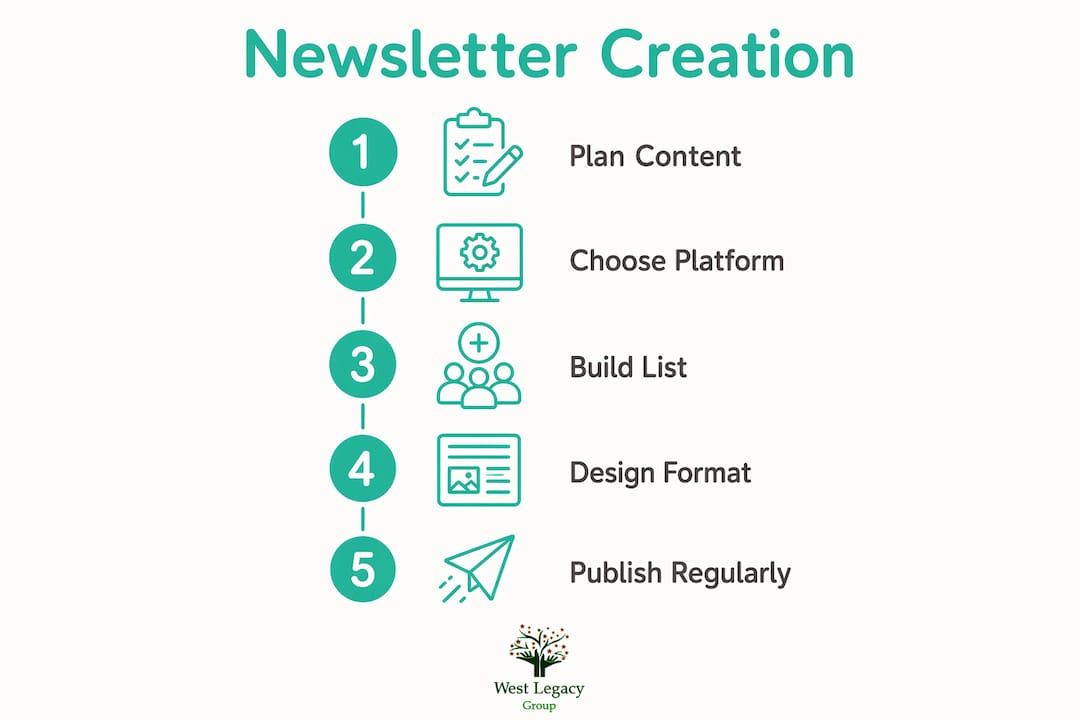
A local business newsletter is a regularly distributed email publication targeting a defined community, designed to inform, engage, and grow a loyal audience through relevant content and a clear call to action. Done well, it gives you a direct communication channel that no social media algorithm can take away. The most effective newsletters in 2026 combine a consistent structure, timely local content, and a predictable publishing rhythm that readers come to rely on.
What makes a local business newsletter work?

A successful local newsletter delivers actionable information in a predictable format, every single time. Readers open it because they know what they will get. That reliability is what builds the habit, and the habit is what builds the audience.
The core elements every issue needs:
- Brief opening: Two to three sentences setting the tone or highlighting the week’s lead story.
- Community or business updates: What is opening, closing, moving, or changing in your area.
- One helpful tip or resource: Educational content your readers can use immediately.
- Single clear call to action: One ask per issue. More than one dilutes the response.
- Consistent sign-off: Your name, contact, and a line reminding readers why you write this.
These five components keep each issue focused and easy to produce. Resist the urge to add more sections before you have published at least ten issues.
Which tools should you use for your newsletter?
Choosing the right platform early saves you from migrating a growing list later. The good news is that all the major tools work in Australia, and most have free tiers that cover you until your list is well established.
- Ghost: A publishing platform suited to creators who want full ownership of their content and a clean reading experience. Ghost supports paid memberships natively and works well if you plan to monetise through subscriptions rather than sponsorships.
- Substack: Free to start, with Substack taking a cut of paid subscription revenue. It is the fastest path to a live newsletter because setup takes under an hour. Strong for community building and discovery within the Substack network.
- ConvertKit (now Kit): Free up to 10,000 subscribers on its current tier, with strong automation and segmentation tools. Best suited if you already have a creator brand or want to build automated email sequences alongside your newsletter.
- Beehiiv: The most common pick for local newsletters in 2026 because of its built-in growth tools, recommendations network, and ad network. Free up to 2,500 subscribers, then tiered pricing applies.
- Mailchimp: Fine for small lists and familiar to most business owners. Its design tools are slower than the alternatives, but if you already use it for other campaigns, staying put is reasonable.
Pro Tip: Start on whichever platform you will actually use. The best tool is the one that gets your first issue out the door this week, not the one with the most features you will never touch.
Pick one platform and commit to it for at least 30 issues before evaluating a switch.
What content ideas work best for local newsletters?
Small business owners often stall on newsletter creation because they focus on topics rather than content types. Shifting your thinking from “what do I write about this week?” to “which type of content am I producing?” removes most of the friction.
The three content types that work consistently for local newsletters:
- Educational content: Tips, how-to guides, and explainers relevant to your industry or community. A local accountant might share a quarterly tax reminder; a café owner might explain how they source their beans.
- Community news and updates: Local events, new business openings, closures, and neighbourhood highlights. Readers consistently rank this as the most forwarded content in general-audience local newsletters.
- Curated recommendations: Your picks for what to do, eat, visit, or read locally. This positions you as a trusted local voice, not just a business sending promotions.
Practical ideas to fill each issue:
- Behind-the-scenes glimpses of your business or team
- Spotlights on other local businesses (which can later become paid placements)
- Upcoming local events with date, location, and a one-line description
- Seasonal tips relevant to your industry
- A reader question answered in 100 words or fewer
Consistency and relevance matter more than production quality. A short, honest issue published on schedule every week builds more trust than a polished one that arrives irregularly.
For local business blog content ideas that translate directly into newsletter sections, the same principles apply: specificity and local relevance outperform generic advice every time.

How do you build and manage your subscriber list?
Your list is your most valuable asset. A small, engaged list of local readers outperforms a large, disengaged one, particularly when you approach local businesses about sponsorships.
Practical ways to grow your list:
- Personal outreach first: Email or message everyone you know in your area and ask them to subscribe. Expect a strong yes rate from people who already trust you.
- Community channels: Post in local Facebook groups, Nextdoor, and community forums. Frame it as something new you are trying and invite feedback rather than just dropping a link.
- Offline capture: QR codes on business cards, counter cards, event flyers, and receipts still work well for local audiences.
- Lead magnet: Offer something immediately useful in exchange for an email address, such as a local events calendar, a discount, or a practical guide relevant to your industry.
- Segmentation: Once your list grows, group subscribers by interest, location, or purchase history so you can tailor content to each group.
Australia’s Spam Act 2003 requires explicit consent before you send commercial emails. Every subscriber must opt in, and every issue must include a clear, functional unsubscribe option. Buying email lists is not compliant and will damage your deliverability. Managing consent records is straightforward on any of the platforms listed above, all of which include built-in unsubscribe handling.
How should you design and format your newsletter?
Clean, simple layouts consistently outperform elaborate designs for local newsletters. Readers are often scanning on a phone between tasks, so your job is to make the key information findable in under 30 seconds.
Design and formatting best practices:
- Single-column layout: Performs better on mobile than multi-column designs. Most platforms default to this.
- Clear section headers: Let readers jump to what they want. A consistent header style also reinforces your brand.
- Short paragraphs: Two to four sentences per paragraph. White space is your friend.
- Images used purposefully: When writing about a new local restaurant, include a photo of the menu directly in the newsletter rather than linking to the restaurant’s website. Readers want to see the menu, and keeping them in the newsletter maintains engagement.
- Accessible text: Use a readable font size (at least 14px for body copy), sufficient contrast, and descriptive alt text on images.
- Authenticated sending domain: Set up SPF, DKIM, and DMARC records for your domain. This improves deliverability and prevents your newsletter from landing in spam folders.
Avoid padding issues to reach a length target. Short, honest issues with a predictable cadence earn higher trust and engagement than long ones that feel like they are filling space.
How do you track and improve newsletter performance?
The three metrics that matter most for a local newsletter are open rate, click rate, and unsubscribe rate. Everything else is secondary until you have a stable publishing rhythm.
Optimisation tips:
- Open rate tells you whether your subject line and sender name are working. If opens are low, test different subject line formats before changing your content.
- Click rate tells you whether your content is compelling enough to prompt action. Low clicks usually mean the call to action is unclear or there are too many competing links.
- Unsubscribe rate spikes after issues that feel off-topic or too promotional. Use it as a signal to recalibrate content mix.
- A/B test subject lines: Most platforms let you test two variants on a portion of your list before sending the winner to everyone. Run this consistently from issue eight onwards.
- Review after every four issues: Look at which stories generated replies or clicks, and do more of that.
Weekly frequency balances reader anticipation with a manageable production load for solo creators. Tuesday and Thursday mornings are the most commonly cited high-performance send windows based on email industry benchmarks, though your own audience data will eventually tell you more than any general rule.
How do you write subject lines that actually get opened?
Your subject line determines whether the issue gets opened at all. For local newsletters, three formats consistently perform well: specificity (“The new café on Smith Street is finally open”), intrigue (“What’s going up at the corner of Main and Oak?”), and list utility (“5 things happening in Ballarat this weekend”).
Subject line and personalisation tips:
- Keep it under 50 characters for reliable mobile display.
- Use the reader’s name in the subject line or opening sentence where your platform supports it. Personalisation in subject lines improves open rates and subscriber retention.
- Avoid spam trigger words: Free, urgent, act now, limited time, and similar phrases increase the chance of landing in junk folders.
- Be specific, not clever: “3 local events this Saturday” outperforms “You won’t want to miss this weekend.”
- Match the subject line to the content: If the subject promises a restaurant recommendation and the issue leads with a policy update, readers feel misled and unsubscribes follow.
Personalisation goes beyond the subject line. Segmenting your list by customer type or interest lets you send different versions of the same issue to different groups, keeping content relevant without doubling your workload.
Should you launch now or wait until everything is perfect?
Ship your first issue within seven days of deciding to start. The single biggest predictor of a local newsletter that survives is whether the operator sent their first issue in the first week. Over-engineering the design or waiting for the perfect template is the top reason new newsletters never launch.
The content type framework makes this easier. Instead of searching for topics, you choose a type and fill the mould:
- Educational issue: One tip or explainer your readers can use this week.
- Update-driven issue: What is new, changing, or worth knowing in your area right now.
- Curated issue: Your picks for the best local events, businesses, or resources this month.
Rotating through these three types gives you a ready-made editorial calendar without needing to reinvent the content each time.
“Small business owners often stall on newsletter creation because they focus on topics rather than content types. Once you know the type of newsletter you’re sitting down to write, the topic becomes much easier to find.” — Astrid Bracke, Small Business Newsletter Magic
A repeatable newsletter format aligned with local interests drives long-term audience trust and growth. Treat each issue like fresh produce: timely, useful, and delivered on schedule, rather than polished but infrequent.
How do newsletters connect with your other local marketing channels?
Your newsletter works best when it is part of a wider local marketing presence, not a standalone effort. Each channel reinforces the others, and the newsletter is often the most durable piece because you own the list outright.
Practical integration strategies:
- Social media: Tease newsletter content on Instagram, Facebook, or LinkedIn with a “full story in this week’s newsletter” prompt. Share your best newsletter sections as social posts to drive new subscribers.
- Local events: Attend or sponsor community events and use QR codes to capture subscribers on the spot. Post-event recaps in your newsletter give attendees a reason to share it with people who missed out.
- Google Business Profile: Link to your newsletter sign-up page in your profile description. Readers who find you through local search are already interested in what you do locally.
- Your website: A newsletter sign-up form on your homepage and blog converts existing website visitors into subscribers. Growing your local online presence and your newsletter list are complementary goals, not competing ones.
- Word of mouth: Readers forward local newsletters when the content feels genuinely relevant. This is the most powerful growth channel and cannot be manufactured, only earned through consistent quality.
The newsletter also gives you owned content to repurpose. A tip you wrote for your subscribers becomes a blog post, a social caption, or a talking point at your next community event. One piece of content, multiple channels.
West Legacy Group helps local businesses get their digital presence right
Running a newsletter is one part of a broader digital strategy, and the two work best when they are built together. West Legacy Group has spent over 20 years helping Australian small businesses build their online presence affordably, without locking them into expensive long-term contracts.
Where most agencies charge agency rates for website design, content, and SEO, West Legacy Group offers all of these as individual services or subscription packages priced for small businesses and start-ups. Whether you need a website that converts newsletter readers into customers, or SEO support to grow the audience finding you in the first place, the services are built to be picked up one at a time or bundled as your business grows.
If you are ready to pair your newsletter with a website that actually works for your local audience, take a look at West Legacy Group’s small business website packages or explore the full range of digital marketing services available across Australia.
Key takeaways
A local business newsletter succeeds when it combines a consistent structure, relevant community content, and a publishing rhythm readers can rely on week after week.
| Point | Details |
|---|---|
| Structure drives consistency | Every issue needs a brief opening, community updates, one tip, and a single clear call to action. |
| Platform choice matters less than launch speed | Ship your first issue within seven days; over-engineering design is the top reason newsletters fail. |
| Content types beat topic lists | Rotate educational, update-driven, and curated formats to fill each issue without starting from scratch. |
| Australian compliance is non-negotiable | The Spam Act 2003 requires explicit consent and a working unsubscribe option in every email you send. |
| West Legacy Group | Pairs newsletter marketing with affordable website design and SEO services built for Australian small businesses. |