

Specialisation in local SEO sharpens your competitive edge by targeting specific services, suburbs, or customer segments with content that matches exactly what local searchers need. Rather than casting a wide net, you focus your digital presence on the queries that actually convert, and that focus pays off. Localised, niche-targeted content captures high-intent searches that generic SEO pages consistently miss.
How specialisation drives local SEO success
The role of specialisation in local SEO comes down to one thing: relevance. Google ranks local businesses based on relevance, distance, and prominence, and specialisation directly strengthens the first and third of those pillars. When your content, Google Business Profile, and structured data all point to a specific service in a specific location, Google can confidently match your business to the right searcher.
Here is what specialised local SEO delivers in practice:
- Higher conversion rates by aligning your content with precise local search intent rather than broad, low-intent queries
- Improved rankings for high-value, niche keywords that generalist pages cannot compete for
- Stronger user engagement because visitors land on pages that answer their exact question
- Competitive differentiation through unique local content, real project examples, and neighbourhood-specific details
- Better AI visibility as structured data and entity-rich content feed AI-generated answers and voice search results
- Reduced wasted spend by concentrating your marketing resources on the locations and services that actually convert
Key tools and concepts that underpin this approach include Google Business Profile management, service area pages with LocalBusiness and Service schema, and citation management across directories. Together, these create a coherent digital footprint that both Google and AI search engines can read with confidence.
When does specialising in local SEO make the most sense?

Not every business needs the same depth of specialisation, but most Australian small businesses benefit from it sooner than they expect.

Single-location businesses in competitive trades, such as plumbing, dental, legal, or home services, gain the most immediate lift. When ten competitors serve the same suburb, the business with a dedicated service-plus-location page and a fully optimised Google Business Profile consistently outranks the one with a generic homepage. Multi-location operations face a different challenge: each location must be treated as an independent entity with its own Google Business Profile, unique location page, and distinct citation profile to avoid algorithmic penalties.
Specialisation also delivers the best return when you align content with high-intent local queries that generalist SEO simply does not target. A search for “emergency electrician Fitzroy” is far more likely to convert than “electrician Melbourne.” Capturing those niche queries requires dedicated pages built around specific services and suburbs, not a single broad service page.
Consider specialising when:
- Your business serves multiple suburbs or towns and you want to rank in each one
- You offer distinct services that attract different customer segments
- Competitors are outranking you for suburb-level or service-specific searches
- You want to reduce reliance on paid advertising by capturing organic, high-intent traffic
- Your local SEO strategies need a clearer structure to support business growth
Key factors and challenges in building specialised local SEO
The biggest trap in specialised local SEO is creating location pages that look unique but are not. Google’s helpful content classifier, sharpened through 2026 core updates, actively identifies near-duplicate templates where only the city name changes. Pages that fall into this “doorway page” pattern get deindexed, not just demoted.
The practical standard that holds up is a significant portion of unique content per location page, with the unique portion drawn from real operational details: specific neighbourhoods served, local landmarks, climate considerations, real project photos with location attribution, and pricing or response time data for that market. This is the content a local customer recognises as genuine knowledge, and it is what Google’s algorithm rewards.
Managing Google Business Profiles across multiple locations adds another layer of complexity. Categories and services tend to be uniform across locations by default, so specialised businesses use hyperlocal FAQs and review responses to semantically differentiate each location. Consistent NAP (name, address, phone number) data across your website, GBP, and directory listings prevents entity split, where Google treats two listings as separate businesses and dilutes your authority.
Other critical factors to manage:
- Schema markup: LocalBusiness and Service schemas are non-negotiable. They help Google and AI systems understand what each location offers and where it operates.
- Internal linking structure: A service hub page linking to individual city pages, with each city page linking back to related service pages, creates the content hierarchy that signals a genuine site rather than a doorway set.
- Content sourcing: Build location pages from operational inputs, including local project photos, staff details, and neighbourhood-specific FAQs, rather than rewriting generic copy.
- Citation management: Tools like Semrush’s Listing Management or BrightLocal help maintain consistent business data across directories, which matters for both traditional rankings and AI entity resolution.
Pro Tip: Start your location page content with real operational data. Ask your team what questions customers in each suburb actually ask, then answer those questions directly on the page. That approach produces genuinely unique content faster than any content brief.
How AI search is reshaping the need for specialisation
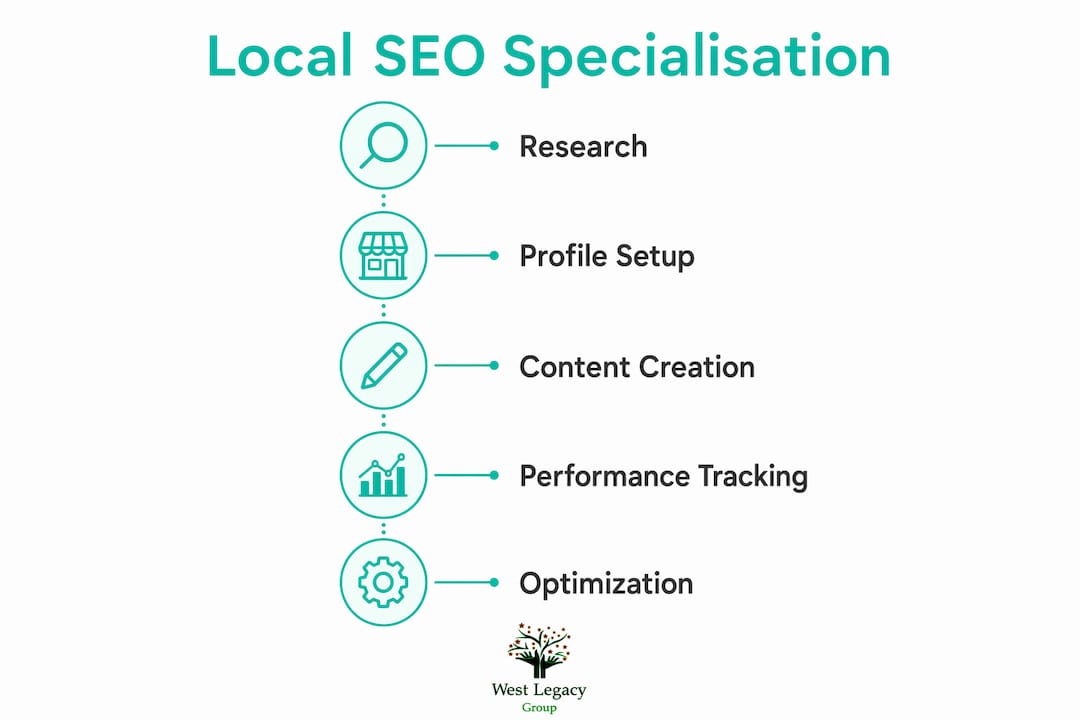
AI-powered search has made specialisation more important, not less. Near me keyword searches have grown 500% in the past five years, making precise local specialisation more urgent. When Google’s AI Overviews or a voice assistant recommends a local business, that recommendation is built from structured, entity-rich data, not generic service descriptions.
The shift in content strategy is direct: move from “who we are” to “what you need.” AI search rewards businesses that answer specific questions with depth and authority. A page that explains “how much does a bathroom renovation cost in Ballarat” with real local pricing data will be cited by AI far more often than a page that says “we offer bathroom renovations across Victoria.”
Answer Engine Optimisation (AEO) is the practice of structuring content so AI models can extract, understand, and cite it. For local businesses, this means:
- Adding FAQ sections that address real local questions, including pricing, response times, and service boundaries
- Using clear H2 and H3 headings that match natural language queries
- Implementing LocalBusiness schema per location page so AI systems can accurately describe each branch
- Monitoring for data drift, where hours, services, or contact details fall out of sync between your GBP, website, and directories
- Earning reviews that mention specific services and local outcomes, since AI models analyse review text to understand what a business actually does well
Specialisation is also what keeps your business trusted by AI over time. Generic content ages quickly. Location-specific content tied to real operational data stays accurate and continues to signal authority.
What specialised local SEO looks like for Australian businesses
Australian businesses across trades, health, and professional services have seen measurable gains from moving to a specialised local SEO structure. A Melbourne-based physiotherapy group that created individual location pages for each clinic, each with suburb-specific FAQs, local staff bios, and service lists reflecting what each clinic actually offered, saw its map pack visibility improve across multiple suburbs rather than concentrating around one central location. The key was that each page reflected genuine differences between clinics, not a template with the suburb name swapped in.
A Bendigo trades business that built service-plus-suburb pages for the specific towns it serviced, complete with local project photos and response time data from its nearest depot, captured suburb-level searches it had never ranked for previously. The local digital marketing approach combined GBP optimisation with structured data and a clear internal linking hierarchy from a service hub to individual city pages.
The pattern across both examples is consistent: specificity wins. Real photos, real pricing context, real neighbourhood knowledge, and real review responses that reinforce service specialties all contribute to the kind of entity clarity that both Google and AI search engines need to recommend your business confidently.
How industry-specific specialisation affects your local search rankings
Industry context shapes how deep your specialisation needs to go. In highly competitive categories like legal services, dental, real estate, and home trades, suburb-level pages with full schema markup are the baseline, not a differentiator. In less competitive categories, a well-optimised Google Business Profile combined with a single strong location page may be sufficient to rank.
Specialised, locally focused content improves rankings for high-intent keywords by capturing niches that generic pages overlook. A general “plumber Sydney” page competes against every plumber in the city. A “blocked drain specialist Newtown” page competes against far fewer, and the searcher using that query is much closer to booking. Industry-specific specialisation also supports topical authority, where Google recognises your site as a credible source for a specific service category in a specific location, which lifts rankings across related queries.
For multi-location businesses, the relevance, distance, and prominence framework that underpins Google’s local algorithm is now interpreted through richer entity matching. A business that clearly signals what each location offers, through aligned GBP categories, location page content, and schema, earns stronger relevance scores than one with uniform, generic profiles across all branches. That difference shows up directly in local pack rankings.
Measuring whether your specialised local SEO is working
Tracking the effectiveness of specialised local SEO requires looking beyond overall website traffic. The metrics that matter are location-specific and intent-specific.
Track these signals consistently:
- Local pack rankings for your target service-plus-suburb keyword combinations, monitored at the suburb or postcode level using tools like Semrush’s Position Tracking or BrightLocal
- Google Business Profile insights: direction requests, phone calls, and website clicks per location, which show whether each GBP is generating real local engagement
- Organic traffic to individual location pages, segmented by suburb or service, to identify which pages are performing and which need attention
- Conversion actions tied to specific location pages, including form submissions, phone calls, and booking requests
- Review velocity and sentiment per location, since review recency and content quality directly influence both traditional rankings and AI recommendations
- Data drift audits conducted at least quarterly, checking that hours, services, and NAP details are consistent across your GBP, website, and major directories
The local SEO checklist approach works well here: set a baseline for each location, track changes after content updates or GBP improvements, and use that data to prioritise where to invest next. Specialisation is not a one-time project. It requires ongoing attention to stay ahead of competitors and remain trusted by AI search systems.
Pro Tip: Set up a simple monthly audit for each location: check GBP data against your website, review the last 10 reviews for service mentions, and confirm your schema is validating correctly in Google’s Rich Results Test. Catching drift early costs far less than recovering lost rankings.
Ready to build a specialised local SEO presence?
West Legacy Group works with Australian small businesses to build affordable, focused SEO strategies that match how local customers actually search. Whether you need a single-location presence or a multi-suburb content structure, the team at West Legacy Group can help you get it right from the start.
Explore our small business website packages or build your own SEO plan tailored to your location and industry.
Key takeaways
Specialisation in local SEO consistently outperforms generic approaches because it aligns your content, structured data, and Google Business Profile with the precise intent of local searchers, giving both Google and AI search engines the entity clarity they need to recommend your business.
| Point | Details |
|---|---|
| Specialisation drives relevance | Targeted service-plus-location content matches high-intent local queries that generic pages miss. |
| Unique content per location | Each location page needs 30–60% unique content to avoid doorway page penalties and rank sustainably. |
| Schema markup is non-negotiable | LocalBusiness and Service schemas help AI systems accurately describe and recommend each location. |
| Near me searches have surged | Near me keyword searches have grown 500% in five years, making precise local specialisation more urgent. |
| Ongoing monitoring is required | Data drift across GBP, website, and directories erodes rankings; quarterly audits keep your presence accurate. |