

Off-page SEO is defined as all optimisation activities that happen outside your own website to build its authority, trust, and relevance in the eyes of search engines. The industry term is “off-site SEO,” and it covers everything from backlinks and brand mentions to social engagement and digital PR. If you want to rank well in Google, off-page signals are not optional. They are the external proof that your site deserves to appear at the top.
Search engines cannot take your word for it when you claim to be an authority. They look outside your website for third-party validation. Backlinks from other sites, mentions of your brand across the web, and your reputation in your niche all feed into how algorithms assess your credibility. For marketers and business owners, understanding these signals is the difference between a site that ranks and one that stagnates.
What does off-page SEO mean for your site’s authority?
Off-page SEO encompasses all strategies outside your website that signal trust, authority, and relevance to search engines. Backlinks are the strongest of these signals. Every link from another site to yours acts as a vote of confidence, telling search engines that your content is worth referencing.
Brand mentions are a growing factor alongside backlinks. When other websites, publications, or social platforms reference your business by name, even without a clickable link, algorithms increasingly connect those references to your brand’s entity and credibility. This matters because unlinked brand mentions help build entity authority as search engines become more sophisticated at recognising patterns across the web.
The full picture of off-page SEO includes a range of complementary tactics:
- Backlink acquisition from relevant, authoritative websites
- Brand mentions and unlinked citations across publications and forums
- Social media engagement that amplifies content reach
- Digital PR campaigns that earn coverage from news and industry sites
- Influencer outreach to reach new audiences and earn natural links
- Local citations in directories and business listings for location-based authority
- Guest posting on reputable sites within your niche
Each of these tactics contributes to your site’s cumulative authority. No single tactic works in isolation. The strongest off-page profiles combine several of these approaches consistently over time.
How do search engines evaluate off-page SEO signals?
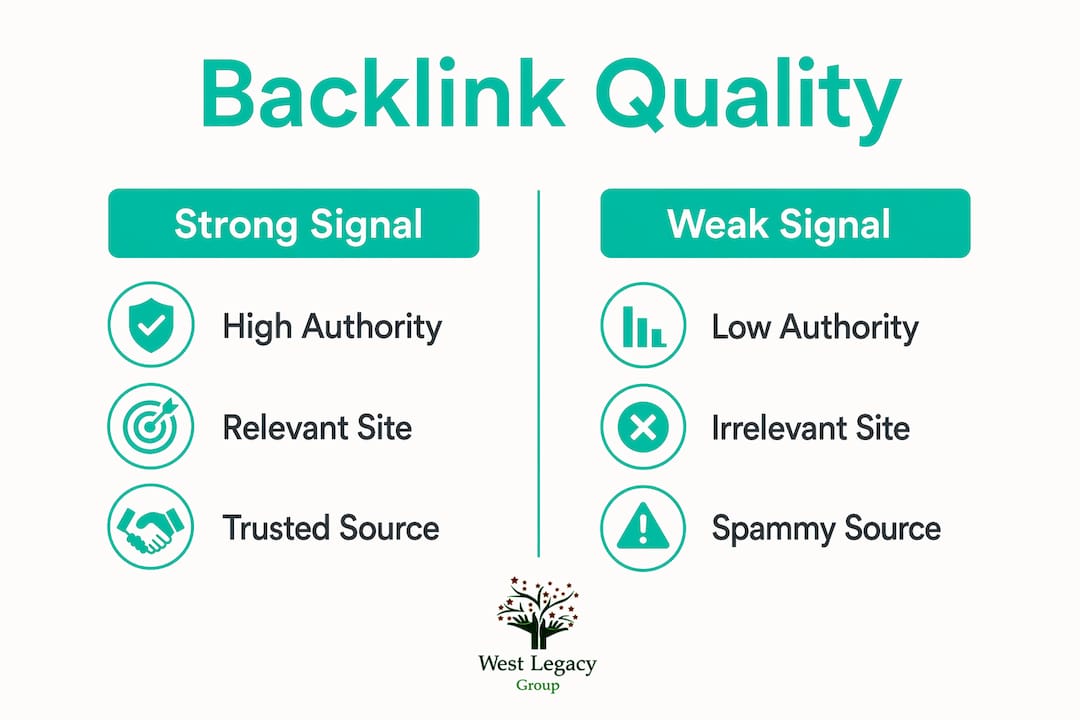
Search engines use algorithms, including Google’s foundational PageRank system, to evaluate backlink quality and quantity as the primary measure of external authority. PageRank assigns value based on how many sites link to you and how authoritative those linking sites are. The result is a compounding effect where links from high-authority domains carry far more weight than links from obscure or low-quality sites.

Quality and relevance matter far more than raw numbers. One link from a high-authority niche site beats many low-quality links. Poor-quality or irrelevant links can actually trigger penalties, which means a careless link-building campaign can do more harm than good.
The table below shows what separates a strong backlink from a weak one.
| Factor | Strong signal | Weak signal |
|---|---|---|
| Domain authority | High-authority, established site | New or low-traffic site |
| Relevance | Same niche or industry | Unrelated topic or category |
| Link placement | Editorial, in-body content | Footer, sidebar, or paid placement |
| Anchor text | Natural, descriptive phrase | Over-optimised exact-match keyword |
| Link velocity | Gradual, organic growth | Sudden spike in link acquisition |
Social signals sit in a different category. Social media platforms do not directly impact rankings but amplify content reach, increasing the chance that other sites discover and link to your content. Think of social media as a distribution channel for your content, not a direct ranking lever.
Domain authority (DA) metrics estimate ranking potential based on backlink profile strength. DA is a proxy metric, not a direct Google ranking factor. Marketers use it to benchmark their site and evaluate the quality of potential link prospects.
Pro Tip: When assessing a potential link source, check its relevance to your niche first, then its authority score. A relevant site with moderate authority will almost always outperform an unrelated site with a high DA.
What are effective strategies for building off-page SEO authority?
Off-page SEO implementation follows a clear process: audit your existing backlink profile, research target sites, run outreach campaigns, and promote your content consistently. Results typically appear within 3–6 months of sustained activity. That timeline reflects the reality that external signals accumulate gradually.
The steps below give you a repeatable framework for building off-page authority.
- Audit your backlink profile. Use a reputable SEO tool to identify your existing links, spot toxic or low-quality links, and understand your current authority baseline.
- Research link prospects. Find authoritative sites in your niche that already link to similar content. Prioritise relevance and domain authority when building your target list.
- Create link-worthy content. Original research, detailed guides, and data-driven articles earn links naturally. Content that answers specific questions in your industry gives other sites a reason to reference you.
- Run targeted outreach campaigns. Contact editors, bloggers, and journalists with a clear value proposition. Personalised outreach consistently outperforms mass email blasts.
- Pursue digital PR and influencer partnerships. Earned media coverage from news sites and industry publications generates high-authority links that are difficult to replicate through direct outreach alone.
- Promote content on social media. Share your content across relevant platforms to increase visibility. Social platforms act as content discovery engines that raise the probability of earning organic links.
- Monitor and maintain your profile. Disavow toxic links, track new link acquisition, and repeat the process quarterly.
Patience is not optional here. Off-page SEO demands persistence because you cannot force external platforms to link to you. Consistent effort over months builds the kind of authority that produces lasting ranking improvements.
Pro Tip: Focus your outreach on 10 genuinely relevant, high-quality prospects rather than 100 generic ones. A targeted approach produces better links and protects your site from penalty risk.
You can read more about the mechanics of earning quality backlinks and how they compound over time to lift your rankings.
How does off-page SEO differ from on-page SEO?
On-page SEO refers to all the internal controls you have over your own website. This includes your content, HTML tags, page titles, meta descriptions, internal linking structure, and site speed. You control every element of on-page SEO directly. Off-page SEO, by contrast, depends on what other people and platforms do in response to your site.
Off-page SEO represents reputation management where third-party endorsements validate the authority you claim on your own pages. Your on-page content tells search engines what you are about. Your off-page profile tells them whether the rest of the web agrees.
The table below clarifies the practical differences between the two.
| Dimension | On-page SEO | Off-page SEO |
|---|---|---|
| Control | Direct, full control | Indirect, earned over time |
| Primary signals | Content, HTML, site structure | Backlinks, brand mentions, citations |
| Timeframe for results | Weeks to a few months | 3–6 months or longer |
| Ranking influence | Relevance and content quality | Authority and trustworthiness |
| Key activity | Content creation and technical fixes | Outreach, PR, and link building |
Neither approach works well without the other. Strong off-page authority pointing to a poorly structured site produces limited gains. Excellent on-page content with no external links struggles to rank in competitive niches. The future of SEO belongs to sites that balance both consistently.
Understanding what is on-page SEO versus off-page SEO also helps when planning a service page SEO strategy. Service pages need strong on-page signals, including clear content and structured data, combined with off-page authority to compete in local and national search results.
Key takeaways
Off-page SEO builds the external authority that search engines require before they will rank your site above competitors in any meaningful way.
| Point | Details |
|---|---|
| Off-page SEO defined | All external activities, including backlinks and brand mentions, that signal authority to search engines. |
| Backlink quality over quantity | One relevant, high-authority link outperforms dozens of low-quality links and avoids penalty risk. |
| Social signals are amplifiers | Social media increases content reach and link-earning potential but does not directly influence rankings. |
| Results take 3–6 months | Sustained outreach and content promotion are required before ranking improvements become visible. |
| On-page and off-page work together | Neither approach alone produces strong rankings; both must be maintained consistently. |
Why I think most businesses get off-page SEO backwards
After years of working with small businesses on their SEO, I have seen the same mistake repeated constantly. Business owners focus almost entirely on their website, polishing every page and tweaking every title tag, while completely ignoring what the rest of the web thinks of them. Then they wonder why their rankings do not move.
The uncomfortable truth is that Google trusts third-party signals more than anything you say about yourself. Your on-page content establishes relevance. Your off-page profile establishes credibility. Without credibility, relevance alone rarely wins in a competitive search result.
The other mistake I see is chasing volume. People buy link packages, chase directory submissions, and celebrate a spike in their backlink count. Then they get hit with a penalty six months later because those links came from irrelevant or low-quality sources. High-quality, relevant backlinks from authoritative domains impact rankings far more than large quantities of weaker links.
My honest advice is to treat off-page SEO like building a professional reputation. You earn it through consistent, quality work over time. You cannot shortcut it. The businesses I have seen succeed with SEO are the ones who commit to a steady programme of content creation, genuine outreach, and brand building. They check their SEO timeline expectations and stay the course. That patience is what separates the sites that rank from the ones that plateau.
— Christopher
How West Legacy Group supports your off-page SEO goals
West Legacy Group has spent over 20 years helping small businesses build a credible online presence. Our SEO services are built specifically for businesses that need real results without enterprise-level budgets.
Whether you are starting from scratch or looking to strengthen an existing site, our small business website packages include foundational SEO support that sets your site up to earn authority over time. If you are ready to go further, you can build a custom SEO plan tailored to your industry, your competitors, and your growth goals. We make affordable SEO practical for businesses at every stage.
FAQ
What does off-page SEO mean in simple terms?
Off-page SEO refers to all activities outside your website that influence its search engine rankings, primarily backlinks from other sites and brand mentions across the web.
Is link building the only off-page SEO technique?
Link building is the strongest off-page signal, but brand mentions and social signals also contribute to overall authority. A complete off-page strategy combines all three.
How long does off-page SEO take to show results?
Off-page SEO typically produces visible ranking improvements within 3–6 months of consistent activity. Results depend on your niche competitiveness and the quality of links you earn.
Do social media posts count as off-page SEO?
Social media posts do not directly affect rankings. They act as content amplifiers that increase the likelihood of earning backlinks from other sites.
What is the difference between on-page and off-page SEO?
On-page SEO covers internal site elements you control directly, such as content and HTML. Off-page SEO covers external signals like backlinks and brand mentions that other sites and platforms generate about you.