

Citation building is the process of creating and managing online mentions of your business’s name, address, and phone number (NAP) across directories, maps, apps, and websites. Done well, it directly improves how often your business appears in local search results, Google Maps, and increasingly, AI-generated answers from tools like ChatGPT and Perplexity.
Here is what you need to know straight away:
- NAP consistency is non-negotiable. Every listing must show identical business details. Even small differences, like “St” versus “Street,” can confuse search engines and split your authority across duplicate listings.
- Start with the big three. Google Business Profile, Bing Places for Business, and Apple Business Connect are your highest-priority claims before anything else.
- Audit before you build. Fixing existing inconsistencies delivers more value than adding new listings on top of broken ones.
- Results take time. Most small businesses see measurable local ranking improvements after several months of consistent citation work.
- AI engines are watching. Citations in AEO play a distinct role from backlinks: AI answer engines select sources based on clarity, structure, topical authority, and freshness, not just link counts.
Key takeaways
Consistent, accurate citations across high-authority Australian directories are the foundation of local search visibility and a growing factor in how AI answer engines select and attribute local business information.
| Point | Details |
|---|---|
| Start with an audit | Check existing listings for duplicates and NAP inconsistencies before adding any new citations. |
| Claim GBP first | Google Business Profile is your highest-impact listing; complete every field and verify it before anything else. |
| Quality over volume | A small number of accurate, complete, high-authority listings outperforms mass low-quality submissions. |
| Expect a 3–6 month timeline | Consistent citation work typically produces measurable local ranking improvements over a period of several months. |
| West Legacy Group | Provides citation audits, GBP management, and ongoing local SEO for Australian small businesses at affordable rates. |
Table of Contents
- What is citation building, and what types of citations exist?
- How does the citation building process work, step by step?
- Why does citation building matter for local SEO?
- Which citations matter most? A simple tier system
- Which Australian directories should you claim first?
- How do you clean up and maintain your citations?
- Should you do citation building yourself or hire someone?
- Nine citation building best practices to act on now
- How do AI answer engines treat citations, and what can you do about it?
- An honest perspective on what citation building actually delivers
- West Legacy Group can handle your citation building and local SEO
- Sources
What is citation building, and what types of citations exist?
A local citation is any online mention of your business’s NAP details. The citation building process is the deliberate effort to create, claim, correct, and maintain those mentions across the web so that search engines and AI platforms can confidently surface your business to nearby customers.
Citations fall into two distinct categories.
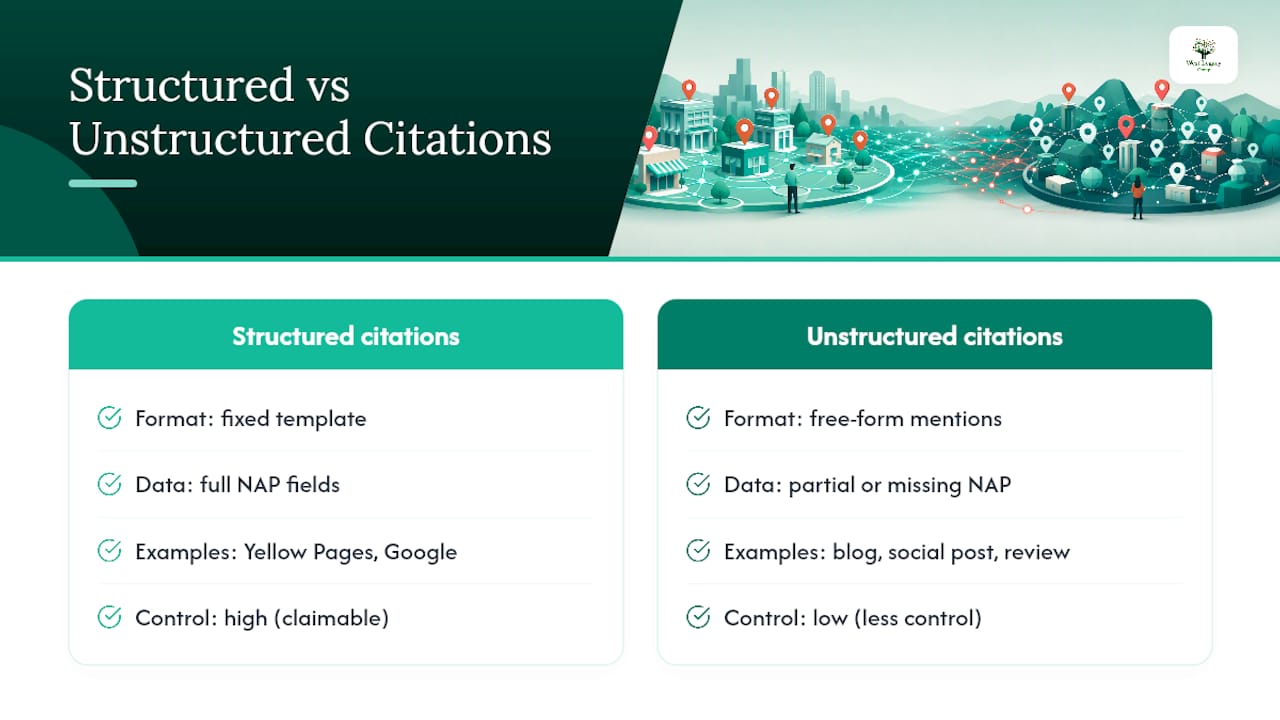
Structured citations appear in formal business directories and listing platforms. They follow a consistent template: business name, address, phone number, website URL, trading hours, and category. Examples include a listing on Yellow Pages Australia, a Google Business Profile entry, or a profile on TrueLocal. Because these platforms use fixed fields, the data is easy for search engines to parse and verify.
Unstructured citations are mentions of your business in free-form content. A local blog post about the best cafés in Fitzroy that names your business and suburb is an unstructured citation. So is a social media post, a podcast show note, or a review on a community forum. These mentions may or may not include your full NAP, and you have less control over their format.
Both types matter. Structured citations build the data foundation that maps and directories rely on. Unstructured mentions build the distributed brand presence that AI answer engines increasingly use to assess authority and relevance. According to Search Engine Land, citations can be partial or complete, and their primary value is data accuracy and local discovery, whether or not they include a link back to your site.
How does the citation building process work, step by step?
The citation building process is straightforward, but it rewards patience and attention to detail. Here is a practical workflow you can follow yourself or hand to a contractor.
-
Audit your existing mentions. Search Google for your business name in quotes, then check major directories manually. Look for duplicate listings, old addresses, disconnected phone numbers, and name variations. Free tools like Google Search and manual directory checks are a good starting point; paid listing scanners can speed this up for businesses with many locations.
-
Set your canonical NAP. Decide on one definitive version of your business name, address, and phone number. Write it down. Should it be “West End Plumbing” or “West End Plumbing Pty Ltd”? Is the address “Level 1, 42 George Street” or “42 George St, Level 1”? Every listing must match this canonical version exactly, including punctuation and abbreviations.
-
Claim and create structured listings, starting with the highest-authority platforms. Work through your priority list (covered in detail below), claim each profile, and fill in every available field: categories, trading hours, photos, website URL, and a business description. Completeness matters. A half-filled listing is less useful to search engines and less convincing to customers.
-
Build unstructured mentions through outreach. Contact local bloggers, industry associations, suppliers, and community organisations. Ask to be listed in their resources pages or mentioned in relevant content. Encourage satisfied customers to leave reviews on Google and other platforms. These organic mentions accumulate over time and contribute to your distributed brand presence.
-
Verify and monitor. Most major platforms require verification before your listing goes live. Set a quarterly calendar reminder to re-check your top ten listings for accuracy. Business details change: hours shift, phone numbers update, locations move. A stale listing is worse than no listing at all.
Pro Tip: Put the direct answer to your customers’ most common question in the first sentence of your Google Business Profile description. AI engines extract answers from the earliest part of a page’s body text, so front-loading your key information makes your listing more likely to be referenced in AI-generated responses.
Claiming and optimising structured listings is one of the most efficient ways to build consistent citations quickly. Listing-management tools can push your canonical NAP data across multiple directories simultaneously, which is particularly useful for businesses managing more than one location.
Why does citation building matter for local SEO?
Citations are one of the core trust signals that Google, Bing, and Apple use to decide whether your business is real, relevant, and worth showing to nearby searchers. When your NAP details are consistent across dozens of authoritative sources, search engines gain confidence in your data and are more likely to include your business in the local pack, the map results that appear above organic listings for searches like “plumber near me” or “café Newtown.”
Inconsistent citations create the opposite effect. If your address appears as “Suite 3” on one platform and “Unit 3” on another, search engines may treat these as two different businesses, splitting your authority and reducing your visibility in both cases.
The role of citations differs from the role of backlinks. Backlinks build credibility through editorial endorsement and pass PageRank for organic rankings. Citations, by contrast, confirm your business’s existence, location, and contact details. Both matter for local SEO, but they do different jobs. For AI answer engines, the distinction is even sharper: AI platforms prefer structured, accurate, and frequently updated data sources when generating local answers, and a well-maintained citation profile feeds directly into that preference.
Research note: According to HubSpot’s analysis of citations in AEO, AI answer engines assign citations based on clarity, structure, topical authority, and freshness. This means a well-maintained, clearly structured listing can become the direct source behind an AI-generated answer, a different mechanism entirely from how backlinks influence traditional organic rankings.
Understanding how long SEO takes helps set realistic expectations: citation work is a foundational investment, not an overnight fix.
Which citations matter most? A simple tier system
Not all citations carry equal weight. Spending equal effort on every possible directory is a poor use of your time. A simple three-tier framework helps you prioritise.
Tier 1: High-authority platforms
These are the listings that directly influence map results, AI answers, and customer discovery. They include national mapping services, major search engine business profiles, and the most-visited general directories. For Australian small businesses, this tier includes Google Business Profile, Apple Business Connect, and Bing Places for Business. A missing or inaccurate listing here has an outsized negative impact.
- Highest priority for time and budget
- Require verification and active management
- Errors here propagate to other platforms that pull data from them
Tier 2: Established Australian directories
These are well-trafficked, trusted directories that customers actively use to find local businesses. Yellow Pages Australia, White Pages Australia, TrueLocal, and Hotfrog Australia sit in this tier. They carry real domain authority and appear in search results for category-based queries.
- Worth claiming and completing fully
- Less time-sensitive to update than Tier 1, but still important
- Contribute to the distributed NAP consistency that search engines look for
Tier 3: Niche directories and unstructured mentions
Industry-specific directories, local community sites, supplier pages, and blog mentions fall here. A mention in a local suburb guide or a listing in a trade association directory is valuable, but it will not move the needle on its own.
- Lower individual impact, but they add up
- Useful for topical authority and AI citability
- Quality and relevance matter more than volume at this tier
The principle that quality beats quick fixes applies directly here. A handful of accurate, complete, high-authority listings outperforms hundreds of low-quality directory submissions every time.
Which Australian directories should you claim first?
This is your practical starting list. Work through it in order, and do not move to the next platform until the current one is claimed, verified, and fully completed.
- Google Business Profile — The single most important listing for any Australian small business. Controls your appearance in Google Maps, the local pack, and Google Search knowledge panels. Free to claim and manage.
- Apple Business Connect — Manages how your business appears in Apple Maps, Siri, and Apple Wallet. With iPhone usage high across Australia, this is a Tier 1 priority that many businesses overlook.
- Bing Places for Business — Powers Microsoft’s search results and is the data source for several AI tools. Straightforward to claim and often pre-populated if you already have a Google Business Profile.
- Yellow Pages Australia (yellowpages.com.au) — One of Australia’s most recognised directory brands. Carries strong domain authority and appears prominently in category searches.
- White Pages Australia (whitepages.com.au) — Primarily a contact reference directory. Useful for NAP consistency and for customers who search by business name.
- TrueLocal (truelocal.com.au) — An Australian-owned local business directory with customer review functionality. Good for service-based businesses targeting suburb-level searches.
- Hotfrog Australia (hotfrog.com.au) — A free business directory with reasonable domain authority. Worth claiming for NAP consistency and category visibility.
- LocalSearch (localsearch.com.au) and AussieWeb (aussieweb.com.au) — Both are Australian-focused directories that contribute to local citation coverage, particularly for businesses in regional areas.
A note on Australian address formatting. Use the full suburb name rather than abbreviations, and always include the postcode. Australian search engines and directory platforms parse suburb and postcode as separate fields, so “Surry Hills NSW 2010” is more useful than “Surry Hills, 2010” or “SH NSW.” Consistent formatting across all listings reduces the risk of duplicate or mismatched entries.
How do you clean up and maintain your citations?
Cleanup is often more valuable than new submissions. Here is a repeatable workflow.
- Identify duplicates. Search each major platform for your business name and suburb. If you find more than one listing, note the URL of each. Duplicates split your authority and confuse customers.
- Correct mismatched fields. Compare each listing against your canonical NAP. Update any field that differs, including phone number format (use the national format: 02 XXXX XXXX for landlines, 04XX XXX XXX for mobiles), trading hours, and website URL.
- Remove or merge duplicates. Most platforms have a process to report or claim duplicate listings. Google Business Profile allows you to request removal of duplicates through the support interface. For directories without a self-service option, contact support directly.
- Flag closed or spammy listings. If a listing references a business that has closed or a location you no longer operate from, remove it. Stale listings actively harm your local search performance.
- Document everything. Keep a simple spreadsheet with each platform’s URL, login credentials, the date last checked, and any pending actions. This makes the next audit significantly faster.
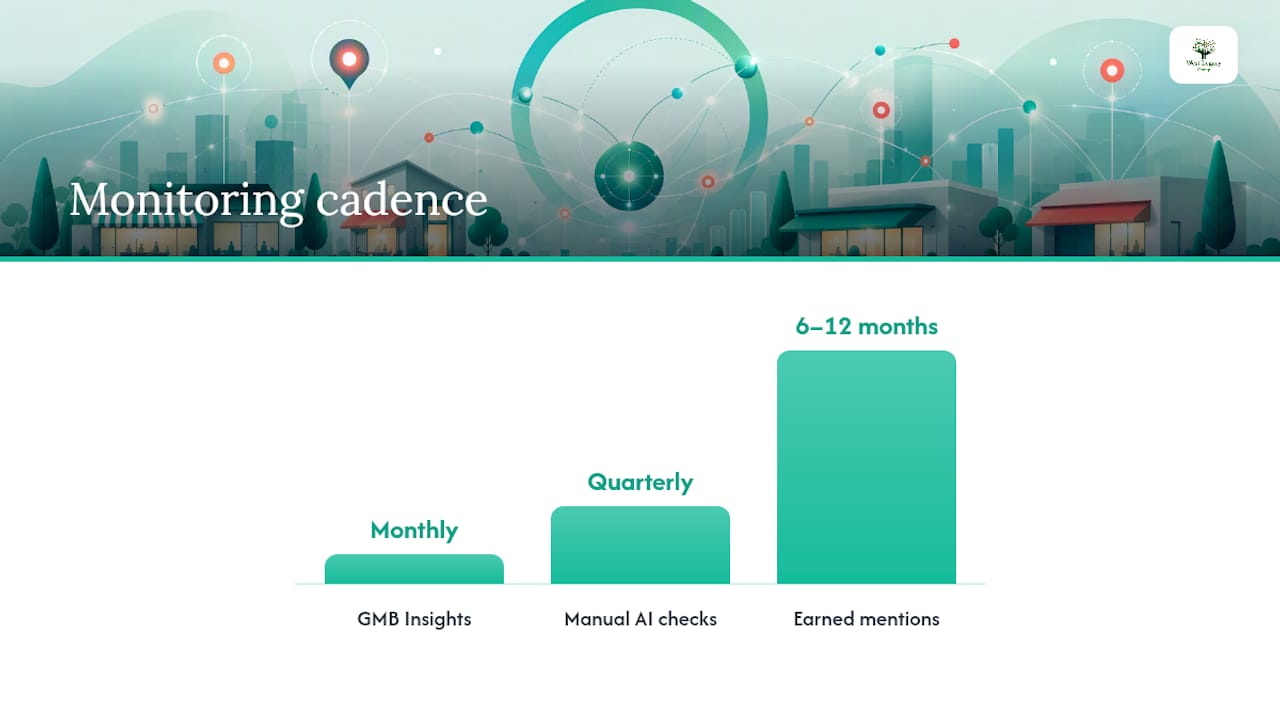
Trigger an immediate update whenever your business changes its phone number, moves address, rebrands, or adjusts trading hours. Do not wait for the quarterly audit cycle. A quarterly audit is the minimum cadence for stable businesses; monthly checks are sensible if your details change frequently or if you are actively building new listings.
For businesses with multiple locations, listing-management tools that push canonical data across platforms simultaneously are worth the investment. For single-location businesses, manual management is entirely workable with a good spreadsheet and a consistent schedule.
Should you do citation building yourself or hire someone?
Both approaches work. The right choice depends on your time, budget, and how many listings you need to manage.
| Dimension | DIY | Hiring a service |
|---|---|---|
| Upfront effort | High — research, claim, verify each platform manually | Low — provider handles submissions and verification |
| Time to complete initial build | several hours for a thorough first pass | 1–2 weeks depending on provider workflow |
| Ongoing maintenance | Requires owner or staff time each quarter | Included in most monthly management retainers |
| Cost range (Australia) | Mostly free; paid tools from roughly $50–$150/month | Agency or freelancer: roughly $300–$800 for a one-off build; $150–$400/month for ongoing management |
| Measurement | Manual checks and Google Business Profile Insights | Provider reporting plus platform dashboards |
DIY works well for businesses with one location, a stable NAP, and an owner or staff member willing to invest the initial setup time. The main risk is inconsistency: it is easy to use slightly different name formats across platforms without realising it.
Hiring a service makes sense when you have multiple locations, have recently rebranded or moved, or simply do not have the time to manage the process properly. Before engaging anyone, ask these questions:
- How do you handle duplicate listings, and can you show me an example of a cleanup you have completed?
- What platforms do you submit to, and how do you verify each listing?
- What does your reporting look like, and how often will I receive updates?
- Do you use automated submission tools, and if so, which platforms do they cover?
- What happens to my listings if I stop using your service?
A credible provider will answer all of these clearly and offer to show you sample reports before you commit.
Nine citation building best practices to act on now
- Audit your canonical NAP first (30–60 minutes). Before touching any listing, decide on your definitive business name, address, and phone number. Write it down and share it with anyone who manages your online presence.
- Claim your Google Business Profile (1–2 hours + verification wait). This is your single highest-impact action. Complete every field, add photos, and select the most specific category available.
- Fix duplicates before adding new listings (variable, 1–3 hours). Duplicate listings dilute your authority. Resolve them before expanding your citation footprint.
- Add specific business categories (15 minutes per platform). Generic categories like “business” or “services” are nearly useless. Use the most specific category each platform offers.
- Request reviews from satisfied customers (ongoing). Reviews on Google and TrueLocal contribute to local ranking signals and build customer trust. A simple follow-up message after a job is completed is enough.
- Claim Apple Business Connect and Bing Places (1 hour each). These are frequently skipped and represent easy wins for map visibility and AI answer coverage.
- Track a simple KPI set monthly (30 minutes). Monitor your Google Business Profile Insights (views, direction requests, calls), your local pack ranking for two or three target keywords, and the number of verified listings you hold.
- Schedule a quarterly audit (2 hours per quarter). Block time in your calendar now. Check your top ten listings for accuracy, look for new duplicates, and update any changed details.
- Document every change in a shared spreadsheet (5 minutes per update). A log of what changed, when, and on which platform makes future audits faster and helps any agency or staff member who takes over the task.
How do AI answer engines treat citations, and what can you do about it?
AI answer engines like ChatGPT, Perplexity, and Google’s AI Overviews do not rank pages the way traditional search does. They retrieve candidate content, evaluate it for relevance and reliability, synthesise an answer, and then assign a citation to the source they drew from. The signals they favour are clarity, structure, topical authority, and freshness, not link counts.
Moz’s Whiteboard Friday on building AI citations outlines practical tactics: prompt-aware outreach, structural content changes, and targeted placement in sources that AI engines already trust. The core principle is that you need to be findable, readable, and credible to a machine that is scanning for the clearest answer to a specific question.
For your listings and website pages, the practical steps are:
- Put the direct answer first. The first sentence of your Google Business Profile description, your homepage, and any service page should answer the most likely customer question directly. AI engines extract answers from the earliest part of a page.
- Make your pages fetchable. Avoid building critical answer pages in heavy client-side JavaScript. If an AI crawler cannot render the page, it cannot cite it. Check your key pages load with JavaScript disabled.
- Use structured data where it makes sense. LocalBusiness schema on your website confirms your NAP details to both search engines and AI crawlers in a machine-readable format.
- Build distributed brand mentions. Supplier pages, industry association listings, local media coverage, and podcast appearances all contribute to the distributed presence that AI engines interpret as authority. This is where brand searches and brand mentions feed directly into AI citability.
- Keep listings fresh. Update your Google Business Profile with posts, new photos, and current hours regularly. Freshness is an explicit signal that AI engines weight when selecting citations.
For measurement, track your Google Business Profile Insights monthly, run manual checks in ChatGPT and Perplexity for your key service queries every quarter, and monitor referral traffic from directory sources in Google Analytics. Structural fixes (answer-first content, schema, fetchability) tend to show results faster than reputational gains from earned mentions, which accumulate over six to twelve months. For a deeper look at structuring content for AI visibility, the West Legacy Group guide on creating content cited by AI search covers the page-level tactics in detail.
An honest perspective on what citation building actually delivers
Citation building is one of the most consistently underestimated tasks in local SEO. Not because it is complicated, but because the results are slow enough that many business owners abandon the process before it pays off.
From working with small Australian businesses across a range of industries, the realistic picture looks like this: a thorough audit and cleanup, followed by claiming and completing the top ten to fifteen listings, typically produces measurable improvements in local pack visibility within three to six months. Businesses that were previously invisible in suburb-level searches often appear in the local pack for their primary service category within that window, provided their Google Business Profile is complete and their NAP is consistent across Tier 1 and Tier 2 platforms.
What surprises most business owners is how much damage inconsistent historical data causes. A business that moved premises two years ago and updated its Google Business Profile but left its Yellow Pages and TrueLocal listings pointing to the old address is actively working against itself. The cleanup phase, not the new submission phase, is where the biggest gains usually come from.
The AI angle is real but requires patience. Getting cited by ChatGPT or Perplexity for a local service query is achievable, but it depends on a combination of listing accuracy, on-page structure, and distributed brand presence that takes time to build. Businesses that invest in both their structured citation profile and their content quality are the ones that start appearing in AI-generated local answers. That combination, not either element alone, is what produces durable visibility.
West Legacy Group can handle your citation building and local SEO
Citation work is time-consuming to do properly, and the cost of getting it wrong compounds over time. West Legacy Group offers local SEO services that cover citation audits, Google Business Profile management, duplicate cleanup, and ongoing listing maintenance, all without locking you into a long-term contract you cannot exit.
The first conversation is practical: you will come away knowing exactly how many listings you currently have, where the inconsistencies are, and what a realistic plan looks like for your business. West Legacy Group has supported Australian small businesses for over 20 years, and the local SEO work is built to be affordable for single-location operators and growing multi-site businesses alike. If you are ready to stop guessing about your local visibility, build your SEO plan or visit West Legacy Group to get started.