

A local content strategy is a planned approach to creating and publishing content that helps search engines connect your business to specific locations, services, and communities. It drives local pack visibility, builds trust with nearby customers, and signals to Google that you are the right answer for location-based searches. Start this week by auditing your Google Business Profile (GBP), fixing any inconsistent NAP (name, address, phone) details across directories, and publishing one well-written location or service page.
Table of Contents
- What is a local content strategy and why does it matter for your rankings?
- What are the core components every local content strategy needs?
- How do you build a local content plan step by step?
- Local content ideas and templates you can use right now
- How do you measure local content success?
- Your 30-day action checklist and the mistakes to avoid
- A real-world example: what a focused local content strategy delivers
- Key takeaways
- When should you do this yourself and when should you hire help?
- West Legacy Group can help you get local results faster
- Useful sources and Australian directories to prioritise
What is a local content strategy and why does it matter for your rankings?
Local search produces two distinct result types: the local pack (the map and three business listings at the top of results) and traditional organic results below it. A strong local content strategy targets both. Local SEO helps search engines understand your business’s location, offerings, and trustworthiness at the city and suburb level, which means a plumber in Parramatta or a physio in Fitzroy can appear for searches that a generic national site never will.
The practical outcomes are direct: more phone calls from GBP, higher map-pack visibility, better odds of appearing in AI-generated local overviews, and stronger conversion from searchers who are already close to buying. AI-driven local overviews are increasingly common in local searches, and keeping your GBP and Bing Places updated helps platforms like ChatGPT that draw on Bing data. For Australian service-area businesses without a shopfront, this matters even more because your content is often the only signal that tells Google where you actually work.
Australian-specific factors also shape your approach. Citation consistency across AU directories (Yellow Pages Australia, TrueLocal, local council business directories) carries measurable weight. Review behaviour here tends to be direct and service-specific, so encouraging customers to mention the suburb and job type in their review text gives search engines stronger local association signals.
What are the core components every local content strategy needs?
Six building blocks form the foundation of any effective local content programme. Miss one and you leave a gap a competitor can fill.
| Content type | Primary local SEO benefit |
|---|---|
| Google Business Profile | Local pack ranking, calls, directions |
| Location page | Organic suburb-level rankings |
| Service landing page | Keyword relevance, conversion |
| Local blog post | Topical authority, long-tail traffic |
| Citation/directory listing | NAP consistency, trust signals |
| Review content | E-E-A-T, click-through rate |
GBP completeness is the single highest-leverage starting point: correct category, recent photos, and a full services list are requirements to rank in the local pack, not optional extras. Location pages need genuine local detail, not city-swapped copies of a generic service description. Local business directories boost visibility and credibility, but only when your NAP is identical across every listing.
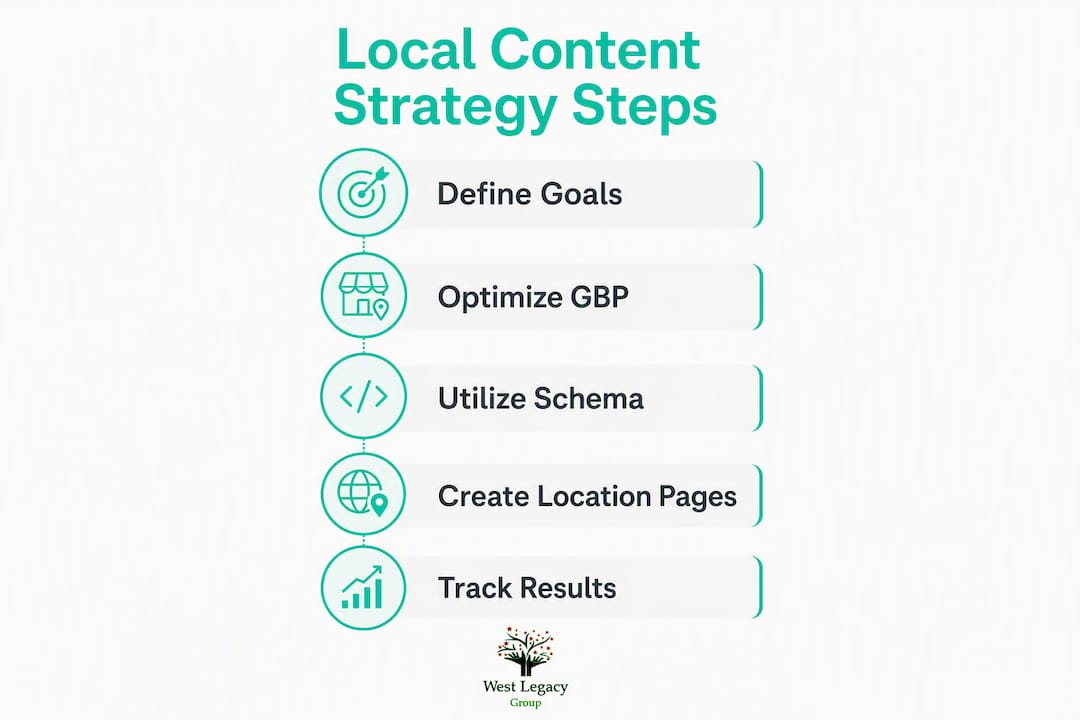
LocalBusiness schema (structured data markup) tells search engines and AI platforms exactly what your business is, where it operates, and what it offers, in a format they can parse without guesswork. Add it to every location and service page.
Pro Tip: Write your location pages around real job details: the suburb, the specific problem you solved, and the outcome. Authentic content converts better than a generic page with the suburb name dropped in.
How do you build a local content plan step by step?
The fastest path to local visibility is a focused sequence, not a scatter-gun approach. Five steps get you from nothing to a working programme.
- Audit (Week 1). Check your GBP for completeness, verify NAP consistency across your top five Australian directories, and list every page on your site that targets a local keyword. Note gaps.
- Keyword research (Week 1–2). Build a list of {suburb} + {service} phrases. For example, a Melbourne electrician might target “emergency electrician Richmond” or “switchboard upgrade Hawthorn.” Use Google Search Console and Google’s autocomplete to find real search terms.
- Content map (Week 2). Match each keyword cluster to a page type: location page, service landing page, or local blog post. Assign priority based on search volume and how close the keyword is to a buying decision.
- Content calendar (Week 3). Schedule one piece of content per week for the first month. Assign roles: the owner handles GBP updates and review responses; an admin manages directory listings; a content writer produces the pages.
- Publish and promote (Week 4 onwards). Publish each page, add internal links from related pages, share on your GBP posts feed, and submit updated URLs to Google Search Console.
A local SEO strategy built on this sequence gives you a testable foundation. Run each location page for 8–12 weeks before drawing conclusions about what is working.
Local content ideas and templates you can use right now
Ten content formats that work for Australian small businesses:
- Suburb service page. Targets one location + one service. Purpose: rank for “[service] [suburb]” searches.
- Local how-to guide. Answers a common question specific to your area. Purpose: long-tail traffic and topical authority.
- Before-and-after case study. Uses a real local job with suburb and outcome details. Purpose: trust and conversion.
- Local FAQ page. Answers the top five questions customers ask at point of enquiry. Purpose: featured snippets and voice search.
- Community event post. Covers or sponsors a local event. Purpose: local relevance signals and backlinks.
- Seasonal local tip. For example, “Preparing your Canberra home’s plumbing for winter.” Purpose: timely traffic.
- Supplier or partner spotlight. Features a local supplier. Purpose: relationship building and local link opportunities.
- Google Posts update. Short GBP post about a recent job or offer. Purpose: GBP engagement signals.
- Review request email. Sent after job completion with a direct GBP link. Purpose: review volume and recency.
- Local comparison guide. For example, “Ducted vs split-system aircon for Brisbane homes.” Purpose: mid-funnel buyers.
For local blog content that generates leads, use real job details and customer outcomes rather than generic descriptions.
Headline templates:
- “[Service] in [Suburb]: What to Expect and What It Costs”
- “Why [Suburb] Homeowners Choose [Your Service] in [Season]”
- “[Number] Questions to Ask Before Hiring a [Trade] in [City]”
Review request micro-template: “Hi [Name], thanks for choosing us for your [job type] in [suburb]. If you have a moment, a quick Google review mentioning what we did and where really helps other locals find us. Here’s the link: [GBP link].”
How do you measure local content success?
Expect early engagement signals within four to six weeks and meaningful ranking changes within 8–12 weeks for well-optimised pages. Tracking both engagement and content metrics together shows whether your content drives real leads, not just clicks.
Core KPIs to track:
- GBP clicks, calls, and direction requests (weekly)
- Organic local traffic by suburb keyword (monthly)
- Review volume and recency (weekly)
- Local keyword rankings for target {suburb} + {service} phrases (monthly)
- Direction requests and branded search volume as engagement signals
| Tool | Primary use | Cost |
|---|---|---|
| Google Business Profile Insights | GBP calls, views, direction requests | Free |
| Google Search Console | Organic keyword rankings, clicks | Free |
| Google Analytics 4 | Local traffic, conversions, time on page | Free |
| Ahrefs or Semrush | Keyword tracking, competitor gap analysis | Paid |
| Whitespark | Citation audit and building (AU-compatible) | Free/Paid |
| Schema Markup Validator | Validate LocalBusiness schema | Free |
Validate your LocalBusiness schema at schema.org’s validator after every new location page. Check GBP Insights weekly for the first three months so you catch drops in direction requests or calls early.
Your 30-day action checklist and the mistakes to avoid
Highest-impact actions first, ordered by the speed at which they produce visible results:
- Claim and fully complete your GBP (correct category, services, hours, photos).
- Audit NAP across Yellow Pages Australia, TrueLocal, and your top five directory listings. Fix any discrepancy.
- Publish one location or service page with genuine local detail and LocalBusiness schema.
- Set up a review request process: send the template within 24 hours of job completion.
- Add GBP posts weekly (a recent job, a tip, or a seasonal offer).
- Submit your site to Google Search Console and verify coverage for new pages.
- Build two to three additional location or service pages targeting your next priority suburbs.
For a more detailed task list, the local SEO checklist for small business covers GBP and on-site items at the task level.
Common mistakes that cost rankings:
- Inconsistent NAP across directories. Even a missing “Pty Ltd” or a different phone format can dilute citation signals.
- Thin or duplicated location pages. Swapping only the suburb name across ten pages is a fast path to a Google quality penalty.
- Ignoring reviews. Review volume and recency are top local-pack ranking factors. A business with three reviews from two years ago loses to a competitor with fifteen from last month.
- Neglecting GBP after setup. An unclaimed or stale GBP sends a trust signal in the wrong direction.
Resource-constrained businesses should fix NAP and GBP first. Those two actions cost nothing and produce the fastest visible lift.
A real-world example: what a focused local content strategy delivers
A focused local content strategy, applied consistently over 8–12 weeks, produces measurable gains in GBP engagement and local keyword rankings.
West Legacy Group worked with an anonymised home services client in a competitive Australian metro market. The business had a GBP with incomplete categories, no location pages, and NAP inconsistencies across four major directories. The approach: fix NAP first, complete the GBP with photos and services, publish two suburb-specific service pages with LocalBusiness schema, and launch a review request process at point of service.
Within ten weeks, GBP views increased, direction requests lifted, and the business began ranking on page one for two target {suburb} + {service} phrases that had previously returned no impression data in Search Console.
Pro Tip: Track GBP direction requests weekly from day one. A lift in direction requests is often the first measurable signal that your local content is working, before ranking changes show up in Search Console.
Christopher brings 20+ years of experience helping Australian small businesses build local search presence that converts.
Key takeaways
A local content strategy works when you focus on a small set of high-leverage actions and measure the right signals from week one.
| Point | Details |
|---|---|
| Start with GBP and NAP | Complete your Google Business Profile and fix citation inconsistencies before creating new content. |
| One excellent location page beats ten thin ones | Write suburb-specific pages with real job details, schema markup, and a clear call to action. |
| Reviews drive local pack rankings | Request location- and service-specific reviews within 24 hours of job completion. |
| Measure engagement signals first | Track GBP direction requests and calls weekly; ranking changes follow within 8–12 weeks. |
| West Legacy Group | Provides local SEO, GBP management, and location page creation for Australian small businesses. |
When should you do this yourself and when should you hire help?
DIY works well when you have one or two target suburbs, a clear service offering, and time to publish one piece of content per week. The GBP, NAP audit, and review process are all owner-manageable with the right checklist.
Bring in professional help when you are targeting multiple suburbs, competing in a high-density market, or when your current content is producing no local impressions after three months of consistent effort. At that point, the gap is usually technical (schema errors, crawl issues, thin page quality) rather than a content volume problem, and an experienced local SEO partner closes that gap faster than trial and error.
Christopher and the West Legacy Group team have spent 20+ years working with Australian small businesses on exactly these challenges. If you are unsure where your biggest gap is, an SEO plan is a practical starting point.
West Legacy Group can help you get local results faster
West Legacy Group gives Australian small businesses a done-for-you alternative to piecing together local SEO alone. Instead of spending months testing what works, you get a team that handles GBP optimisation, location page creation, citation building, and content writing as part of an affordable monthly plan.
Services that map directly to this guide include small business website packages (location pages built and optimised from day one), local SEO plans covering GBP management and citation audits, and copywriting for suburb-specific service pages and blog content. Every service is available as a standalone item or as part of a subscription package priced for small business budgets.
Ready to stop guessing which suburb pages to build first? Visit westlegacygroup.com.au or get in touch to discuss a local content plan built around your specific service area and goals.
Useful sources and Australian directories to prioritise
Authoritative references used in this guide:
- Google Business Profile Help — official GBP documentation and category guidance
- Ahrefs: Local SEO guide — definitions, ranking factors, and measurement
- Moz: Local SEO content planning — content strategy and directory citation guidance
- WordStream: Local SEO tips — GBP optimisation, review signals, and AI overview readiness
- Schema.org Markup Validator — validate LocalBusiness structured data
Australian directories to claim and verify:
- Yellow Pages Australia (yellowpages.com.au)
- TrueLocal (truelocal.com.au)
- Hotfrog Australia (hotfrog.com.au)
- Local council business directories (search “[your council] business directory”)
- Bing Places for Business (feeds ChatGPT and Bing local results)
For each directory, verify that your business name, address, and phone number match your GBP exactly, character for character. Set a quarterly reminder to check for duplicate or outdated listings, which can appear without notice when data aggregators update their records.