

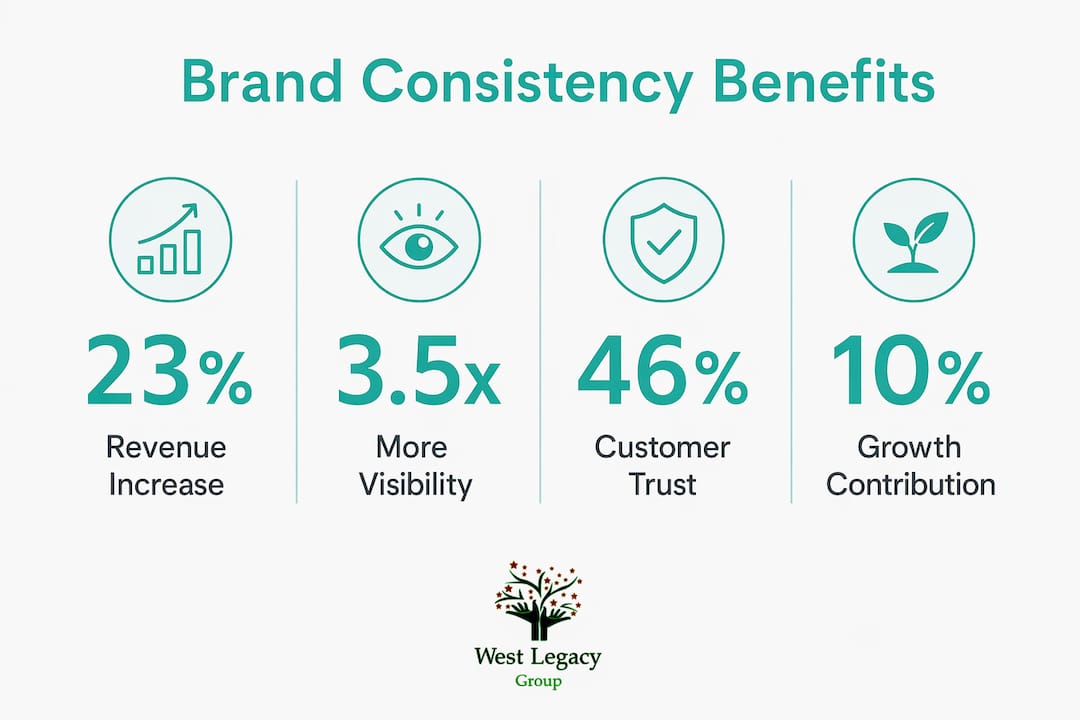
Consistent branding is defined as the unified expression of your visual identity, messaging, and tone across every digital touchpoint your business occupies. This is the formal practice known as brand identity management, and understanding why consistent branding matters online is the first step to building real trust with your customers. Businesses with consistent branding see an average revenue increase of 23%. That figure alone tells you this is not a cosmetic concern. It is a direct driver of growth, and small businesses that treat it as optional leave measurable money on the table.
How does consistent branding directly impact online visibility and revenue?
Brand consistency produces measurable results, not just a polished appearance. Consistent brands are 3.5 times more visible to consumers and gain improved search rankings. Greater visibility means more people find you before they find someone else.
The revenue connection is equally clear. 68% of businesses report that brand consistency contributes at least 10% to overall revenue growth. When your logo, colour palette, and tone of voice appear the same on your website, your social media profiles, and your email campaigns, customers begin to recognise you without effort. Recognition builds familiarity, and familiarity builds trust.

Trust directly influences purchasing decisions. 46% of consumers are willing to pay a premium for brands they trust. That premium comes from consistently reinforced brand identity, not from a single impressive ad. Every time a customer sees your brand presented the same way, their confidence in you grows.
Search engine performance also benefits. Google rewards brands that publish regular, on-brand content because irregular posting and off-brand content erodes both customer confidence and search rankings. A consistent content schedule signals authority and reliability to both your audience and search algorithms.
| Benefit | What it means for your business |
|---|---|
| 23% average revenue increase | Consistent branding directly lifts your bottom line |
| 3.5x consumer visibility | More people recognise and find your brand online |
| 46% willing to pay premium | Trust built through consistency commands higher prices |
| Improved search rankings | Regular, on-brand content strengthens SEO performance |
Pro Tip: Audit your last 10 social media posts and compare them to your website. If the colours, tone, or messaging feel different, that gap is costing you recognition and trust.
What are the broader operational and strategic advantages?
Brand consistency does more than impress customers. It reduces the internal friction that quietly drains small business resources.
Brand inconsistency creates operational drag through the hidden overhead of correcting off-brand content. Every time a team member produces something that does not match your brand standards, someone else spends time fixing it. For a small business with limited staff, that wasted time adds up fast.
Brand discipline creates decision empowerment by giving your team a clear operating system for communication. When your brand guidelines are documented and accessible, your staff can produce content, respond to customers, and create marketing materials without waiting for approval at every step. That is a genuine efficiency gain.
Consistency also signals leadership clarity to the outside world. When your brand looks and sounds the same everywhere, customers and partners perceive a business that knows what it stands for. That perception builds credibility before a single conversation takes place.
The strategic advantages of maintaining brand consistency include:
- Reduced correction time: Clear brand standards mean fewer mistakes and less rework across all content.
- Faster content production: Teams work faster when they are not second-guessing brand decisions.
- Stronger team alignment: Shared brand guidelines create a common language across your entire business.
- Clearer market positioning: Consistency reinforces what makes your business different from everyone else.
- Lower onboarding friction: New staff and contractors get up to speed faster with documented brand standards.
Pro Tip: Create a one-page brand reference sheet with your logo versions, hex colour codes, approved fonts, and tone of voice notes. Pin it in your shared drive so every team member can access it instantly.
What are the key components of consistent branding online?
Consistent branding rests on five practical pillars. Each one needs to be defined, documented, and applied across every platform you use.
Visual identity
Your logo, colour palette, and typography form the foundation of how customers recognise you. Use the same logo file, the same hex colour codes, and the same font combinations on your website, social profiles, email templates, and digital ads. Variation here is the most visible form of inconsistency and the fastest way to erode recognition.
Messaging and tone of voice
Your words carry as much weight as your visuals. Define whether your brand speaks formally or conversationally, uses humour or stays serious, and addresses customers by first name or more formally. Apply that tone consistently across every piece of content you publish, from blog posts to customer service replies.
Content strategy
Consistent content means publishing regularly with on-brand messages. A content calendar keeps your publishing schedule predictable and your messaging aligned. Irregular content breaks the pattern your audience is learning to expect from you.
Unified naming
Inconsistency in naming can break brand recognition before visual or messaging consistency is even established. Your business name should appear identically across your domain, social media handles, Google Business Profile, and directory listings. Even small variations, such as “West Legacy Group” versus “WLG Services,” create confusion and weaken your searchability.
Reputation management
Your brand also lives in reviews, comments, and customer interactions. Responding to reviews in a consistent tone and addressing feedback with the same professionalism you bring to your marketing reinforces your brand identity at every touchpoint.
| Pillar | What to standardise | Where it applies |
|---|---|---|
| Visual identity | Logo, colours, typography | Website, social, email, ads |
| Messaging and tone | Language style, voice, formality | All written content |
| Content strategy | Publishing schedule, topic alignment | Blog, social media, email |
| Unified naming | Domain, handles, directory listings | All online platforms |
| Reputation management | Review responses, customer tone | Google, social, review sites |
How can small businesses implement and maintain brand consistency?
Implementation is where most small businesses struggle. Knowing what consistency looks like is one thing. Building the habits and systems to maintain it is another.
-
Create a brand style guide. Document your logo usage rules, colour codes, typography, tone of voice, and messaging principles in a single reference document. This does not need to be a 50-page manual. A clear, two-page guide that your team actually reads and uses is far more valuable than an elaborate document that sits untouched.
-
Centralise your brand assets. Store all approved logos, images, templates, and copy examples in one shared location. Google Drive, Dropbox, or any shared folder works. The goal is that anyone producing content for your business can find the right assets without asking.
-
Audit your online presence every quarter. Check your website, social media profiles, Google Business Profile, and any directory listings. Look for outdated logos, inconsistent bios, or off-brand language. A quarterly audit catches drift before it becomes a problem.
-
Build templates for recurring content. Create pre-approved templates for social media posts, email newsletters, and blog headers. Templates reduce the chance of inconsistency and speed up content production significantly.
-
Set clear approval workflows. For small teams, this can be as simple as one person reviewing all public-facing content before it goes live. The point is that someone is accountable for brand consistency, not that the process is complicated.
-
Review your brand guidelines annually. Your business evolves, and your brand should too. An annual review keeps your guidelines current without triggering constant changes that confuse your audience.
-
Track the impact of your branding efforts. Use reporting and analytics to monitor engagement, traffic, and conversion trends over time. When you can see that consistent content drives better results, it reinforces the discipline needed to maintain it.
The most common pitfall is treating brand consistency as a one-time project. You set up your guidelines, launch your new look, and then gradually let things slip as the business gets busy. Consistency is an ongoing discipline. The businesses that maintain it over years are the ones that build the strongest recognition and the deepest customer trust.
Customers experience brands as a unified pattern, and breaking that pattern reduces confidence and trust. Every inconsistency, no matter how small it seems internally, registers with your audience. Protecting that pattern is one of the highest-value habits a small business owner can build.
In 2026, the stakes are higher than they have ever been. Brands failing to maintain messaging and tone alignment risk being lost in the growing volume of AI-generated content. A distinct, consistent brand identity is what makes your business recognisable and trustworthy when everything else online starts to look the same.
Key takeaways
Consistent branding is the single most reliable way for small businesses to build recognition, earn customer trust, and drive measurable revenue growth online.
| Point | Details |
|---|---|
| Revenue impact is real | Businesses with consistent branding see an average 23% revenue increase. |
| Visibility multiplies | Consistent brands are 3.5 times more visible to consumers online. |
| Trust commands premium pricing | 46% of consumers pay more for brands they consistently recognise and trust. |
| Consistency reduces internal waste | Clear brand standards cut correction time and speed up content production. |
| Ongoing discipline is required | Brand consistency is a continuous practice, not a one-time setup. |
Brand consistency: what I have learned from working with small businesses
Working with small business owners over many years, I have noticed a consistent pattern. The businesses that struggle most with their online presence are rarely the ones with the worst products or services. They are the ones whose branding looks different every time a customer encounters them.
The mindset shift that makes the biggest difference is treating your brand as a business asset, not a design preference. Your logo and colour palette are not just aesthetic choices. They are the visual shorthand your customers use to recognise and trust you. When that shorthand changes without warning, you are asking your audience to start the recognition process from scratch.
I have also seen small business owners underestimate how quickly inconsistency compounds. One off-brand social post, a slightly different logo on a flyer, a bio that uses a different business name. Each one seems minor. Together, they create a fragmented impression that quietly undermines everything else you are doing well.
The businesses I have seen grow most confidently online are the ones that commit to their brand identity and protect it consistently. They use the same voice, the same visuals, and the same values in every customer interaction. That commitment is what turns a small business into a recognised brand. You can read more practical guidance on building that kind of presence on the West Legacy Group blog.
— Christopher
How West Legacy Group helps small businesses build a consistent online brand
West Legacy Group works with small businesses and startups across Australia to build the kind of consistent online presence that drives real results.
Our services cover website content, web design and development, digital marketing, and affordable SEO in Melbourne and beyond. Every service is built to be affordable and available as a single item or subscription package. If you are ready to put a proper brand strategy behind your online presence, you can build your own SEO plan and start with exactly what your business needs right now.
FAQ
What is consistent branding?
Consistent branding is the practice of presenting a unified visual identity, tone, and messaging across every platform your business uses online. It includes your logo, colour palette, typography, language style, and content schedule.
Why does brand consistency matter for small businesses?
Brand consistency builds customer recognition and trust, which directly drives revenue. Businesses with consistent branding see an average revenue increase of 23%, and consistent brands are 3.5 times more visible to consumers.
How do I start building brand consistency online?
Start by creating a simple brand style guide that documents your logo, colours, fonts, and tone of voice. Then audit your existing online profiles to align them with those standards.
How often should I review my brand consistency?
A quarterly audit of your online presence catches inconsistencies early. Review your full brand guidelines annually to keep them aligned with how your business has evolved.
Does brand consistency affect SEO?
Yes. Regular, on-brand content signals authority and reliability to search engines. Irregular posting and off-brand messaging erode both customer confidence and search rankings over time.