

An “AI report” means one of two things. It’s either an evidence-based industry or safety document, like the AI Index, or it’s a business report generated by an AI tool that turns your own data into a narrative with charts attached. Knowing which one you need saves hours of wasted searching.
If you’re researching policy, funding decisions, or where AI capability is heading, go straight to the primary industry and safety reports. If you need a sales summary, a client dashboard, or a one-page executive brief by Friday, you want an AI report generator instead.
- Need research or policy evidence? Download a primary report such as the AI Index or the UN’s preliminary safety report.
- Need an operational or business report? Open a report generator, feed it a short brief and your data, and export.
Key Takeaways
Reliable AI reporting depends on matching the report type to the job, verifying provenance at every stage, and keeping a human in the review loop before anything gets acted on.
| Point | Details |
|---|---|
| Two report types exist | Industry/safety reports suit research and policy; AI generators suit operational and business reporting. |
| Clean data comes first | Preprocessing and structuring inputs before generation prevents misleading, confident-sounding errors. |
| Provenance is non-optional | Check model version, source citations, and audit trails before trusting any generated figure. |
| Treat indexes as living documents | Revisit annually updated sources like the AI Index rather than citing a single old edition. |
| Human review closes the loop | Every generated report needs a person checking claims against the underlying data before use. |
Table of Contents
- Types and use cases of AI reports
- What do AI report generation tools actually deliver?
- How do AI report generators actually work?
- Where do you find authoritative AI industry and safety reports?
- How do you evaluate whether an AI report is reliable?
- A step-by-step workflow to get a reliable AI report
- What West Legacy Group brings to reporting and analytics
- How do the popular AI report generation tools compare?
- Where is AI report generation technology heading?
- How should you interpret and use an AI-generated report well?
- What matters most when you’re choosing between report types
- Sources
Types and use cases of AI reports
The two lanes rarely overlap in practice, but they often serve the same person at different points in the week.
Industry and safety reports get used for policy briefings, literature reviews, board-level governance discussions, and investment due diligence. Researchers, policy teams, and executives cite these because they carry named authorship, stated methodology, and independent expert review baked in.
Tool-generated reports do the daily grind: sales and marketing performance summaries, one-page executive reports for a Monday meeting, and scheduled analytics exports that land in an inbox every week without anyone touching a spreadsheet.
- Researchers and policy analysts lean on the AI Index and the UN panel’s findings for citations and trend data.
- Marketing teams and small-business owners lean on generators for weekly performance snapshots.
- Investors and industry strategists use national capability reports like the Australian AI Industry Capability report to ground decisions in local context.
What do AI report generation tools actually deliver?
Most generators export the same handful of formats: PDF for sharing, PPTX for presentations, CSV for further analysis, and live dashboards for anyone who wants the numbers updated in real time.
The features worth checking before you commit to a tool:
- Templates that match your industry or report type, so you’re not building a layout from scratch every time.
- Data connectors that pull directly from your CRM, ad platforms, or spreadsheets instead of manual uploads.
- Visualisation engines that turn a column of numbers into a chart worth putting in front of a client.
- Scheduling so recurring reports arrive automatically, and custom prompts so you can ask for a specific angle each time.
The limits matter just as much as the features. Generators need clean, structured data to work properly, and messy inputs produce misleading outputs. AI summarisation also carries hallucination risk. A model can state a trend confidently that isn’t actually in your data, which is why a human still needs to check the finished document before it goes anywhere near a client.
Pro Tip: Run a small test dataset through any new generator before trusting it with real client numbers. If it invents a figure on data you already know inside out, you’ll spot the error immediately instead of six months later.
How do AI report generators actually work?
The pipeline behind every AI report follows roughly the same shape, whether the tool is generating a marketing summary or a financial dashboard.
Raw data goes in first: spreadsheets, database exports, API feeds. This stage lives or dies on preprocessing. Experienced analysts consistently clean and structure their inputs before generation, because a model summarising messy, inconsistent data produces a messy, inconsistent report.
From there, the tool moves into processing: model summarisation condenses the numbers into language, natural language generation writes the narrative, and templating drops charts and text into a finished layout.
The step most tools skip, and the one you should insist on, is verification. That means:
- The model and version used to generate the report.
- Source citations for every figure, not just a general “based on your data” disclaimer.
- Confidence statements flagging where the model is inferring rather than reporting.
- An audit log so you can trace a number back to its origin months later.
The International AI Safety Report itself was informed by input from more than 100 independent experts across over 30 countries, a scale of review that no business report generator attempts. However, the principle of provenance still applies at every level.
Where do you find authoritative AI industry and safety reports?
Four sources cover most of what a researcher, policy team, or curious executive actually needs.
- The AI Index / State of AI Report from Stanford HAI is an annual technical and economic tracker, useful when you need hard numbers on research output, investment, and capability trends.
- The UN Independent International Scientific Panel on AI publishes evidence-based assessments meant to give policymakers a shared scientific baseline, established under a 2025 General Assembly resolution.
- The Australian AI Industry Capability report from Austrade gives national context that global indexes can’t.
- AI and employment in Australia from the Office of the Chief Economist covers workforce exposure, essential if your report needs to speak to jobs and labour impact rather than just technology trends.
When you open any of these, go straight for the executive summary, then the methodology section, then the supporting dataset or slide deck if you need to build your own presentation from it. Because this field moves fast, treat every report as a snapshot. Check for a newer edition annually or subscribe where the publisher offers it, rather than citing a two-year-old figure as current.
How do you evaluate whether an AI report is reliable?
Run this checklist before you cite anything or hand a report to a client.
- Check authorship. Is there a named author or organisation, or is it anonymous?
- Check the date. Data more than 12 to 18 months old in a fast-moving field like AI needs a caveat.
- Check methodology. Does the report explain how it gathered and analysed its data, or just state conclusions?
- Check citations. Are claims backed by sources you can independently verify?
- Check for review. Was the report peer-reviewed, expert-reviewed, or validated externally in any way?
For tool-generated reports, add three more checks: confirm the data provenance (where did the numbers actually come from), note the model version used (outputs change between versions), and keep an audit trail so you can explain any figure later.
Red flags worth stopping for: a statistic with no source, a data appendix that’s simply missing, or two sections of the same report quoting different figures for what should be the same number.
Pro Tip: If a report can’t show you its methodology in under two minutes of looking, treat every number in it as provisional until you find a source that can.
A step-by-step workflow to get a reliable AI report
Whether you’re generating an internal dashboard or briefing a client, the same five steps apply.
- Set scope and success metrics first. Decide what the report needs to prove or show before you touch a tool.
- Gather and clean your inputs. Structured, deduplicated data produces a structured, trustworthy report; messy data produces confident nonsense.
- Choose your template or primary source. For operational reports, pick the closest matching template. For research, start with the AI Index or a relevant national report.
- Generate, then verify. Cross-check the headline figures against your source data before anyone else sees the draft.
- Human review, then export and version. Someone who understands the business context reads it end to end, then you save it with a version number and date.
Off-the-shelf generators suit recurring, structured reporting where the format barely changes week to week. Commission a custom synthesis from an expert when the stakes are higher, the data’s messier, or the audience needs a level of interpretation a template can’t offer. Either way, version everything. A dated, numbered file trail is what saves you when someone asks “where did this figure come from” six months later.
What West Legacy Group brings to reporting and analytics
West Legacy Group was founded by Christopher more than 20 years ago, built around the idea of creating something lasting for small businesses that often can’t afford a full in-house analytics team.
The services relevant here sit squarely in the operational lane: reporting built around real business data, not guesswork, alongside SEO, website design, and copywriting packages priced for small operators rather than enterprise budgets.
- Reporting templates tailored to what a small business actually tracks: leads, traffic, conversions.
- SEO and content services that feed clean, trackable data into any reporting workflow.
- Affordable packages, whether you need a single report or an ongoing subscription.
[Case study and client performance data to be added.]
How do the popular AI report generation tools compare?
Report generators tend to split into three broad categories rather than a single spectrum, and the right one depends on how much control you need versus how fast you need output.
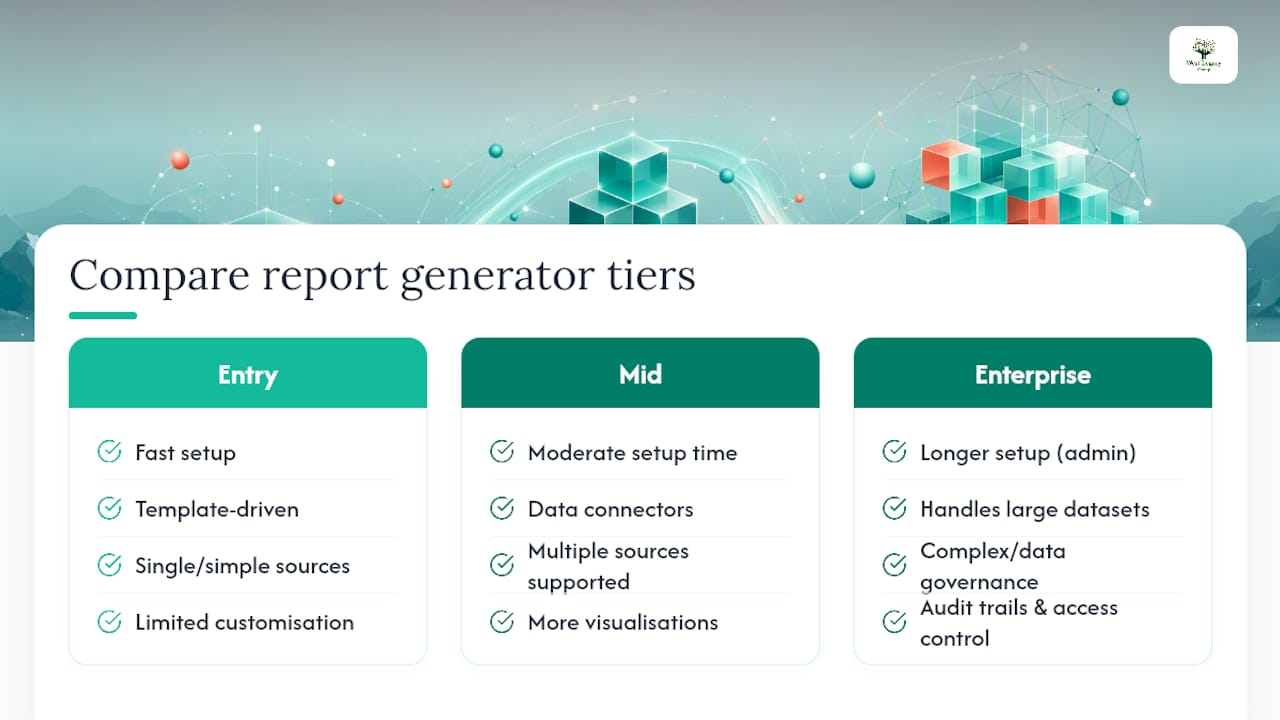
Entry-level, template-driven tools work well for small businesses that need a recurring dashboard or a monthly summary without custom configuration. You pick a template, connect a data source, and the tool fills in the gaps. These are fast to set up but limited in how far you can customise the narrative or the visual style.
Mid-tier platforms with data connectors suit teams running multiple data sources, think ad platforms, a CRM, and website analytics feeding into one report. These typically add scheduling, more visualisation options, and some prompt customisation, at the cost of a steeper learning curve.
Enterprise-grade platforms handle large, complex datasets and offer governance features like audit trails, access controls, and model version tracking. They’re built for organisations where a wrong figure in a board report has real consequences, and they usually require a dedicated administrator to configure properly.
The trade-off across all three tiers is consistent: more customisation and governance means more setup time. A small business generating a weekly marketing summary doesn’t need enterprise audit trails. A finance team publishing quarterly figures to a board absolutely does. Match the tool tier to the stakes of the report, not to whichever platform has the flashiest demo.
Where is AI report generation technology heading?
The next wave of development is less about writing prettier paragraphs and more about trust. Expect provenance features, source citations embedded directly in generated text, confidence scores on individual claims, and version histories, to move from niche add-ons to standard expectations across most platforms.
Conversational interfaces are already reshaping who can build a report. Instead of configuring a dashboard, a marketing coordinator can simply ask a tool “why did conversions drop in March” and get a narrative answer with a supporting chart. That shift moves report generation from a specialist skill to something closer to a conversation, and AI Index data on tooling adoption suggests this pattern is accelerating across business software generally, not just dedicated reporting platforms.
Real-time and streaming reports are also gaining ground over static, scheduled exports. Instead of waiting for a weekly PDF, dashboards increasingly update continuously as new data lands, with the “report” becoming a living view rather than a fixed document.

The governance side is catching up too, driven partly by the same evidence-based scrutiny you see in reports like the UN panel’s safety assessment. Expect more platforms to build in audit logging and model transparency by default rather than as a premium feature, because regulators and enterprise clients are starting to ask for it directly.
None of this removes the need for a human to read the final output before it goes to a client. If anything, as generation gets faster, the review step becomes the only thing separating a useful report from a confidently wrong one.
How should you interpret and use an AI-generated report well?
Read the methodology or data source note before you read the headline numbers. It sounds backwards, but if you don’t know what data fed the report, you can’t judge whether the conclusions actually apply to your situation.
Treat every AI-written narrative sentence as a claim to verify, not a fact to repeat. If a report says “conversions improved due to the new landing page,” check whether the data actually supports causation or just correlation. Models are good at writing confident sentences and not always good at knowing the difference.
Cross-reference big claims against a second source where you can, such as a digital marketing agency in Sydney experienced in using AI insights for marketing optimization. If your generator says traffic dropped 40%, does that match what you see in your own analytics platform? Great copywriting still beats AI content when it comes to explaining why a number matters to your specific business, so use the AI report for the numbers and human judgement for the interpretation.
Finally, keep a record of which version of a report you acted on. Decisions made from a report should be traceable back to the exact file, date, and data snapshot that informed them. That single habit prevents the common mess of two people in the same business arguing over figures from two different report versions.
What matters most when you’re choosing between report types
The industry treats “AI report” as if it’s one thing, and that’s the first mistake worth correcting. Conflating a peer-reviewed safety assessment with a marketing dashboard export leads people to either over-trust a generated report or under-trust a rigorously reviewed one.
What the evidence in this guide actually supports is a simple filter: reach for named-author, methodology-transparent sources when the decision carries real weight, like an investment call or a policy position, and reach for a generator when you need a fast, operational snapshot of your own data. The mistake most small operators make isn’t picking the wrong tool. It’s skipping the verification step because the output looked polished.
Polished and accurate aren’t the same thing, and a well-formatted PDF can still contain a hallucinated statistic. Prioritise checking your data inputs and reviewing the finished draft yourself before you send anything to a client or a board. That single habit, more than any feature comparison, determines whether an AI report earns trust or loses it.
— Christopher
Sources
- AI Index / State of AI Report 2026
- Preliminary report — Independent International Scientific Panel on AI (UN)
- Australian AI Industry Capability report
- AI and employment in Australia — Office of the Chief Economist