

AI visibility optimisation is the practice of structuring your brand’s content, entities and citations so that AI systems like ChatGPT, Perplexity and Google’s AI Overviews mention, cite and recommend you when someone asks a relevant question. The measurable outcome you’re chasing is straightforward: a higher mention rate, a bigger citation share, and more frequent recommendations when your category comes up in an AI-generated answer.
You don’t need to guess at this. Five pillars drive the result, each one something your team can act on this quarter:
- Entity clarity — consistent naming, structured data and a canonical presence across the web
- Citation authority — earning placement on the third-party sources AI models actually cite
- Topical content — answer-first writing that AI systems can lift and quote cleanly
- Technical readiness — making sure AI crawlers can actually reach and render your pages
- Measurement — tracking prompt coverage and citation share so you know what’s working
Key Takeaways
AI visibility optimisation works when entity clarity, citation authority, topical content, technical readiness and measurement run as parallel, continuously tested workstreams rather than a one-off project.
| Point | Details |
|---|---|
| Define your metrics first | Track visibility score, mention rate, citation share and prompt coverage before changing any content. |
| Fix technical access early | Confirm robots.txt allows AI crawlers and pages render without heavy client-side scripts. |
| Earn third-party citations | Target placement on sites AI models already cite in your category rather than only publishing more of your own content. |
| Test before you scale | Run a 20-prompt, 30-day proof of concept to validate citation share movement before committing budget to a tool. |
| Fold it into existing SEO work | West Legacy Group builds AI visibility tracking into ongoing SEO retainers, so audit, quick wins and measurement run as one connected process. |
Table of Contents
- What is AI visibility optimisation and how does it differ from SEO?
- The five pillars: exact changes that influence AI citations
- What should you do this week, this quarter, and this year?
- How do you actually measure AI visibility?
- How do you choose the right AI visibility tool?
- How does West Legacy Group approach AI visibility work?
- What actually moves the needle, and what’s overrated
- Get AI visibility optimisation built into your SEO plan
- Where to read more on measuring and implementing this
- Sources
What is AI visibility optimisation and how does it differ from SEO?
AI visibility optimisation and traditional SEO share a foundation but chase different scoreboards. SEO measures rankings and click-through. AI visibility optimisation measures whether a generative engine mentions your brand at all, and whether it cites you as the source when it does.
Four metrics matter here. Visibility score is a composite measure of how often your brand shows up across a defined set of prompts. Mention rate is the raw percentage of tested prompts where your brand appears, cited or not. Citation share tracks how often you’re the linked source behind an AI answer, versus a competitor. Recommendation rate measures how often the model actively suggests you as the answer to a “which one should I choose” query. Rankscale’s AI visibility framework organises these into a maturity ladder, moving brands from basic visibility through to being the model’s default recommendation.
The mechanics behind this matter too. Most AI answer engines use retrieval-augmented generation, or RAG, where the model pulls in real documents at the moment of answering rather than relying purely on what it learned during training. This is why citations matter so much. If your page isn’t retrievable, structured clearly, or trusted enough to surface in that retrieval step, the model has nothing to ground its answer in, and it will cite someone else instead. Google’s own AI optimisation guidance confirms that core technical and content quality practices remain the foundation for showing up in generative results, not a replacement for them.
AI visibility carries outsized weight in a few specific situations:
- Describe-the-problem queries (“why does my invoice software keep timing out”) where the searcher hasn’t named a brand yet
- SaaS and software categories, where buyers routinely ask an AI to shortlist options before visiting a single website
- Complex or high-consideration purchases, where people ask AI to summarise trade-offs instead of reading ten tabs
The five pillars: exact changes that influence AI citations
Treat these as five parallel workstreams, not a sequence. Each one changes a different lever in how models decide what to mention.
- Entity clarity. Use one consistent business name, address and description everywhere. Add Organisation schema to your homepage and key pages. Claim or correct your Wikidata entry if one exists, and check that your Google Business Profile, LinkedIn page and website all state identical facts about what you do.
- Citation authority. Find out which third-party sites AI models are already citing for your category’s prompts, then pursue placement on those specific sites through editorial outreach, contributed articles or earned mentions in industry roundups. This matters more than publishing more of your own content, because earning placement in widely cited third-party sources changes what a model retrieves, not just what you say about yourself.
- Topical content. Open every important page with a self-contained concise answer that states the core fact plainly, before you explain the nuance. Add three to five FAQ pairs per key page, written as direct questions with direct answers. Build comparison and evaluative content that weighs options honestly, because answer-first openings and FAQ pairs are disproportionately likely to get lifted and quoted. West Legacy Group’s guide to creating content cited by AI search walks through the exact formatting patterns that make a paragraph extractable.
- Technical readiness. Confirm your robots.txt doesn’t block AI crawlers like GPTBot or PerplexityBot. Serve content that renders without heavy client-side JavaScript, since many AI crawlers don’t execute scripts the way a browser does. Keep page load fast and structured data current.
- Measurement. Track prompt coverage (how many of your priority prompts return any mention of you), visibility score and citation share on a recurring cadence, and connect those numbers to actual site sessions and conversions rather than treating them as vanity metrics.
Pro Tip: Run entity clarity and citation authority as parallel projects, not sequential ones. Fixing your schema markup takes an afternoon. Earning a mention on an industry roundup site can take months of outreach, so start that clock immediately while your developer handles the technical fixes.
What should you do this week, this quarter, and this year?
Prioritise by revenue impact first, prompt opportunity second. A page that converts well but never appears in AI answers is a bigger opportunity than a low-value page with the same visibility gap.
This week:
- Rewrite the opening paragraph of your three highest-traffic pages as self-contained, answer-first leads
- Draft three FAQ question-and-answer pairs for your most commercially important page
- Check your robots.txt and confirm major AI crawlers aren’t blocked, using a free checker like Isvisible
This quarter (30 to 90 days):
- Implement Organisation schema across your site’s key pages
- Run a targeted citation outreach campaign to the three or four third-party sites your prompt testing shows AI models already trust in your category
- Map your prompt gaps: the specific questions your buyers ask where you currently get zero mentions
- Add sourced, specific statistics to your core pages, since fact density is one of the more reliable citation triggers
This year (continuous):
- Build genuine topic clusters instead of isolated blog posts, so your site reads as an authority on the whole subject
- Publish original data or original research your industry doesn’t already have
- Schedule a monthly prompt review and a quarterly full audit, treating both as fixed calendar items, not optional extras
If you’re weighing which workstream to fund first, weigh it against two things: how much revenue sits behind the query cluster, and how wide the prompt coverage gap currently is. A high-value cluster with zero visibility beats a low-value cluster you’ve already partly won.
How do you actually measure AI visibility?
Measurement only works if you’re testing the right prompts, at the right frequency, across enough engines to see past model noise.
Start with the metrics themselves. Visibility score gives you a single composite number to track trend over time. Mention rate tells you how often you show up at all. Citation share tells you whether you’re the source being linked when you do show up, versus a rival getting the credit. Prompt coverage measures how many of your priority questions return any result for your brand. Sentiment and recommendation rate go a layer deeper, showing whether the model is neutral about you or actively pushing you as the answer.
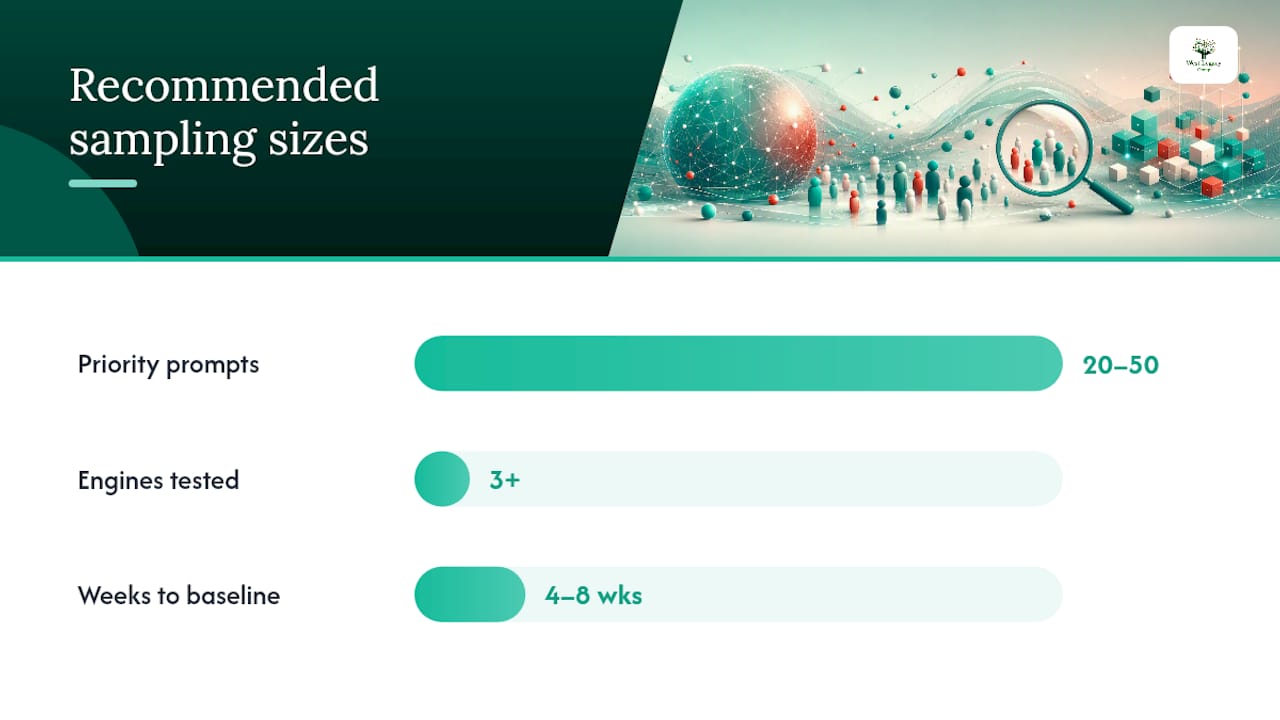
A practical sampling methodology from Cited recommends picking 20 to 50 priority prompts and testing each across three or more engines weekly, for four to eight weeks, before you draw conclusions from a baseline. This matters more than it sounds. AI model outputs shift week to week even without any changes on your end, so a single snapshot tells you almost nothing.
Build this into a repeatable workflow:
- Daily to weekly: run your priority prompt set across engines and log raw mentions
- Monthly: compile a report showing movement in visibility score and citation share
- Quarterly: connect visibility changes to actual sessions and conversions in a shared dashboard, the way platforms described in Adobe’s brand visibility documentation tie prompt-level detail to revenue outcomes
Three pitfalls trip up most teams early. Small sample sizes (testing five prompts and calling it a trend) produce noise, not signal. Model updates can shift results overnight for reasons that have nothing to do with your content. And teams often confuse simple recall, the model knowing your brand exists, with actual citation, the model linking to you as the source.
Pro Tip: Don’t panic over a single week’s dip in mention rate. Model updates happen without notice, and a genuine trend needs at least four weeks of data before it means anything.
How do you choose the right AI visibility tool?
The tool matters less than the capability it gives you, so evaluate against a capability checklist rather than a feature list or a brand name.
- Multi-engine prompt coverage — testing across several AI engines at once, not just one
- Citation tracking — showing you exactly which sources the model pulled from, not just whether you were mentioned
- A prompt database with export — so you can hand raw evidence to a PR team or a content writer, not just a dashboard screenshot
- Analytics integration — connecting visibility changes to your actual site sessions and conversions
On the operational side, prioritise refresh cadence (daily beats monthly for catching model shifts), API access if you want to build your own dashboards, and exportable evidence your content and PR teams can actually use. Contentelli’s readiness guidance points out that platforms vary widely here, and the ones worth paying for let you test a change and see the result, not just admire a static score.
Before committing budget, run a proof of concept. Pick 20 priority prompts, track them for 30 days, and watch whether citation share moves at all. This costs you a month and some analyst time, and it tells you far more than a sales demo. Team sizing follows naturally from what you find: one analyst can usually run this kind of test alone, and only scale up once you’ve proven the workstream earns its keep.
How does West Legacy Group approach AI visibility work?
West Legacy Group has spent more than 20 years building small business websites, running SEO retainers and helping Australian businesses get found, first by search engines and now by AI systems asking the same underlying questions. The process doesn’t change dramatically for AI visibility. It sharpens.
Our approach runs four stages: audit (where are you mentioned today, and where are the gaps), quick wins (schema, answer-first leads, FAQ pairs), citation outreach (targeted placement on the sites AI models already trust in your category), and measurement (a recurring loop, not a one-off report).

A workable audit template needs three things: a prompt set of 20 to 50 questions your buyers actually ask, a sample size large enough to smooth out weekly noise, and a fixed cadence, weekly for testing, monthly for reporting.
Pro Tip: Start your prompt set with the exact questions your sales team hears on calls. Those are the prompts your buyers are typing into AI tools before they ever reach you.
What actually moves the needle, and what’s overrated
Most of the AI visibility advice circulating right now treats it like a checklist you complete once. That’s the wrong mental model. It’s closer to the ongoing discipline of digital PR crossed with technical SEO, and it rewards teams who treat every change as a small experiment rather than a guess dressed up as a strategy.
The most overrated tactic is publishing more content in the hope that volume alone earns citations. It doesn’t. A single well-placed mention on a site an AI model already trusts will outperform a dozen mediocre blog posts on your own domain, because the model is grounding its answer in sources it judges credible, not sources that simply exist. The most underrated lever is measurement discipline itself. Teams love implementing schema and writing FAQs. Far fewer commit to the weekly prompt testing that tells them whether any of it worked.
If you take one thing from this guide, take this: pick your 20 highest-value prompts, test them properly for four weeks before changing anything, then change one thing at a time. Gimmicks get discovered and discounted quickly. Measured, incremental authority building doesn’t.
— Christopher
Get AI visibility optimisation built into your SEO plan
West Legacy Group runs AI visibility work as part of the same SEO retainer that’s helped small businesses get found in traditional search for over 20 years, so you’re not paying twice for two separate specialists chasing the same goal. Where a standalone AI visibility consultant charges for audits in isolation, our team folds entity clarity, citation outreach and prompt monitoring straight into the SEO work already underway on your site.
A typical engagement starts with an audit against your priority prompt set, moves into quick technical wins like schema and answer-first content, then settles into an ongoing retainer that tracks citation share month over month. It’s built for small business owners and marketing teams who need results without hiring an in-house AI visibility specialist. If you’d rather scope your own priorities first, you can build your own SEO plan and add AI visibility tracking as a line item, or head straight to our affordable SEO services page to see what an ongoing retainer looks like. Either way, the next step is simple: request an audit and see where your current mention rate actually sits before you spend another dollar guessing.
Where to read more on measuring and implementing this
- Google’s AI optimisation guide covers crawlability, structured data and Search Console measurement for generative features.
- Rankscale’s AI visibility framework explains the visibility to recommendation maturity ladder in more depth.
- Cited’s measurement methodology details prompt sampling and citation share tracking.
- Isvisible offers a free check of how accessible your site is to major AI crawlers.