

Performance-based SEO works well when you can define a measurable trigger, such as a ranking, lead or sale, and stick to a narrow scope like one product line or service area. It suits businesses with clean analytics and clear KPIs. It backfires when the contract is vague, the KPIs are vanity metrics, or the provider won’t name their tools.
TL;DR:
- Performance-based SEO suits businesses with clear analytics, measurable goals, and predictable KPIs, especially in short sales cycle or ecommerce sectors.
- Common triggers include ranking keywords, growth in organic sessions, verified leads, or revenue, with revenue sharing KPIs generally being more reliable and harder to fake.
- Risks involve black-hat tactics, vanity keywords, vague contract terms, and undisclosed tools, which can lead to penalties or wasted spend.
- Proper contracts should specify measurement tools, proration rules, caps on liabilities, method transparency, and attribution standards to prevent disputes.
- Starting with small, clearly defined pilots that include technical audits and agreed metrics offers a safer way to test performance-based SEO without large upfront commitments.
Table of Contents
- What is performance based SEO and how does it differ from a retainer?
- Pricing models: pay-per-ranking, pay-per-lead, revenue share and hybrids
- When performance-based SEO makes sense
- Risks and red flags in performance-based SEO proposals
- How to vet vendors and write safe performance contracts
- Realistic timelines and cost expectations
- How West Legacy Group approaches performance-based SEO
- Legal and ethical considerations in performance-based SEO agreements
- Author perspective: a pragmatic recommendation
- How West Legacy Group can help you run a safe pilot
- Sources
What is performance based SEO and how does it differ from a retainer?
Performance-based SEO, sometimes called pay-for-results, pay-per-rank, or results-driven SEO, flips the usual payment logic. Instead of paying for hours or activity each month, you pay when a defined outcome happens. That outcome, the “trigger”, is agreed upfront and tied to something measurable.
Common triggers include:
- A keyword reaching a specific position (usually page one, sometimes top three)
- Growth in non-brand organic sessions above an agreed baseline
- A qualified lead, verified by a call tracking system or CRM entry
- Actual revenue, tracked through ecommerce analytics or a shared sales report
Traditional retainers pay for a scope of work: audits, content, technical fixes, link building, delivered monthly regardless of outcome. The agency carries less financial risk; you carry the uncertainty of whether the work produces results. Performance models shift that risk onto the provider, but they also narrow the scope. A provider chasing a ranking trigger has less incentive to fix your site speed or improve your Google Business Profile unless that work directly serves the trigger. Different performance models suit different business types, and the trade-off between risk and scope is the first thing you need to understand before signing anything.
Pricing models: pay-per-ranking, pay-per-lead, revenue share and hybrids
Four structures dominate the performance-based SEO market, and each rewards different behaviour from your provider.
- Pay-per-ranking. You pay only when a specified keyword hits an agreed position, often top three or top ten. It works well when you have a tight, high-intent keyword list. The risk is providers gaming the system by ranking you for low-volume, low-value terms that technically hit the target but bring no traffic.
- Pay-per-lead (CPL). You pay a fixed amount per qualified lead. This depends entirely on how “qualified” is defined. A phone call that hangs up in ten seconds shouldn’t count the same as a booked consultation, so lead definitions need to be locked down before work starts.
- Revenue share or CPA. You pay a percentage of revenue attributed to organic search. This aligns incentives well, but attribution windows and exclusions (returns, existing customers, phone sales not tracked online) can create disputes if they’re not spelled out.
- Hybrid. A reduced monthly retainer plus a performance bonus. This is often the most balanced structure because it covers baseline technical and content work while still rewarding results.
Pro Tip: Push for revenue-related KPIs over pure ranking triggers wherever your analytics allow it. Rankings can move for reasons that have nothing to do with your provider’s work, but a sale attributed through your CRM is much harder to fake.
When performance-based SEO makes sense
This model isn’t a fit for every business, but a few profiles suit it particularly well.
- Local services with a short sales cycle, such as tradies, clinics, or repair shops, where a keyword-to-enquiry link is easy to trace through call tracking.
- Ecommerce stores with clean transaction data, where a sale can be tied back to an organic session without much guesswork.
- Businesses with mature analytics or a CRM already in place, since verifying leads or revenue is impossible without a reliable source of truth.
- Anyone testing the model for the first time, who starts with a small pilot, a single subdirectory, product category, or service page, rather than betting the whole site on an unproven arrangement.
If your business runs on word-of-mouth referrals with almost no digital footprint to measure against, performance-based SEO has little to grab onto. The model rewards businesses that already track outcomes, not businesses hoping SEO will finally give them something to track.
Risks and red flags in performance-based SEO proposals
The upside of paying for results is obvious. The downside is what some providers will do to hit a trigger without doing the real work.
- Black-hat shortcuts. Link schemes, cloaking, and hidden text are explicitly listed as spam behaviours that trigger manual penalties under Google’s policies, and a provider under pressure to hit a monthly trigger has every incentive to use them.
- Vanity keyword chasing. Ranking for a term nobody searches is easy and meaningless. Insist on KPIs tied to traffic value or revenue, not just rank position.
- Contract ambiguity. Vague trigger definitions, no proration rules for keywords that rank one week and drop the next, and hidden caps on how much you’ll actually be charged.
- Provider behaviour to watch. Pressure to install tracking that inflates numbers, or reluctance to name the specific tools they use to measure your results.
The financial risk isn’t just wasted spend. Sudden, large traffic losses are frequently linked to risky link profiles or unresolved technical problems, the kind of damage that takes far longer to undo than it took to create. A cheap short-term win that trips a Google penalty can cost you months of recovery.
How to vet vendors and write safe performance contracts
A performance contract is only as good as its definitions. Before you sign anything, work through these steps.
- Agree on a baseline and a named measurement tool. Specify the exact rank tracker, the GA4 property, or the call tracking vendor that will decide whether a trigger has been hit. Without a single source of truth, disputes are inevitable.
- Document proration rules. What happens if a keyword ranks in position three for two weeks, then slips to position twelve? Get this in writing before it happens, not after.
- Set caps on downside exposure. Agree a maximum monthly liability so a sudden spike in “qualified leads” doesn’t blow out your budget unexpectedly.
- Require transparency on methods. You should be allowed to audit backlinks, content, and technical changes at any point, and the contract should explicitly prohibit black-hat tactics.
- Lock in attribution governance. Agree on CRM integration, UTM tagging conventions, and attribution windows before the first invoice is due.
Pro Tip: Ask for the exact GA4 property ID or rank tracker dashboard you’ll both be viewing, in writing, before you sign. If a provider hesitates to share that level of detail, treat it as a warning sign. Reviewing your SEO contract properly before you sign it is worth the hour it takes.
Realistic timelines and cost expectations
Performance-based SEO doesn’t move faster than any other kind of SEO, and providers who promise otherwise are usually cutting corners.
- 0 to 3 months: Technical fixes and quick-win content changes may show early movement on easy keywords.
- 3 to 6 months: Broader ranking gains and measurable traffic increases typically start to show, assuming the foundational work was solid.
- 6 to 12+ months: Competitive keywords and genuine revenue impact usually need this longer runway, particularly in crowded local or ecommerce categories.
Onboarding and audit fees are common even in “performance” deals, so treat any offer of zero upfront cost with scepticism. Per-lead or per-ranking fees often look steeper than a retainer’s line-item cost, but that’s the price of shifting risk onto the provider rather than carrying it yourself. Understanding how long SEO genuinely takes before you commit to a pilot will save you from judging a six-month strategy on a six-week scorecard. For a fair pilot, keep the scope small, agree on measurement upfront, and set clear rules for when and how the arrangement scales.
How West Legacy Group approaches performance-based SEO
West Legacy Group builds performance and hybrid arrangements around white-hat, sustainable methods and transparent timelines, never shortcuts that risk a penalty down the track. Our approach to sustainable SEO favours durable gains over quick wins that don’t last.
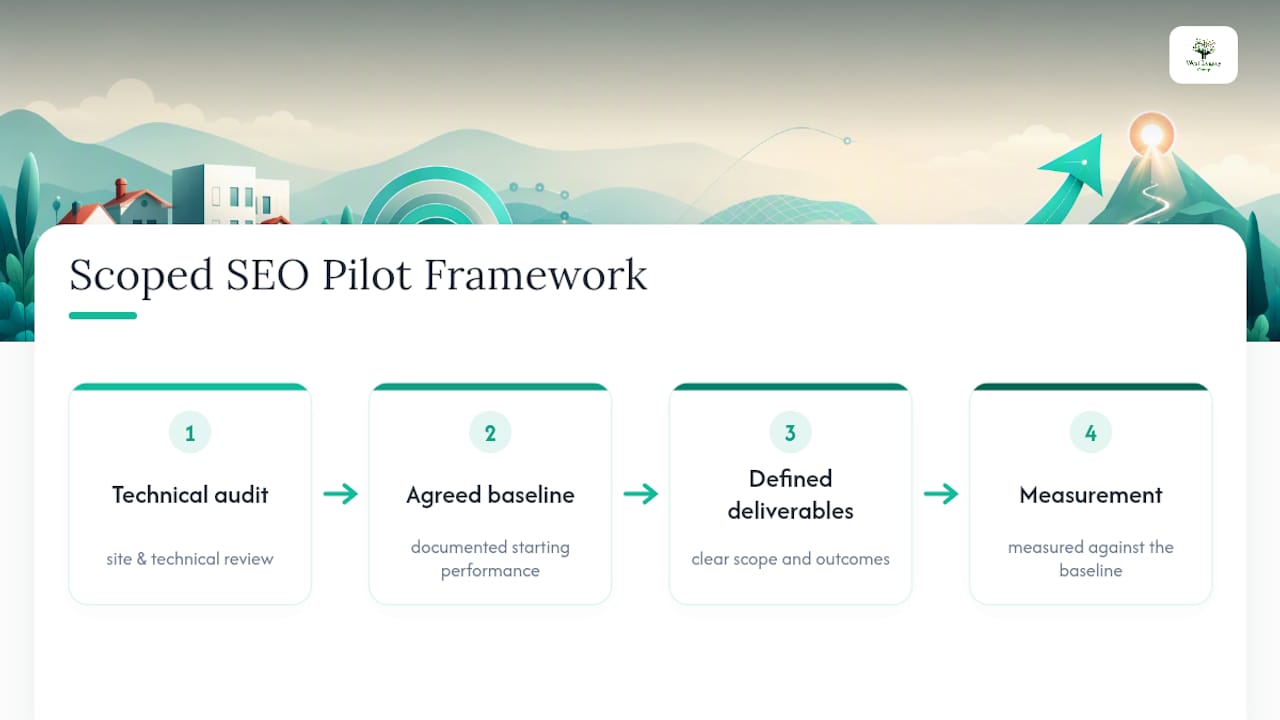
For small businesses testing the model, we offer scoped pilots that include a technical audit, an agreed baseline, and clearly defined deliverables, so you know exactly what you’re paying for and how it will be measured. These pilots sit alongside our affordable subscription SEO plans, built for businesses that want professional SEO without committing to an oversized retainer from day one.
Legal and ethical considerations in performance-based SEO agreements
A performance contract is a commercial agreement, and like any commercial agreement, ambiguity favours whoever wrote it. Most disputes in this space don’t come from bad faith. They come from triggers that were never defined precisely enough to survive a disagreement six months later.
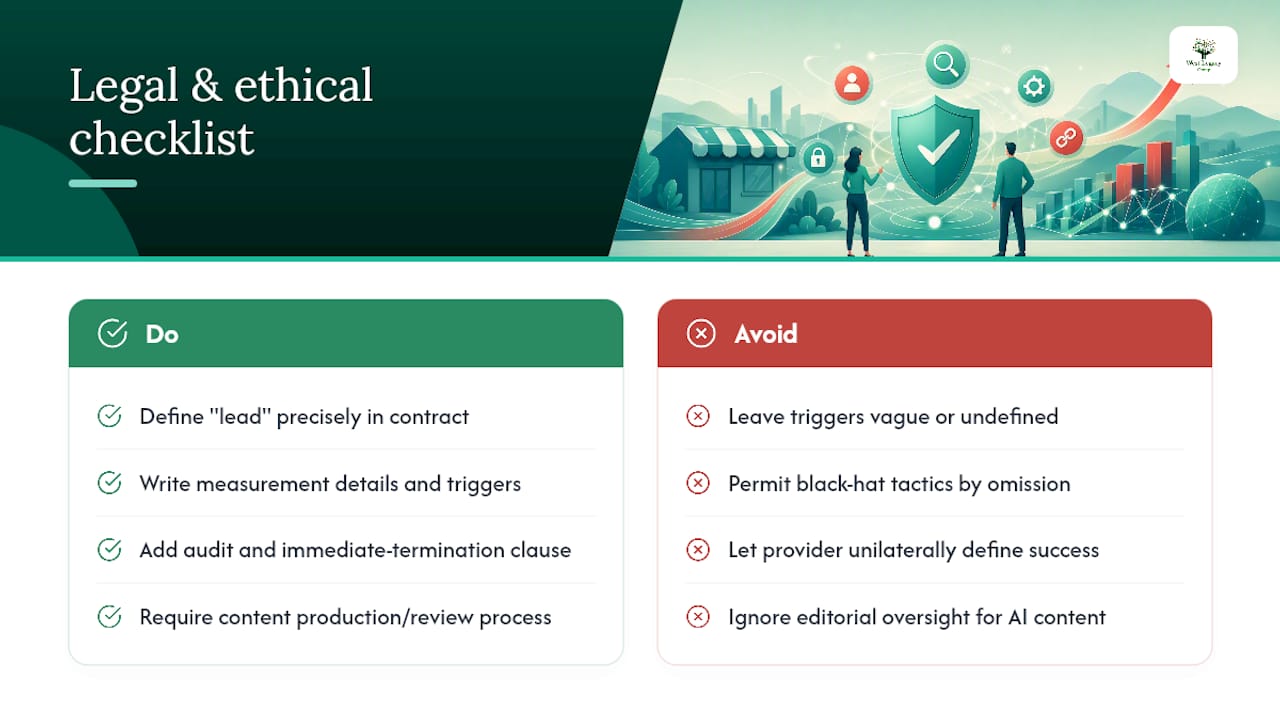
Get specific about what counts as a “lead”. Does a missed call qualify? Does an enquiry from an existing customer count toward a new-business bonus? These questions feel pedantic when you’re excited to sign, but they’re exactly where disputes happen later.
Ethically, the bigger issue is what a provider might do under pressure to hit a trigger. Buying links, stuffing hidden text, or cloaking content to manipulate rankings all breach Google’s spam policies and can trigger a manual penalty that damages your site for months. If your contract doesn’t explicitly prohibit these tactics, you’re implicitly permitting them. Add a clause that lets you audit the work at any time and terminate immediately if black-hat methods are found, regardless of how well the trigger metrics are performing.
There’s also a fairness dimension worth naming plainly: a provider who insists on defining “success” without your input, or who won’t put measurement details in writing, isn’t offering you a partnership. They’re offering you a bet where they set the odds. AI-assisted content production is increasingly common in performance deals because it lowers the provider’s cost per page, but scaled AI content needs editorial oversight to avoid thin, low-value pages that can hurt more than help. Ask directly how content is produced and reviewed before you agree to anything.
Author perspective: a pragmatic recommendation
If you’re weighing this model, start small. Pilot performance-based SEO in one subdirectory or product line, not your whole site, and choose non-brand conversions as your KPI wherever your analytics support it. Rankings are easy to manipulate; a genuine sale tracked through your CRM is not.
Before you sign anything, request a named measurement tool, written proration rules, and a 90-day review point. If a provider won’t commit to any of those three things in writing, that tells you more than their pitch deck ever will.
— Christopher
How West Legacy Group can help you run a safe pilot
There are practical alternatives to a high-risk performance gamble or an oversized retainer you can’t yet justify. We build scoped, affordable pilots for small businesses that want to test results-driven SEO without locking into unclear terms or paying for work you can’t verify.
Pilots often start with a technical audit and an agreed baseline, so you know what “before” looks like before any work begins. From there, we scope deliverables against your structured project framework, whether that’s local SEO for a service business or ecommerce SEO for a Shopify store, and report against the measurement tools we agree on together, not numbers we invent after the fact. If your site needs work before a pilot can even start, our small business website packages cover that groundwork too.
Ready to see what a scoped pilot looks like for your business? Get in touch for a quote, or start with our flexible SEO plan builder to see pricing that fits a small business budget.
Sources
For deeper technical grounding, read Google’s own spam policies before signing any performance contract, along with Google’s guidance on when SEO is necessary. For cost benchmarking, Chrome Cactus Studio’s analysis of SEO pricing structures offers useful context on how performance and retainer costs compare.
- Google Search Central — Spam policies
- Ahrefs — Biggest traffic losers: why sites lose organic traffic
- Single Grain — 7 performance-based SEO services that drive real revenue