

Most small and medium sites start showing measurable SEO signals within 3 to 6 months, with revenue and stable rankings commonly arriving between 6 and 12 months. Two things shift that window: how much trust your domain already carries and how fast your team implements fixes. Your first move is simple. Commission a technical audit and confirm your analytics tracking works before you judge anything else.
TL;DR:
- Trust and implementation speed significantly influence whether SEO results appear closer to 3 months or extend beyond a year.
- Technical fixes and proper analytics validation in the first month are crucial to prevent delays in rankings and traffic growth later.
- Visible ranking improvements for long-tail keywords typically emerge around months 4 to 6, with organic traffic stabilizing after 6 to 12 months.
- Consistent backlink building, content depth, and fast technical responses can accelerate results, especially in competitive industries.
- Marketing claims promising rankings within 30 days are unrealistic; genuine SEO progress usually takes at least 3 to 6 months for signals and 6 to 12 months for revenue impact.
Table of Contents
- What does the SEO timeline look like month by month?
- What factors change how fast SEO works?
- Which KPIs tell you SEO is actually working?
- How can you speed up SEO results without cutting corners?
- What are the biggest SEO timeline misconceptions?
- How would West Legacy Group plan your first 12 months?
- Why most SEO advice sets the wrong expectations
- Get a realistic SEO plan built around your business
- Sources
What does the SEO timeline look like month by month?
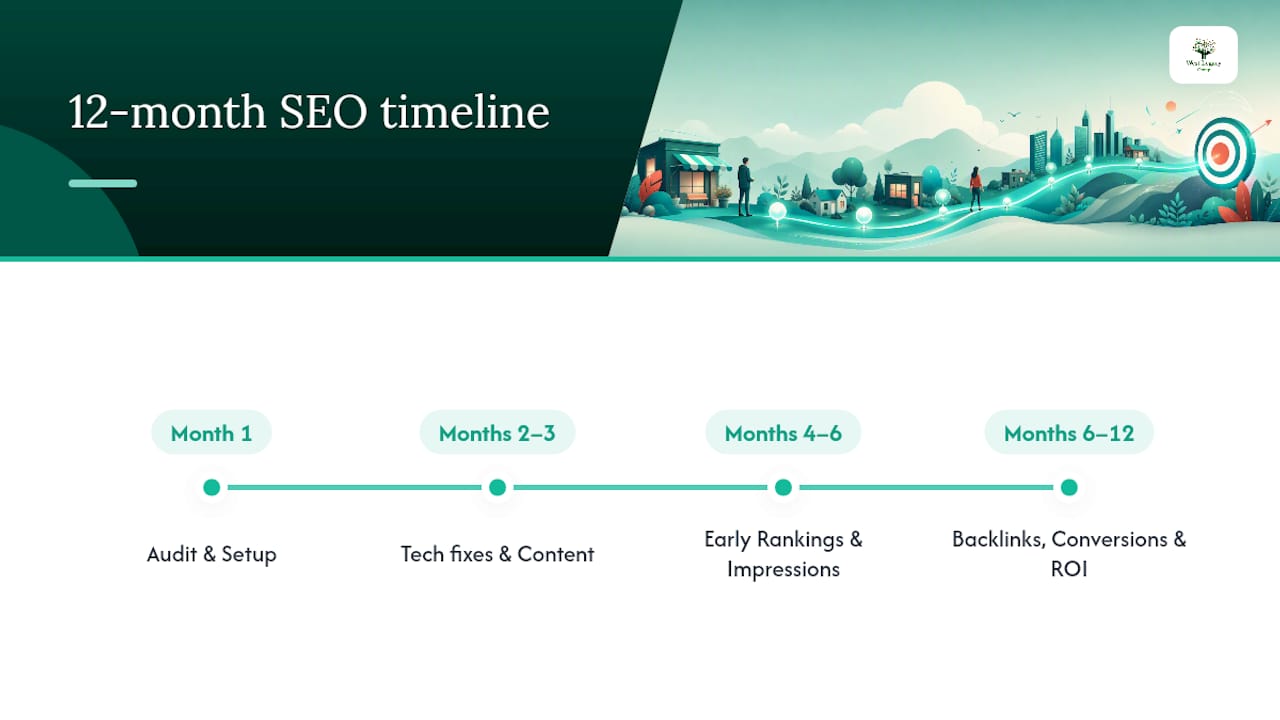
Every SEO campaign follows a rhythm, even when it doesn’t feel like it from the inside. The early months are quiet, almost frustratingly so. Then things move. Understanding what happens at each stage stops you from panicking in month two and getting complacent in month eight.
Month 1: audit, foundation, and the priority list
Nothing gets published in the first month if it’s done properly, and that’s by design. This is where a technical audit finds the crawl errors, redirect chains, broken canonicals, and JavaScript rendering issues that would otherwise sabotage every page you publish afterwards. Front-loading this work is the single biggest lever for avoiding wasted content budget later, because Google can’t rank a page it can’t properly crawl.
You should also be validating your analytics setup this month. If Google Search Console isn’t verified, or your Google Analytics goals aren’t firing correctly, every number you look at for the next six months will be wrong. This is also when you build the priority list: which pages need fixing first, which keywords matter commercially, and which quick wins exist.
Months 2 to 3: technical fixes and first content
This is where the audit becomes action. Developers implement the fixes, on-page elements get optimised (title tags, headers, internal links), and your first priority pages go live. According to Shopify’s breakdown of the SEO timeline, month two typically covers technical optimisation and content creation, with month three shifting into on-page work and publishing.
You’ll usually see your first indexing activity here. Pages start appearing in Search Console’s coverage reports, and impressions begin to tick up from zero, even if clicks are still minimal. This is a signal worth checking, not celebrating.
Months 4 to 6: early ranking movement
Long-tail keywords and low-competition terms start moving. You might see a page jump from position 40 to position 18 for a specific phrase, nothing dramatic, but real. Impressions climb more noticeably, and you’ll start seeing clicks trickle in for terms you didn’t even know you were ranking for.
Search Engine Land’s research points to leading indicators, like impressions and crawl signals, appearing within 60 to 90 days for well-executed campaigns. By month six, many sites begin to see measurable results such as consistent impressions growth, ranking terms in the top 20, and early organic sessions that were not present before.
Months 6 to 9: backlink momentum and conversion lifts
If outreach started a few months in, this is when it begins to pay off. Backlinks take time to influence rankings, and within six to nine months you may observe the compounding effect of earlier link-building efforts alongside your content. Rankings that were volatile in month four start to stabilise. You’ll also usually see your first meaningful conversion lift, whether that’s form submissions, phone calls, or eCommerce sales directly attributable to organic traffic.
This stretch is where you can start comparing organic sessions against your baseline with genuine confidence, not just hope.
Months 9 to 12: compounding authority and clearer ROI
By now, content published in month two or three has had time to earn links, get indexed properly, and climb rankings through normal algorithmic re-evaluation. Mangools’ analysis notes that most sites see early movement in the 3 to 6 month window, but new sites or highly competitive keywords often need closer to a year for consistent traffic gains. This is that year playing out.
Revenue attribution becomes clearer here. You can look at year-on-year or quarter-on-quarter organic revenue and see a trend line, not just noise. This is typically when a return on investment becomes obvious enough to justify scaling the budget rather than defending it.
12 months and beyond: scaling and new opportunity
Once the foundational work is done and stable, the campaign shifts from fixing to expanding. New keyword clusters, content hubs around adjacent topics, and deeper competitor gap analysis all become viable. Google’s own search algorithm history shows how frequently ranking factors get re-evaluated, which is part of why ongoing monitoring matters even after you’ve hit your targets.
- Month 1 — Audit, tracking validation, and priority list.
- Months 2 to 3 — Technical fixes, on-page work, first priority pages published.
- Months 4 to 6 — Long-tail ranking movement, rising impressions and clicks.
- Months 6 to 9 — Backlink momentum, stabilising rankings, first conversion lifts.
- Months 9 to 12 — Compounding authority, clear ROI, scaling decisions.
- 12+ months — New keyword clusters, content hubs, ongoing technical audits.
Pro Tip: Screenshot your Search Console coverage report and top queries in month one. It’s the only reliable baseline you’ll have, and without it, month six’s “improvement” is just a guess.
What factors change how fast SEO works?
No two sites move through this timeline at the same speed, and pretending otherwise sets everyone up for disappointment. Here’s what actually determines whether you land at the fast or slow end of the range.
- Domain age and trust history. A domain with a decade of clean history and existing backlinks starts with more credibility than one registered last month, and it shows up in how quickly new pages get crawled and ranked.
- Competitive intensity. Ranking a local plumber for “emergency plumber Bendigo” is a different fight to ranking a national retailer for “running shoes”. Keyword difficulty directly extends or shortens your timeline.
- Technical health. Crawlability issues, slow load times, and JavaScript-heavy pages that don’t render properly for search engines can quietly stall an entire campaign, no matter how good the content is.
- Content depth and topical authority. A handful of thin pages won’t compete with a site that’s built genuine coverage of a topic. Depth earns trust faster than volume.
- Backlink profile and outreach capability. Sites with the relationships or budget to earn quality links consistently tend to see ranking gains stabilise sooner than sites relying purely on on-page work.
- Resourcing and implementation speed. How quickly your developers apply fixes is one of the clearest determinants of outcome that practitioners and Google’s own guidance agree on. A fix that sits in a developer’s backlog for eight weeks costs you eight weeks of results, every time.
Fast-moving industries also need more frequent check-ins than a “set and forget” annual review. Shopify’s guidance suggests an audit cadence of every 3 to 6 months for competitive sectors, catching new technical issues or competitor moves before they erode the gains you’ve already made. If you’re running an eCommerce store on Shopify or WooCommerce, this cadence matters even more, because product pages, collection structures, and seasonal changes create technical debt fast. Our guide to growing organic traffic for eCommerce stores covers this in more detail.
Which KPIs tell you SEO is actually working?
You don’t need to wait for a sales spike to know whether a campaign is on track. Search Console and analytics give you leading indicators long before revenue moves, and knowing what to check each month keeps everyone honest.
- Indexing and coverage. Confirm your sitemap is submitted, check the coverage report for crawl errors, and make sure pages you’ve published are actually indexed. Google’s own guidance on helpful content recommends this as a first-line check before looking at anything else.
- Impressions and queries vs baseline. In months 1 to 3, look for impressions climbing from your baseline, even if clicks haven’t followed yet. This is your earliest genuine signal.
- Clicks and organic sessions. From month 3 onwards, clicks should start following impressions. By month six, organic sessions should show a visible upward trend against your starting point.
- Conversion metrics and revenue attribution. Months 6 to 12 are when conversion data becomes reliable enough to attribute to organic traffic specifically, assuming your tracking was validated back in month one.
- Tracking accuracy. Double check goal configurations, UTM parameters on any paid campaigns running alongside SEO, and that Search Console and Analytics are linked properly. A surprising number of “SEO isn’t working” complaints trace back to broken tracking, not broken strategy.
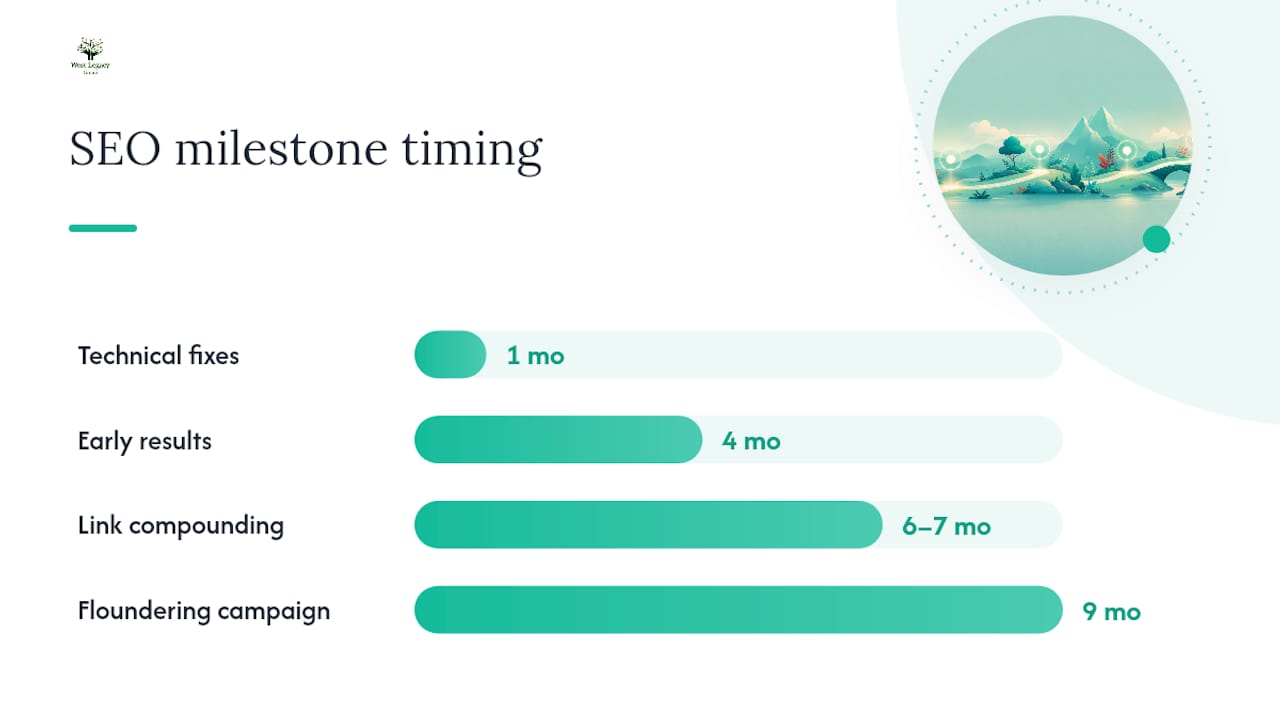
Measurable results from SEO typically begin appearing between 3 and 6 months, with meaningful revenue impact usually taking 6 to 12 months, and highly competitive industries sometimes stretching to 12 to 18 months.
If you’re seeing zero movement in impressions after technical fixes have gone live, or coverage errors that haven’t budged in two audit cycles, that’s your cue to check the work, not just wait longer. Our piece on tracking website leads for small business walks through setting up attribution properly from the start.
How can you speed up SEO results without cutting corners?
You can’t skip the timeline, but you can absolutely waste less of it. The difference between a campaign that shows results in month four and one still floundering in month nine usually comes down to sequencing.
- Fix crawl and index issues in month one. This is non-negotiable. Redirect chains, canonical errors, and JS rendering problems commonly multiply time-to-value if left unresolved, and no amount of good content fixes a page Google can’t properly read.
- Apply the 80/20 rule to page priority. Focus effort on the small set of pages or keywords most likely to drive conversions, rather than spreading thin across everything at once. This matters most when budgets or developer time are limited.
- Fix internal linking and canonicalisation on priority pages first. A well-linked page with a clean canonical tag gets crawled and understood faster than an orphaned one buried three clicks deep.
- Publish hub pages with supporting long-tail content around them. This builds topical depth faster than scattering unrelated blog posts, and it gives search engines a clear structure to follow.
- Run simple outreach for early backlinks. You don’t need a massive PR budget. A genuinely useful data page, tool, or local resource is often enough to earn a handful of relevant links early, which compounds by month six or seven.
- Set up developer sprints, tracking handoffs, and a change log. Every fix, publish date, and technical change should be logged with a timestamp. When rankings move in month five, you want to know exactly what caused it.
Our technical SEO checklist for 2026 goes deeper into the specific fixes that tend to matter most in month one. If you’re weighing up how conversion tracking ties into all this, Conversational AI’s guide to live chat and conversion is worth a look, since faster response times on a newly ranking page can noticeably lift the conversion rate you’re trying to measure.
Pro Tip: Keep a simple shared document logging every technical fix and content publish date alongside your Search Console screenshots. When a client or manager asks “why did rankings jump in July?”, you’ll have the answer in seconds instead of guessing.
What are the biggest SEO timeline misconceptions?
The myth that causes the most damage is the promise of big wins within 30 days. If someone guarantees first-page rankings in a month, that’s a red flag, not a selling point. Genuine SEO works through crawling, indexing, and algorithmic trust building, none of which can be rushed regardless of budget.
Watch for these warning signs that a campaign is off-track or being misreported:
- Tracking problems that never get resolved. If nobody can explain why your analytics numbers don’t match Search Console, that’s a problem worth escalating immediately.
- Unchanged coverage reports after months of “work.” If crawl errors from month one are still sitting there in month four, fixes aren’t being implemented, regardless of what the report says.
- Flat impressions despite reported changes. Impressions should move even before clicks do. If they’re not moving at all, something upstream is broken.
- No access to your own Search Console or analytics. You should always have direct access to your own data. If an agency won’t grant it, that’s worth questioning straight away.
- Persistent implementation delays. If technical fixes agreed on in month one still haven’t shipped by month three, the timeline resets, and someone needs to explain why.
Some ranking volatility after major changes is completely normal. Google re-evaluates pages as part of ongoing algorithm updates, and a temporary dip after a big technical change often precedes a stronger, more stable position. Don’t mistake short-term noise for failure, but don’t excuse genuine stagnation as “just volatility” either.
How would West Legacy Group plan your first 12 months?
A realistic 90-day roadmap starts with the same sequence every time: audit, fix, publish, measure. In the first 30 days, we run a full technical audit, validate your analytics and Search Console setup, and build a prioritised fix list based on what’s actually stopping pages from ranking, not a generic checklist. Days 31 to 60 cover implementation: technical fixes, on-page optimisation, and the first priority pages going live. Days 61 to 90 focus on measurement and refinement, using early impressions and query data to adjust what comes next.
By months 4 to 6, clients typically see their first long-tail ranking movement and a visible lift in impressions. By months 6 to 12, the goal shifts to conversion lifts and clearer reporting on what organic traffic is actually delivering.
- Month 1 to 3 deliverables: technical audit report, tracking validation, priority fix list, first content published.
- Month 4 to 6 deliverables: ranking movement report, expanded content coverage, backlink outreach underway.
- Month 6 to 12 deliverables: conversion and revenue attribution reporting. Scaling recommendations for new keyword clusters.
Our own 90-day audit and remediation checklist for eCommerce stores walks through exactly how this sequencing works for online retailers specifically. [author_bio] [brand_signal] [internal_data]
Why most SEO advice sets the wrong expectations
The biggest failure in most SEO advice isn’t the strategy. It’s the timeline dishonesty. Agencies that promise page-one rankings in 30 days aren’t lying about tactics, they’re lying about physics: Google’s own re-evaluation cycles simply don’t move that fast, and pretending otherwise sets small business owners up to abandon a campaign right before it would have worked.
What the evidence actually supports is a 3 to 6 month window for the first genuine signals, and 6 to 12 months before revenue reflects the work. That’s not a disappointing number. It’s a planning number. The businesses that do best treat month one as audit and foundation, not launch day, and they check impressions and coverage reports themselves rather than waiting for a monthly PDF to tell them what happened.
If there’s one thing owners should prioritise above everything else, it’s this: verify your own tracking before you judge anyone’s results, including your own team’s.
— Christopher
Get a realistic SEO plan built around your business
We offer a practical alternative to a traditional agency retainer with no clear deliverables. Instead of vague monthly reports, clients can receive a technical audit up front, a prioritised fix list, and a plan built around their actual site history and budget rather than a one-size-fits-all package.
We offer this work as standalone engagements or ongoing packages, including small business website builds that fix technical issues at the source, and structured SEO plans built around the LEGACY Framework. An initial engagement typically starts with audit and tracking validation, so clients understand issues before investing in content or outreach. If you’d rather scope your own priorities first, you can build your own SEO plan and see what a realistic timeline looks like for your specific site.
Sources
- How long does SEO take to work? SEO timeline & results explained
- How long does SEO take? Month-by-month results timeline (Shopify)
- How long does SEO take? (Mangools)