
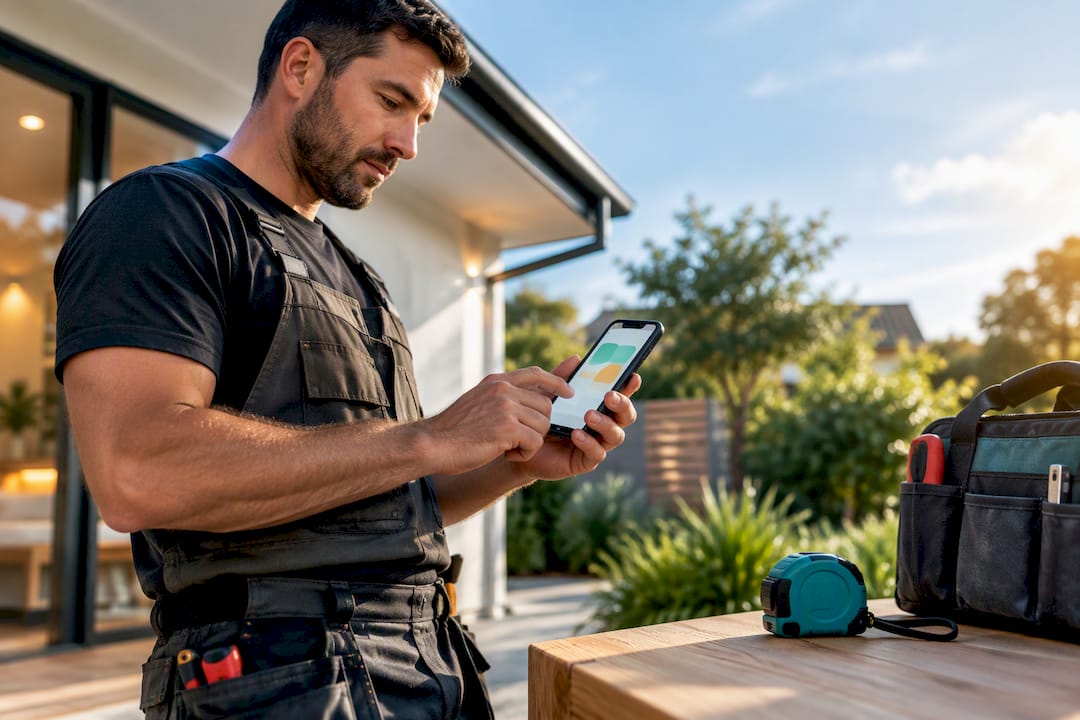
A tradie website design must do three things: load fast on a phone, make calling or quoting a single tap, and pair with a claimed Google Business Profile so local searches find you first. Everything else is detail. Get those right and the site earns its keep; get them wrong and you’re paying hosting fees for a digital business card nobody uses. The checklist and buyer’s guide below cover exactly what to demand before you sign anything.
TL;DR:
- Most trades rely on fast-loading websites with click-to-call buttons and minimal quote form fields to convert visitors within seconds on mobile devices.
- Essential pages include service-specific and suburb-targeted pages, a portfolio of real projects, and clear trust signals like licenses and years trading, all optimized for local SEO.
- Contracts should specify ownership of all content, images, and design, with clear timelines of four to six weeks and full CMS access at launch; vague promises and early exit costs are red flags.
- Websites must meet Core Web Vitals standards for loading speed and responsiveness, with mobile-first design and structured data to improve local search rankings regularly tested post-launch.
- Reliable backing includes verified Google Business Profiles with real project photos, accurate hours, and local schema markup, combined with ongoing support for SEO and profile management for maximum lead generation.
Table of Contents
- What a lead-focused tradie website actually does
- Checklist: what to include in a tradie website package
- What to expect during the build: process and timeline
- Costs, ownership and contract points to check
- Technical performance and local search essentials to demand
- Portfolio, proof and how West Legacy Group approaches tradie websites
- How to choose between designers and packages
- Content strategy tailored for tradie services
- Accessibility considerations for tradie websites
- Publisher perspective: why we favour conversion-first tradie websites
- How West Legacy Group can help
- Sources
- FAQ
What a lead-focused tradie website actually does
A tradie website has one job: turn a stranger’s Google search into a phone call, a quote request, or a WhatsApp message. Everything on the page should push toward one of those three outcomes, because a visitor who leaves without contacting you is a lost job, not just a bounced page.
The typical journey starts with a search like “emergency plumber Bendigo” or a tap on your Google Business Profile listing. From there, most visitors check three things fast: do you cover their suburb, have you done this job before, and can they reach you in the next ten seconds. If any of those takes more than a glance to confirm, they’re back on Google looking at your competitor.
That’s why mobile-first design isn’t optional for trades. Most enquiries happen on a phone, often from someone standing in a flooded laundry or staring at a tripped switchboard, so the site needs:
- A click-to-call button visible without scrolling on every page
- A quote form with no more than four fields (name, phone, suburb, job type)
- Trust signals above the fold: licence number, years trading, service area
- Photos of real jobs, not stock images of generic tool belts
A conversion-focused local SEO approach ties this structure to the service and suburb pages that actually get found in search.
Checklist: what to include in a tradie website package
Before you brief a designer or compare quotes, paste this list into your notes. It covers what should exist on the site and what should sit behind it.
Pages and features to require:
- A homepage that states your trade, service area, and a phone number in the first screen
- Individual service pages (one for “hot water repairs,” another for “blocked drains,” rather than one page trying to cover everything)
- Service × suburb pages if you cover multiple towns or regions, so “electrician Castlemaine” and “electrician Bendigo” both rank
- A portfolio or gallery page with real project photos
- A contact page with click-to-call, a short form, and your physical or postal address
- A privacy policy page and visible ABN, which Australian Consumer Law expects for business registration transparency
- LocalBusiness schema markup so Google can pull your services, hours, and service area into rich results
Integrations to confirm before signing:
- A connected and verified Google Business Profile, not just a mention of one
- Analytics set up from day one, so you can see which pages actually generate calls
- Reliable hosting with automatic backups, plus CMS access so you’re not locked out of your own site
Pro Tip: Ask for raw, unedited copies of every photo used on your site before you pay the final invoice. Some designers only hand over compressed web versions, which leaves you stuck if you switch providers later.
What to expect during the build: process and timeline
A straightforward tradie site should follow a predictable rhythm, and any quote that skips stages or promises a live site in 48 hours deserves a harder look.
Expect four stages: discovery (a call or brief covering your services, service area, and competitors), design (mockups of the homepage and one service page for approval), build (the full site, forms, and integrations), and launch (testing on real phones, then going live with redirects if you had an old site). For a small trade business, four to six weeks from signed brief to launch is realistic. Rushed three-day builds usually mean templated pages with your logo dropped in.
At handover, you should receive:
- Full CMS login credentials, not just viewer access
- Analytics access (Google Analytics or equivalent) already connected
- Original image files, not just what’s published on the live pages
- A short launch checklist confirming forms work, tracking fires, and mobile pages load correctly
Your side of the bargain: have your ABN, licence numbers, insurance details, real job photos, and a handful of customer testimonials ready before the discovery call. The faster you supply these, the faster the build moves.
Costs, ownership and contract points to check
Small trade business websites typically run from a few thousand dollars for a template-based build to significantly more for a fully custom, multi-page site with suburb targeting and ongoing SEO support. A detailed breakdown of Australian small business website costs is worth reading before you request quotes, since price swings depend heavily on how many service pages you need and whether SEO is bundled in.
Ongoing costs to budget for beyond the build:
- Hosting and domain renewal, usually billed annually
- Security updates and backups, which some hosts include and others charge extra for
- Any local SEO or Google Business Profile management retainer
- Content updates if you add new services or locations later
Before signing, confirm in writing who owns the final design, the written content, and the photos. Some agencies retain rights to templates or lock content behind proprietary platforms, which makes switching providers painful later. The ACCC’s guidance on small business rights is clear that contract terms shouldn’t be unfairly weighted against you, and that deliverables need to match what was promised in the brief. Read the cancellation clause specifically. If leaving early costs more than the site is worth, that’s a red flag worth raising before you sign.
Technical performance and local search essentials to demand
Google measures three Core Web Vitals that directly affect whether your site ranks and whether visitors stick around: Largest Contentful Paint (LCP) under 2.5 seconds, Interaction to Next Paint (INP) under 200 milliseconds, and Cumulative Layout Shift (CLS) under 0.1. A slow-loading hero image or a form button that jumps around as the page loads can reduce your rankings and enquiries.
Why these numbers matter: a homepage that takes four seconds to load on a job site’s patchy 4G connection loses the visitor before they’ve seen your phone number. Optimising the hero image, keeping JavaScript lightweight, and locking layout dimensions before assets load are the three practical fixes.
Google uses mobile-first indexing, meaning it indexes your mobile page, not your desktop one. Any designer who builds desktop first and “shrinks it down” for mobile is working backwards.
For local search, your Google Business Profile should include:
- Full service list matching your website’s service pages
- Real project photos, updated regularly
- Accurate opening hours and service area boundaries
- Structured data on your site listing address, phone, and LocalBusiness schema fields like priceRange and openingHoursSpecification
Check performance after launch using the Core Web Vitals report in Search Console, which flags exactly which pages are dragging on LCP, INP, or CLS.
Portfolio, proof and how West Legacy Group approaches tradie websites
A portfolio worth trusting shows the problem, the approach, and the result, not just a screenshot of a finished homepage. Ask any prospective designer for a case study that explains what the client’s old site was failing to do, what changed, and what happened to enquiries afterwards.
Trust assets to expect on a legitimate proof page:
- Client testimonials naming the trade and location
- Before-and-after photos of the actual website, not stock mockups
- Documented outcomes such as call volume or quote form submissions where the designer tracked them
An independently owned website also matters longer term. Choice’s guidance on finding a tradie points out that a site you own reduces dependence on lead platforms and their fees. West Legacy Group’s small business website packages are built around that same principle: an asset the tradie controls, not a listing rented from someone else’s platform.
How to choose between designers and packages
Comparing quotes gets easier with a fixed set of questions, because most proposals hide their weaknesses in vague language rather than outright lies.
Ask every designer:
- Can I see two examples in my exact trade, not just “similar” industries?
- What happens to my Core Web Vitals scores after launch, and how do you test them?
- Who owns the final design, content, and photos once I’ve paid?
- What’s included in ongoing support, and what costs extra?
- How long is the contract lock-in, and what’s the exit process?
- Will you set up or audit my Google Business Profile as part of the build?
- What’s the realistic timeline from brief to launch?
- Can you show me the CMS I’ll have access to before I sign?
Pro Tip: Score each proposal out of 10 on price transparency, portfolio relevance, and ownership clarity, then average the three. A proposal that scores well on price but poorly on ownership is usually cheap for a reason.
Red flags include vague “SEO included” claims with no specifics, contracts with no clear end date, and designers who won’t show live examples of similar trade websites they’ve built — for practical guidance on spotting such issues, see How to avoid SEO scams: a guide for businesses.
Content strategy tailored for tradie services
Generic “About Us” copy doesn’t rank and doesn’t convert. Each service page needs to answer the specific question a searcher typed: what the job involves, what it costs to have it looked at, and how fast you can turn up. A blocked drain page should mention common causes, typical response times, and whether you charge a call-out fee, because that’s what someone standing over a backed-up sink actually wants to know.
FAQs belong on every service page, not just a single generic FAQ page buried in the footer. Questions like “do you charge for quotes” or “are you licensed for gas work” answer objections before they become a reason not to call. They also tend to match the exact phrasing people type into Google, which helps the page surface in search.
Keep service descriptions specific to the suburb you’re targeting where it’s genuinely relevant. Rather than one page trying to cover ten towns, separate service × suburb pages let you mention local landmarks or common local issues, like older homes in a particular area needing switchboard upgrades. This is the same structure that underpins effective local SEO for trades, and it works because it matches how people actually search rather than how a business owner might describe their own operation.
Accessibility considerations for tradie websites
A site that’s hard to use for someone with low vision, a motor impairment, or a slow connection is losing enquiries you’ll never know about, because that visitor simply leaves without a trace in your analytics.
Practical fixes matter more than compliance jargon here. Use text with enough contrast against background colours, particularly on click-to-call buttons where low contrast on a bright day outdoors can make a button invisible on a tradie’s own ute-mounted tablet. Keep font sizes readable without zooming, since many visitors are checking your site one-handed on a job site. Make sure forms can be completed using a keyboard alone, and that every image has descriptive alt text, both for screen reader users and because it feeds into how Google understands your images.
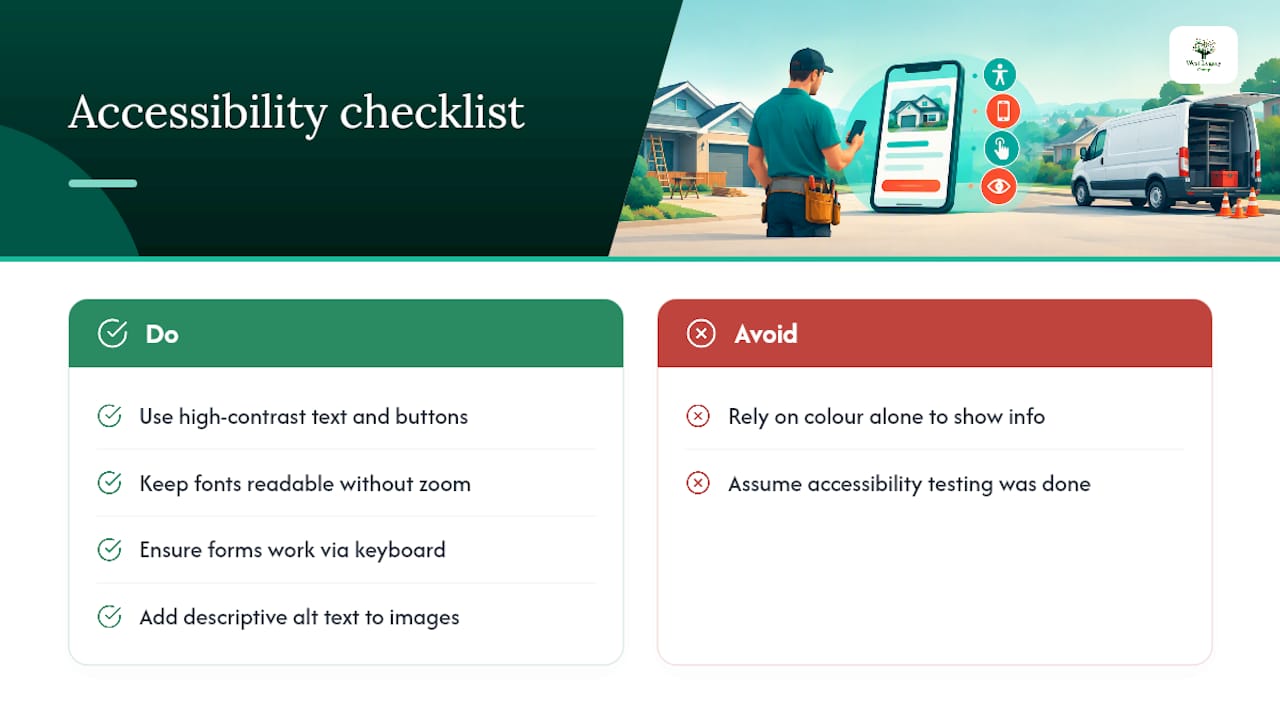
Avoid relying purely on colour to convey information, such as a green “available now” tag with no accompanying text. And test your site with a screen reader at least once. Most designers won’t do this unprompted, so it’s worth asking directly whether accessibility testing was part of the build rather than assuming it was.
Publisher perspective: why we favour conversion-first tradie websites
Most tradie sites fail not because they look bad, but because nobody designed for the ten seconds before someone hits the back button. West Legacy Group built its LEGACY Framework™ around that gap between traffic and enquiries, treating trust signals as seriously as page speed. A pretty homepage that doesn’t convert is worse than no website at all, because it’s cost you money to lose the job anyway. If you want proof rather than promises, ask to see real case studies before signing anything.
— Christopher
How West Legacy Group can help
West Legacy Group builds tradie websites as an asset you own outright, not a listing you rent from a lead platform that can change its fees or algorithm overnight. For trades wanting a lead-focused site without agency overhead, the small business website packages cover the full build: mobile-first design, service and suburb pages, click-to-call prominence, and CMS access handed over at launch, not held hostage.
If your enquiries are stuck on a Google Business Profile alone, a managed Google Business Management service at $95 AUD per month keeps that listing accurate while your site does the heavier conversion work. For trades wanting SEO folded into an ongoing plan, the Sapling, Oak and Redwood plans start from $750 AUD per month. Book a discovery call to talk through your current site, or request a quote directly through the web design page.
Sources
Verify claims yourself using Core Web Vitals thresholds, Google’s mobile-first indexing guidance, Google Business Profile, and the ACCC’s small business toolkit.
- Mobile sites, mobile-first indexing
- Small business rights and responsibilities | ACCC
- Australian Consumer Law and your business
FAQ
What Makes a Tradie Website Design Actually Convert?
A converting tradie website leads with click-to-call buttons, keeps quote forms under four fields, and shows real job photos above the fold. It also pairs with a claimed Google Business Profile so local searches find the business before a competitor does.
How Much Does a Trade Business Website Cost?
Costs vary depending on how many service pages and suburb pages you need, with a detailed cost breakdown for small business websites showing the typical ranges. West Legacy Group’s own web design packages are priced on request through the web design services page.
What Are Core Web Vitals and Why Do They Matter?
Core Web Vitals measure loading speed, responsiveness, and visual stability, with targets of LCP under 2.5 seconds, INP under 200 milliseconds, and CLS under 0.1. Sites that miss these thresholds tend to lose visitors before a call-to-action ever loads.
Do I Need a Website If I Already Have a Google Business Profile?
Yes, because a profile alone leaves you dependent on a platform you don’t control, while an owned website builds long-term equity, a point Choice’s tradie guidance makes directly. The two work best together, with the profile driving discovery and the website handling the conversion.
Who Should Own the Website Once It’s Built?
You should own the design, written content, and photos outright once the final invoice is paid, and this should be stated clearly in the contract. The ACCC’s guidance on small business rights confirms that deliverables must match what was agreed in the brief, so get ownership terms in writing before you sign.