

Faceted navigation SEO is the practice of managing filtered category pages so search engines crawl and index only the URLs that deliver real ranking value. Every time a visitor filters products by size, colour, or price, your site can generate a new URL. Left unmanaged, those URLs multiply fast, waste your crawl budget, and flood Google’s index with near-duplicate content. This guide explains how faceted navigation works, why it creates SEO risk, and what you can do right now to control it.
What is faceted navigation SEO and why does it matter?
Faceted navigation is a filtering system that lets visitors refine results by selecting attributes such as brand, size, price range, or rating. Each filter selection typically generates a new URL. The SEO challenge is that tens of thousands of URL combinations can appear when multiple filter groups are active at once. That scale overwhelms the Google search engine crawler and pulls it away from your most valuable pages.
The industry term for this problem is “parameter bloat.” It sits at the intersection of crawl budget management, duplicate content, and index health. Understanding all three is the foundation of effective SEO for faceted navigation.

Three core risks define the problem. First, crawl budget waste occurs when Google spends its allocated crawl time on low-value filter URLs instead of your core product or category pages. Second, index bloat produces millions of near-duplicate pages that confuse crawlers and dilute ranking signals. Third, link equity dilution spreads page authority across hundreds of thin filtered pages instead of concentrating it where it counts.
How does faceted navigation generate so many URLs?
Four common URL behaviours appear in faceted navigation: parameter-based, fragment-based, clean path, and duplicate parameter variations. Parameter-based URLs are the most common and the most dangerous from an SEO standpoint. A URL like /shoes?colour=red&size=10&brand=nike is a distinct address that Google can crawl, index, and treat as a separate page.
The combinatorial explosion is where the real damage happens. Consider a site with five filter groups, each containing ten options. The number of possible URL combinations runs into the tens of thousands. Add a sixth filter group and that number multiplies again. Most of those pages contain near-identical content with only minor variations in the product list.
| Filter groups | Options per group | Approximate URL combinations |
|---|---|---|
| 2 | 5 | 25 |
| 3 | 10 | 1,000 |
| 4 | 10 | 10,000 |
| 5 | 10 | 100,000+ |
The table above shows how quickly combinations grow. A mid-sized ecommerce site with a modest filter set can generate more crawlable URLs from facets alone than from its entire product catalogue. That is the core problem you need to solve.
Key SEO risks to keep in mind:
- Crawl budget waste: Google allocates a finite number of crawl requests per site. Faceted URLs consume that budget without adding ranking value.
- Duplicate content: Filtered pages often share the same title tags, meta descriptions, and body content, which weakens topical authority.
- Link equity dilution: Internal links pointing to dozens of filter combinations spread page authority thin across low-value pages.
- Index bloat: A bloated index slows down Google’s ability to discover and rank your genuinely important pages.
What are the best practices for managing faceted navigation SEO?
The most effective approach is a tiered strategy: index high-value filtered pages that match real search demand, and block or control everything else. Selective indexing combined with crawl limitation is the industry standard in 2026. No single technical tag solves the problem on its own.
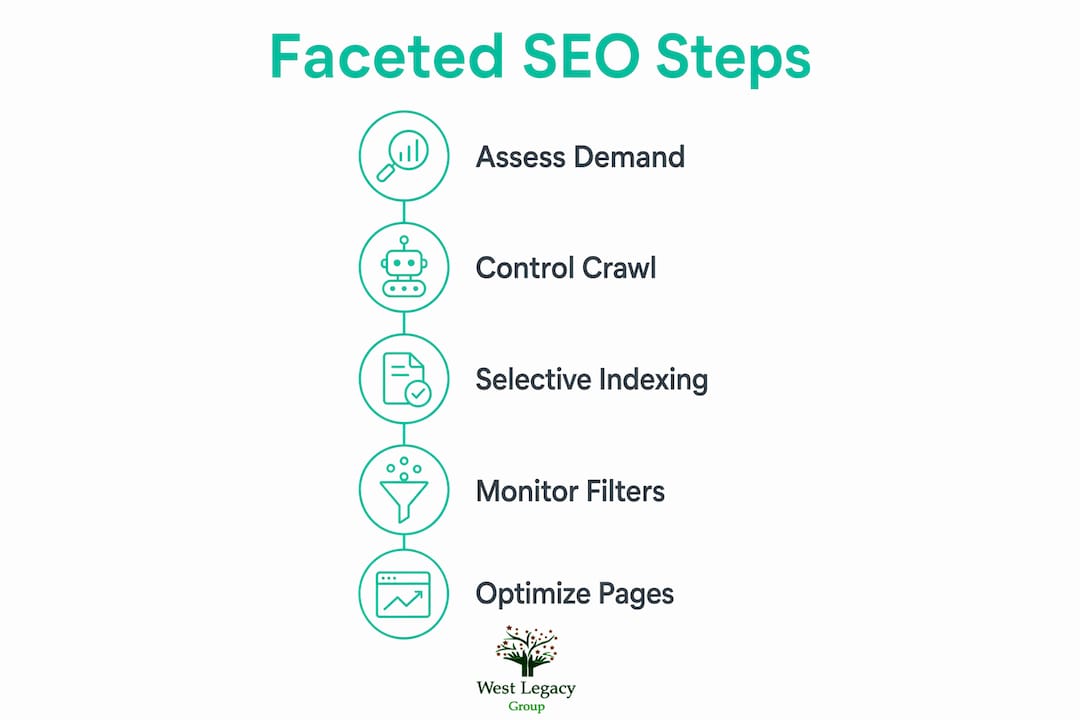
Crawl control techniques
| Technique | Pros | Cons |
|---|---|---|
| Canonical tags | Signals preferred URL to Google | Does not prevent crawling |
| Meta robots noindex | Removes page from index | Pages still consume crawl budget if linked |
| Robots.txt disallow | Prevents crawling entirely | Disallowed pages cannot be indexed or pass signals |
| Parameter management (Google Search Console) | Guides crawler behaviour | Deprecated in newer GSC versions |
| JavaScript/Ajax filtering | Keeps ephemeral states out of URLs | Requires development resources |
Using JavaScript or Ajax for ephemeral filters such as sorting or colour toggles prevents those states from generating new crawlable URLs. This is one of the most efficient ways to keep your crawl budget focused on pages that actually rank.
Internal linking is equally critical. Effective internal linking directs crawlers only to the filtered pages you want indexed. If you do not link to a low-value filter combination, Google is far less likely to find and crawl it. Your SEO glossary covers canonical tags and related directives in plain language if you need a refresher.
Pro Tip: Never rely on noindex tags alone. Noindexed pages linked internally still consume crawl budget. Combine noindex with controlled internal linking and robots.txt exclusions for genuine crawl efficiency.
What are the practical implementation challenges in 2026?
Site owners consistently underestimate the damage faceted navigation causes until they review their crawl budget and indexing data. By that point, thousands of low-value URLs are already in Google’s index and the retrofit work is significant. Auditing faceted navigation early in site development prevents that outcome.
Common implementation challenges include:
- Crawl traps: Filter combinations that link to each other in a loop, causing Google to crawl the same content repeatedly.
- No-results pages: Filter combinations that return zero products. Returning a proper 404 status code for these pages prevents soft 404 inflation and improves crawler resource allocation.
- UX versus SEO tension: Blocking a filter URL from crawling does not remove it from the user interface. You need to maintain usability while hiding low-value URLs from crawlers.
- Ongoing monitoring: Faceted navigation problems grow over time as new products and filters are added. A one-time fix is not enough.
Pro Tip: Set up a crawl monitoring schedule. Run a technical audit every quarter to catch new filter combinations before they inflate your index. Tools like Screaming Frog or Sitebulb make this straightforward for most site sizes.
The combinatorial explosion of URLs renders most crawlers ineffective if all filter combinations are exposed via internal links. The key is controlling crawlability through your link structure, not solely relying on technical directives. This is a point that many SEO guides understate. Your link architecture is your primary crawl control mechanism.
For ecommerce sites in particular, pairing your faceted navigation strategy with strong product page SEO practices compounds the benefit. Crawl budget saved on low-value filter pages flows directly to your product pages.
How can faceted navigation create SEO opportunities?
Faceted navigation is not purely a risk to manage. Filtered pages that match genuine search demand can rank as landing pages in their own right. A page like /running-shoes/womens/trail may attract significant organic traffic if “women’s trail running shoes” is a term people actually search for.
The benefits of faceted navigation SEO go beyond risk mitigation when you treat high-value filtered pages as first-class content. That means writing unique meta titles and descriptions, adding a short introductory paragraph, and building internal links from related content. The backlinks and credibility you earn for those pages reinforce their authority.
Practical ways to capture long-tail traffic from faceted navigation:
- Identify search demand first. Use keyword research to find filter combinations that people actually search for before deciding to index them.
- Write unique metadata. A filtered page with a generic title tag will not rank. Write a specific title and description for each indexed filter page.
- Add introductory content. Even two or three sentences of unique copy above the product grid helps Google understand the page’s topic.
- Use structured data. Marking up filtered pages with schema.org
ItemListorBreadcrumbListmarkup helps Google understand the page hierarchy. - Apply the same logic across industries. Travel booking sites index filtered pages for “flights Sydney to Melbourne under $200.” Real estate sites index pages for “3-bedroom houses in Bendigo under $600,000.” The principle is identical across sectors.
Maintaining a balance between user-friendly filtering and crawl efficiency is the greatest SEO challenge in managing faceted navigation. The sites that get this right treat their filter taxonomy as a content strategy decision, not just a technical one.
Key takeaways
Faceted navigation SEO requires controlling crawl paths through internal linking and selective indexing, not just applying canonical tags or noindex directives.
| Point | Details |
|---|---|
| URL combinations grow fast | Five filter groups with ten options each can generate over 100,000 URL combinations. |
| Noindex alone is insufficient | Noindexed pages linked internally still consume crawl budget; combine directives with link control. |
| Audit early and often | Catching faceted navigation problems early prevents costly index bloat and retrofit work. |
| High-value filters can rank | Filtered pages with real search demand should be treated as landing pages with unique metadata. |
| Internal linking is your primary tool | Controlling which filter URLs receive internal links is more effective than technical tags alone. |
My take on faceted navigation SEO
I have reviewed enough technical SEO audits to say this clearly: faceted navigation is the most underestimated source of crawl budget waste on ecommerce and catalogue sites. Site owners focus on content and backlinks, which are both important, but they ignore the fact that Google is spending half its crawl allocation on filter URLs that will never rank for anything.
The thing that surprises most people is how little the canonical tag actually does on its own. Google treats canonical tags as a hint, not a directive. If you have thousands of low-value filter URLs linked throughout your site, Google will crawl many of them regardless of what your canonical says. The real fix is removing those internal links.
I also see teams over-engineer the JavaScript solution. Yes, client-side filtering for ephemeral states is excellent practice. But if your development team cannot implement it quickly, start with internal linking controls and robots.txt exclusions. Those two changes alone will produce a measurable improvement in crawl efficiency within a few months.
The sites that handle this best treat their filter taxonomy as a product decision made by the whole team, not a technical afterthought. When the marketing team, developers, and SEO professionals agree on which filter combinations deserve to be indexed before the site launches, the problem is manageable. When that conversation happens after the site has been live for two years, the cleanup is painful.
Audit early. Link deliberately. And stop trusting noindex to do all the heavy lifting.
— Christopher
West Legacy Group can help with your faceted navigation SEO
Managing faceted navigation at scale takes more than a checklist. It takes a clear site architecture, deliberate internal linking, and ongoing monitoring to keep crawl efficiency high as your catalogue grows.
West Legacy Group works with small businesses and growing ecommerce sites to build affordable SEO plans that include technical audits, crawl budget management, and filtered page strategy. Our small business website packages are built with crawl control and indexing best practices from the ground up, so you are not retrofitting fixes later. If your site uses faceted navigation and you are not sure whether it is helping or hurting your rankings, get in touch with West Legacy Group for a tailored review.
FAQ
What is faceted navigation in SEO?
Faceted navigation is a filtering system that generates multiple URLs when visitors select product attributes. In SEO, it refers to the practice of managing those URLs to prevent crawl budget waste, duplicate content, and index bloat.
How does faceted navigation affect SEO?
Unmanaged faceted navigation creates tens of thousands of low-value URLs that consume crawl budget and dilute ranking signals. Controlled correctly, high-value filtered pages can rank for long-tail search terms.
Should I use canonical tags or noindex for faceted navigation?
Use both, but neither alone is sufficient. Noindexed pages still consume crawl budget if they receive internal links. Combine canonical tags, noindex directives, and controlled internal linking for genuine crawl efficiency.
What HTTP status code should no-results filter pages return?
No-results filter pages should return a 404 status code. Returning a 200 status with empty results creates soft 404 pages that inflate your index and waste crawl budget.
When should I audit my faceted navigation setup?
Audit faceted navigation early in site development and repeat the audit every quarter. Early intervention prevents exponential URL growth and saves significant cleanup work later.