

Product page SEO optimisation is the process of making each product page discoverable to search engines and compelling to shoppers, so you capture organic traffic and convert it into sales. Done well, optimised product pages drive 67% more organic conversions and convert 3.2 times better than unoptimised pages. Poor SEO on product pages costs the average e-commerce site $89,000 in lost revenue each year. That figure alone makes product page SEO one of the highest-return activities you can invest in as an e-commerce manager or small business owner.
What are the essential elements of product page SEO optimisation?
Effective product page SEO covers three layers: keyword targeting, on-page content, and technical structure. Each layer reinforces the others, and neglecting any one of them limits your results.
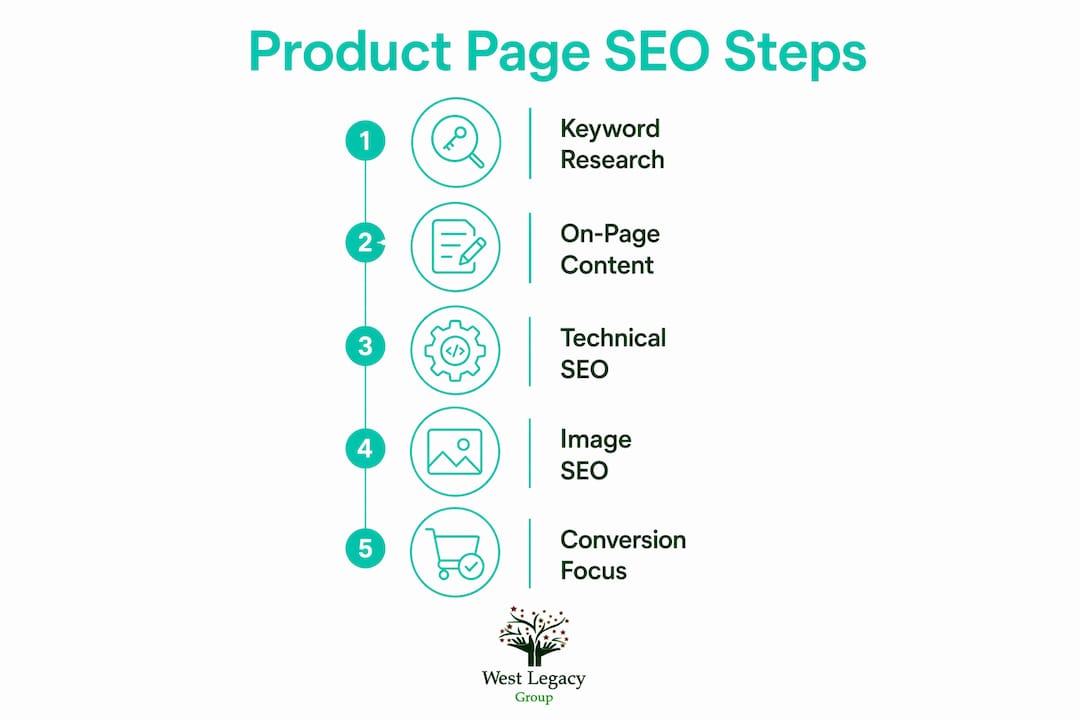
Keyword targeting

Transactional and commercial investigation keywords belong on product pages. Targeting these intent-driven phrases captures 78% of conversions, outperforming broad volume keywords by a significant margin. Phrases like “buy stainless steel water bottle 750ml” signal purchase intent far more clearly than “water bottle.” Long-tail keywords on product pages convert 40–60% better than broad terms because they match specific purchase intent.
On-page content essentials
- Unique product descriptions: 68% of e-commerce sites suffer ranking penalties from copying manufacturer descriptions. Write buyer-focused copy that answers real questions your customers ask.
- Title tags and meta descriptions: Include the primary keyword and a clear benefit within 60 characters for the title tag. A well-written meta description lifts click-through rates before a shopper even lands on your page.
- Heading structure: Use H1 for the product name, H2 for key sections like specifications and reviews, and H3 for sub-topics.
- Product schema markup: Implementing structured data enables rich snippets showing price, availability, and ratings. Rich snippets increase click-through rates by 36% and improve visibility in Google Shopping results.
- URL structure: Keep URLs short, descriptive, and keyword-rich. Use canonical tags to avoid duplicate content from filtered or sorted page variants.
Pro Tip: Write your product description to answer the three questions every buyer has: What is it? Why do I need it? Why should I buy it from you? Answer all three above the fold.
How to improve product image SEO and site performance
Images are the most overlooked ranking factor on product pages. Poor image SEO costs you both organic traffic from Google Images and page speed scores that affect your Core Web Vitals.
- Use descriptive filenames. Rename files before uploading. “blue-merino-wool-beanie-mens.jpg” tells Google exactly what the image shows. “IMG_4821.jpg” tells it nothing.
- Write specific alt text. Alt text should describe the product variant shown, not just the product category. “Navy merino wool beanie, size medium, front view” outperforms “beanie.”
- Choose the right file format. WebP and AVIF formats deliver smaller file sizes than JPEG or PNG at equivalent quality. Smaller files load faster, which directly improves your LCP score.
- Set fetchpriority on your hero image. The primary product image is typically your page’s Largest Contentful Paint element. Remove lazy loading from this image and add
fetchpriority='high'to tell the browser to load it first. - Lazy load gallery thumbnails. Apply
loading='lazy'to secondary images and zoom views. This defers their load until the shopper scrolls, keeping initial page load fast. - Submit an image sitemap. An image sitemap helps Google discover and index your product photos, especially images loaded via JavaScript.
Pro Tip: Combine high-quality photography with complete SEO metadata. Missing alt text or inconsistent filenames across a large catalogue undermines your image SEO efforts at scale.
The table below summarises the image format trade-offs worth knowing:
| Format | Best use case | Compression | Browser support |
|---|---|---|---|
| WebP | General product images | High | Excellent |
| AVIF | High-detail photography | Very high | Good and growing |
| JPEG | Legacy fallback | Moderate | Universal |
| PNG | Images with transparency | Low | Universal |
What technical optimisations support product page SEO success?
Technical SEO is the foundation that makes all your content and image work count. Without it, even excellent product pages struggle to rank.
Canonical URLs and duplicate content
E-commerce platforms generate duplicate URLs constantly through filters, sorting parameters, and product variants. Set canonical tags on all variant pages to point back to the primary product URL. This consolidates ranking signals and prevents index bloat, which dilutes your site’s crawl budget.
Breadcrumb navigation and internal linking
Product pages rarely earn external backlinks on their own. Internal linking from category and guide pages is the primary way to build authority and help product pages rank for non-brand terms. A well-structured breadcrumb trail (Home > Category > Subcategory > Product) also passes link equity down the hierarchy. Linking from high-authority category pages to product pages passes relevance and improves rankings for competitive keywords.
Core Web Vitals benchmarks
- LCP (Largest Contentful Paint): Target under 2.5 seconds. This is usually your hero product image.
- CLS (Cumulative Layout Shift): Keep below 0.1. Reserve space for images and dynamic elements to prevent layout jumps.
- INP (Interaction to Next Paint): Minimise JavaScript execution time to keep pages responsive.
Pages that meet Core Web Vitals thresholds rank 1.7 positions higher on average. That is a meaningful ranking lift without creating a single new piece of content.
Structured data validation
Deploy Product schema using JSON-LD and validate it regularly with Google’s Rich Results Test. Pricing and availability data in your schema must match what appears on the page. Mismatches cause Google to suppress your rich snippets, which removes the 36% CTR advantage that schema provides. Audit your structured data whenever you update pricing or stock status.
Avoiding common e-commerce SEO mistakes at the technical level saves you from undoing months of content work.
How to balance SEO content and conversion rate optimisation on product pages
SEO and conversion rate optimisation (CRO) pull in opposite directions on product pages. SEO rewards depth and keyword coverage. CRO rewards clarity and brevity. The solution is to give each objective its own zone on the page.
Above the fold: conversion first
Place price, the primary CTA button, key shipping information, and your hero image above the fold. Shoppers make purchase decisions fast. Placing essential conversion elements above the fold while reserving SEO-rich content below is a proven structure for improving both rankings and revenue. Do not bury the “Add to Cart” button under a wall of keyword-rich copy.
Below the fold: SEO depth
- Full product specifications in a structured table
- Frequently asked questions targeting long-tail search queries
- Use cases and application guides
- Customer reviews with schema markup
- Related products with contextual internal links
Jump links or expandable accordion sections let you include detailed content without cluttering the visual experience above the fold. This structure satisfies Google’s preference for depth while keeping the buying experience clean.
Media as a dual-purpose asset
Short product videos and crisp lifestyle photography serve both SEO and CRO simultaneously. Videos increase time on page, which signals engagement to Google. High-quality images reduce purchase hesitation, which lifts conversion rates. Both outcomes compound over time.
Pro Tip: Target long-tail keywords in your FAQ section below the fold. Questions like “Is this water bottle dishwasher safe?” match real search queries and capture shoppers who are close to buying.
Key takeaways
Effective product page SEO optimisation requires combining keyword targeting, unique content, technical structure, and image performance to rank well and convert shoppers consistently.
| Point | Details |
|---|---|
| Target transactional keywords | Use purchase-intent phrases and long-tail terms to capture buyers ready to convert. |
| Write unique product descriptions | Avoid manufacturer copy; original buyer-focused descriptions prevent duplicate content penalties. |
| Optimise your hero image | Remove lazy loading and add fetchpriority=‘high’ to improve LCP and page speed scores. |
| Meet Core Web Vitals benchmarks | Pages hitting LCP under 2.5s and CLS under 0.1 rank 1.7 positions higher on average. |
| Separate SEO depth from CRO clarity | Place conversion elements above the fold and detailed SEO content below for best results. |
Why most product page SEO advice misses the real bottleneck
Most guides focus on individual tactics: add schema, write better titles, compress images. That advice is correct, but it misses the real constraint for e-commerce managers with large catalogues. The bottleneck is not knowing what to do. It is deciding where to start when you have 500 product pages and limited time.
My honest recommendation: start with your top 20% of revenue-generating products and get those pages right before touching anything else. Apply consistent metadata templates across the rest of the catalogue to handle technical SEO at scale. Then audit for accuracy, particularly pricing and availability data in your schema, because stale data actively hurts you.
The other thing I see consistently underused is internal linking from blog content and category pages down to product pages. Product pages rarely earn external links naturally. Your category pages and buying guides are the internal authority sources that lift them. Build that funnel deliberately, not as an afterthought.
Avoid what I call “SEO by volume,” where you push out hundreds of thin product descriptions hoping some will rank. Google’s quality signals have made that approach counterproductive. Ten well-optimised pages outperform a hundred mediocre ones. Prioritise depth and accuracy over sheer quantity, and your catalogue will compound in authority over time.
— Christopher
How West Legacy Group supports your product page SEO
Small business owners should not have to choose between a well-designed website and one that ranks well. West Legacy Group builds small business website packages that are designed for both from the ground up, with SEO structure built into every product page template.
West Legacy Group works with e-commerce managers and small business owners to set up scalable product page SEO frameworks, covering technical setup, content strategy, and ongoing performance reporting. If you want a custom SEO plan built around your catalogue and growth goals, the team at West Legacy Group is ready to help you get there.
FAQ
What is product page SEO optimisation?
Product page SEO optimisation is the process of improving each product page so it ranks higher in search results and converts more visitors into buyers. It covers keyword targeting, on-page content, technical structure, and image performance.
How do long-tail keywords help product pages rank?
Long-tail keywords match specific purchase intent and convert 40–60% better than broad terms. They also face less competition, making it easier for smaller e-commerce sites to rank on page one.
Why does product schema markup matter?
Product schema enables rich snippets showing price, ratings, and availability directly in search results. These rich snippets increase click-through rates by 36%, meaning more shoppers reach your page before a competitor’s.
What Core Web Vitals scores should product pages target?
Target an LCP under 2.5 seconds and a CLS score below 0.1. Pages meeting these benchmarks rank 1.7 positions higher on average, which translates to significantly more organic traffic.
How do I avoid duplicate content on product pages?
Set canonical tags on all variant and filtered URLs to point back to the primary product page. Write unique product descriptions rather than copying manufacturer text, as 68% of e-commerce sites face ranking penalties from duplicate manufacturer copy.