
Local link building means earning backlinks from geographically and topically relevant websites, such as local news outlets, chambers of commerce, and community sponsors, to boost your Google Business Profile and organic rankings in your service area. It matters now because link signals still drive roughly 24% of local organic ranking factors. The fastest high-impact move? Join your local chamber of commerce or sponsor a community event this week.
TL;DR:
- Joining your local chamber of commerce can provide a permanent, authoritative link with minimal effort and cost, approved within a week.
- Sponsoring community events or sports clubs usually results in long-lasting links from sponsorship pages, often at a low cost and quick turnaround.
- Reclaiming unlinked brand mentions or fixing broken links takes limited monthly time but can generate high-value backlinks and improve local rankings.
- Building genuine local assets like neighbourhood guides or event calendars encourages organic linking from residents and other local sites without direct outreach.
- Consistent, modest outreach combined with content creation over time is more effective than short-term link spikes, with measurable SEO benefits emerging within 8 to 16 weeks.
Table of Contents
- Quick local link wins you can do this month
- Deep dive: 12 proven local link building strategies and how to execute them
- Citations versus backlinks: what each does for local SEO
- How many local links do you need, and what’s a healthy pace?
- A repeatable monthly local link building workflow
- Measuring ROI and tracking the impact of local links
- Common mistakes, red flags, and what not to buy
- Publisher expertise: West Legacy Group’s experience and resources
- Examples of successful local link building campaigns
- How to identify and qualify high-quality local link opportunities
- Leveraging local influencers and community figures
- Integrating local link building with your wider SEO strategy
- Why consistency beats intensity in local link building
- How West Legacy Group helps you build local links that actually work
- Sources
- FAQ
Quick local link wins you can do this month
You don’t need a six-month strategy to get your first few quality local backlinks. Some of the best opportunities are sitting in plain sight, waiting for a phone call or a $150 sponsorship cheque.
Here are the tactics that deliver the fastest return, ranked roughly by how quickly you can get them live:
- Join your local chamber of commerce — most chambers list members on a directory page with a live link. Cost: typically a modest annual fee. Time: one application, usually approved within a week.
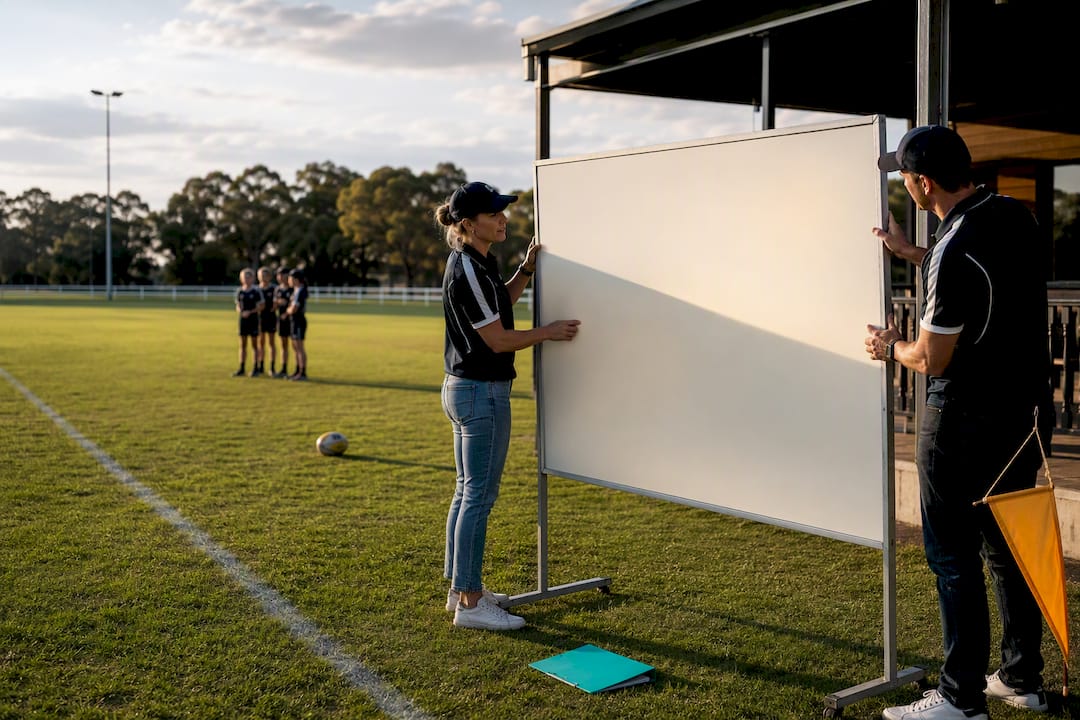
- Sponsor a junior sports club or school fête — small sponsorships often earn a permanent link on a “our sponsors” page. Cost: typically under a few hundred dollars. Time: a phone call and a logo file.
- Reclaim unlinked brand mentions — search your business name and find articles that mention you without linking. Reclaiming these mentions is a high-conversion, low-effort tactic. Time: two to three hours a month.
- Fix broken links pointing to old pages — find sites linking to your defunct URLs and offer your current page as a replacement. Time: half a day of prospecting.
- Get listed on supplier and partner pages — ask trade partners for a spot on their “who we work with” page. Time: a short email, often converts within two weeks.
- Pitch a local news story — a genuine local angle (a hiring milestone, a community grant, a product first) can land a feature with a link. Time: one press release, results in one to four weeks.
- Write a guest column for a local business publication — regional business magazines often accept expert contributions. Time: two to three hours to draft.
- Offer a scholarship at a local TAFE or university — a modest scholarship can secure a valuable .edu link that’s hard to get any other way. Cost: from a few hundred dollars.
- Appear on a local podcast or radio segment — most shows link back to guests from their episode notes page.
- Build a neighbourhood resource page — a genuinely useful local guide (best cafés, parking tips, event calendar) attracts organic links from residents and other local sites.
- Ask for links from your own testimonials — when a client mentions you on their own site, ask them to add a link.
- List with your industry association — trade bodies often maintain member directories with follow links.
Tactics 1, 2, 5, 6, and 8 depend on relationships and a bit of negotiation. Tactics 3, 4, 10, and 11 are largely creatable assets you can knock out solo, with no one else’s approval needed. Split your time between both types so you’re not entirely dependent on someone else saying yes.
Deep dive: 12 proven local link building strategies and how to execute them
Knowing the tactic is one thing. Knowing what to say when you pick up the phone is another. Here’s how to execute the highest-value strategies properly.
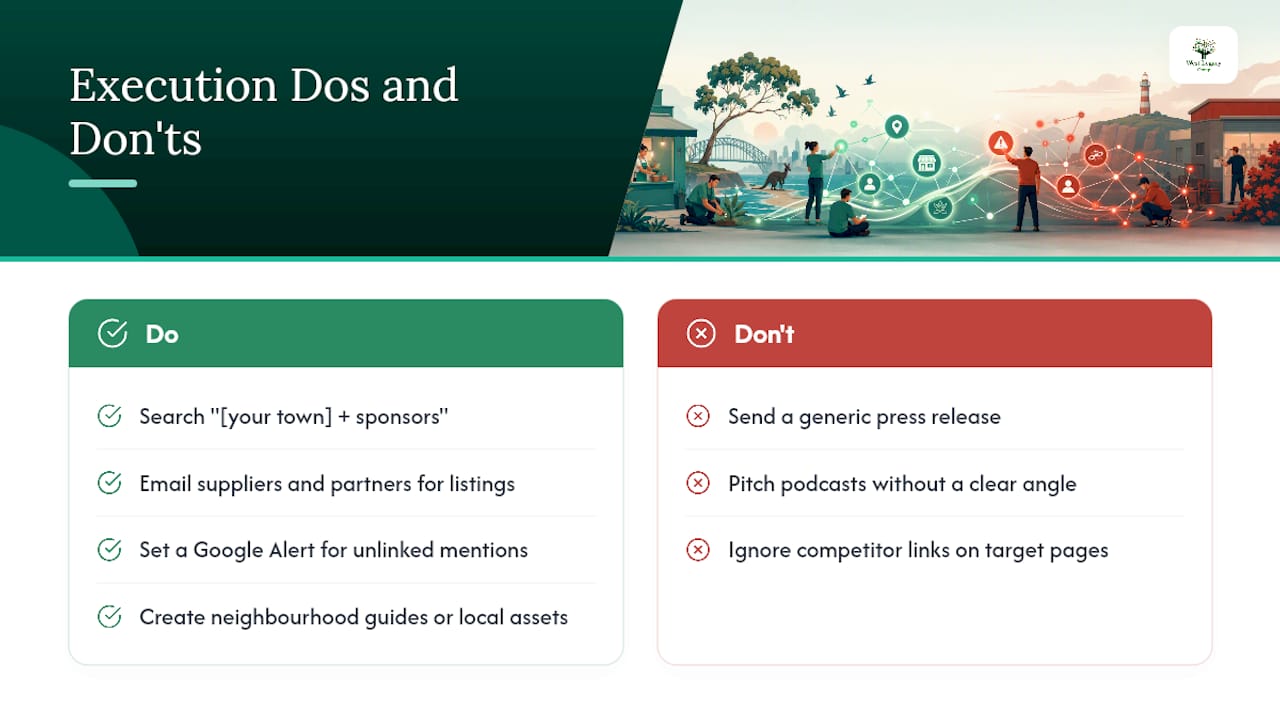
Sponsorships and event links. Search for “[your town] + sponsors” or check local sporting club websites for a sponsors page. A short pitch works best: “We’d like to sponsor [event/team] for the season in exchange for a logo and link on your sponsors page — happy to discuss the package.” Sponsorships often provide long-lived links on stable pages, and they double as genuine community goodwill.
Chamber and association listings. Membership usually costs a modest annual fee and expects some participation, attending a networking breakfast, sponsoring a raffle prize, but the payoff is a permanently listed, editorially trusted link.
Local PR. Journalists want a story, not a press release about your grand opening. Pitch an angle: a milestone, a local hire, a community partnership, or data specific to your suburb. Supply a photo, a quote, and your website URL. Follow up once a week later asking if they need anything else, and politely request the article link your site if it doesn’t already.
Partnership and vendor pages. Email suppliers, complementary businesses, and past clients asking to be added to their partner or recommended-business page. Conversion rates on this outreach tend to be higher than cold link requests, because you already have a relationship.
Guest columns, podcasts, scholarships, and .edu opportunities. Local business podcasts are hungry for guests. Offer a specific, useful talking point rather than “I’d love to chat about my business.” Scholarships need a simple application form and a small budget, but the resulting university link carries real weight.
Reclaiming mentions and broken-link repair. Set a Google Alert for your business name. When you find an unlinked mention, email the site politely asking them to add a link for readers who want to find you. Do the same for any site linking to a page on your site that no longer exists.
Creating linkable local assets. A well-researched neighbourhood guide, an annual “best of” list, or a local event calendar gives other sites a genuine reason to link to you, no ask required. West Legacy Group’s local business blog content examples show what this looks like in practice.
Pro Tip: Before you pitch anyone, check whether they already link to a competitor. If a sponsor page or resource list links to a rival business, that’s proof the opportunity converts, and proof you should be on it too.
Citations versus backlinks: what each does for local SEO
Citations and backlinks solve different problems. A citation is a business listing (name, address, phone number) on directories like Yellow Pages or True Local, with or without a clickable link. A backlink is an editorial link from another website’s content, a news article, a sponsor page, a blog post, pointing to your site.
- Citations build trust and consistency. Consistent NAP data across directories can lift your Local Pack chances by double-digit percentage points.
- Backlinks multiply organic visibility. Link signals make up about 24% of local organic ranking weight, 8% of Local Pack weight, and 13% of AI search ranking weight for local businesses.
The practical order is simple: audit and fix your citations first, then invest in editorial backlinks. A guide to citation building walks through the cleanup process if your NAP data is scattered across old directories.
How many local links do you need, and what’s a healthy pace?
There’s no single magic number, but the pattern holds across markets: 5 to 10 genuinely relevant local links tend to outperform 50 generic directory links. A hairdresser in a small town might only need six or seven strong local links to dominate their Map Pack. A plumber in a competitive metro area may need 20 to 30 over a year to keep pace with rivals.
- Small towns: three to five new quality links over six months is often enough to move rankings.
- Mid-size cities: aim for two to four new links a month, sustained over a year.
- Competitive metro markets: four to six a month, mixed between Tier 1 authority links and Tier 2 community links, keeps pace with aggressive competitors.
Watch your velocity. A sudden jump from two links a month to thirty is the clearest signal to Google that something’s off. Spread outreach evenly, prioritise a handful of Tier 1 sources (your council, local paper, chamber), then layer in Tier 2 and Tier 3 community links for volume.
A repeatable monthly local link building workflow
Local link building rewards consistency over intensity. A simple four-week cycle repeated every month beats one frantic outreach sprint a year.
- Week 1: Prospecting and outreach. Identify 10 to 15 targets (sponsor pages, chamber listings, local press contacts) and send your first outreach emails.
- Week 2: Follow-ups and applications. Chase anyone who hasn’t replied, and submit any sponsorship or membership applications you’ve decided to pursue.
- Week 3: Content creation. Draft the guest column, press release, or resource page asset you need to support that month’s outreach.
- Week 4: Verification and logging. Confirm every new link is live, correctly attributed, and dofollow where expected, then log it and check your rankings.
| Column | Purpose |
|---|---|
| Target site | Name and URL of the prospect |
| Contact name/email | Who you reached out to |
| Outreach date | When you first made contact |
| Status | Pending, replied, secured, declined |
| Link type | Sponsorship, editorial, directory, partner page |
| Live link URL | Where the link appears once published |
| Dofollow/nofollow | Confirms link value |
| Date verified | When you last checked it’s still live |
This cadence mirrors what most practitioner guides recommend for sustainable growth: steady prospecting, not sporadic bursts.
Measuring ROI and tracking the impact of local links
Track four things: Local Pack position for your priority keywords, Google Business Profile actions (calls, direction requests, website clicks), organic impressions in Google Search Console, and referral traffic and leads from the linking sites themselves in Analytics.
- Google Search Console shows impression and click growth for local queries tied to pages you’ve been building links to.
- Analytics referral reports reveal which links are actually sending visitors, not just sitting there for SEO value.
- Rank trackers confirm whether Local Pack position is shifting for your target terms.
Most businesses see measurable ranking movement within 8 to 16 weeks of consistent effort, with meaningful Local Pack gains typically taking 4 to 9 months depending on how competitive your market is. If you want a broader sense of realistic SEO timeframes beyond just links, A guide on how long SEO takes provides a full overview of realistic SEO timeframes.
Common mistakes, red flags, and what not to buy
The “500 backlinks for $50” offers flooding your inbox are almost always spam. These links come from link farms and irrelevant, low-quality sites that carry no local relevance and no editorial trust, and Google’s algorithms are increasingly good at spotting and discounting them.
- Avoid bulk directory submissions with no editorial oversight; they add noise, not authority.
- Watch your anchor text. If every link says “best plumber [suburb]”, that pattern looks manufactured rather than earned.
- Don’t chase velocity spikes. Jumping from zero to fifty links in a month is a red flag, not a win.
- Don’t dismiss nofollow links outright. A healthy profile includes a mix of follow and nofollow links, and nofollow links from trusted local sites still send referral traffic.
Pro Tip: If a link-building offer doesn’t ask a single question about your business, your suburb, or your target customer, it’s not local link building. It’s a numbers game that will do nothing for your Map Pack ranking.
Publisher expertise: West Legacy Group’s experience and resources
The company started over 20 years ago, built on the idea of creating something lasting for small businesses. That philosophy carries into the small business services division, where the team has spent years running SEO, Google Business Profile management, and content programs for tradies, local service providers, and eCommerce operators.
- Practical resources include a local SEO checklist and a guide to local SEO strategies.
- Outreach typically runs on the same monthly cadence outlined above, prospecting, follow-up, content, verification, tracked in a shared spreadsheet with clients.
- Reporting focuses on Local Pack position, GBP actions, and referral leads, not vanity metrics like raw link counts.
Examples of successful local link building campaigns
A regional café chain built a “best coffee walk” neighbourhood guide covering six suburbs, ranking cafés by roast style and seating. Local food bloggers and two council tourism pages linked to it within three months, no outreach required, because it filled a genuine content gap.
A suburban plumbing business sponsored two junior football clubs for $600 combined per season. Both clubs added a sponsors page link, and one local paper covered the sponsorship as a community story, delivering a third link at no extra cost.
A boutique accounting firm offered a $1,000 scholarship at a local TAFE for a business studies student. The TAFE’s scholarships page linked back with a .edu domain, and the firm picked up a mention in the college’s annual newsletter as a bonus.
A family-run nursery reclaimed 14 unlinked mentions across garden club newsletters and local Facebook community group websites over two months of manual outreach. Twelve of the fourteen sites added a link once asked, at zero cost beyond the time spent emailing.
What connects all four: none of these links came from generic outreach templates. Each one matched a real community need or relationship the business already had, which is exactly why they converted.
How to identify and qualify high-quality local link opportunities
Not every local website deserves your outreach time. Before pitching, check whether the site is genuinely active (recent posts, real traffic, not an abandoned directory), whether it’s topically or geographically relevant to your business, and whether the link would sit in editorial content rather than a footer link farm.
Tracking link quality requires more than looking at a domain authority score: capture topical relevance, page context, whether the link is dofollow, and whether it’s genuinely editorial. A low-authority local newspaper article about your business is often worth more than a high-authority but irrelevant national directory listing.
Useful qualifying questions before you invest outreach time:
- Does this site already link to businesses like mine, including competitors?
- Would a real local resident find this page useful, or does it exist purely for SEO?
- Is the site updated regularly, or does it look abandoned?
- Does the link sit within genuine content, or in a generic sidebar list?
For prospecting itself, specific search operators and local site crawls surface sponsor pages, “recommended businesses” lists, and event sponsor pages that a plain Google search often misses. A short, repeatable list of these search operators, saved and reused every month, meaningfully improves your hit rate over generic manual searching.
Leveraging local influencers and community figures
Local influencers aren’t always Instagram personalities with big followings. In most towns and suburbs, the people with real local link power are community Facebook group admins, local radio hosts, neighbourhood newsletter editors, and well-known small business owners who already have an audience’s trust.
Reach out with something genuinely useful rather than a generic collaboration request: offer a local expert quote for their next post, a giveaway for their audience, or a co-hosted community event. A quoted expert contribution to a community newsletter or local Facebook group often earns a link back to your site as attribution, and it costs nothing but your time and expertise.
Local radio and podcast hosts are particularly underused. Most community radio stations maintain a website with episode notes, and guests almost always get a link back. A ten-minute segment about your industry, tied to a seasonal angle (tax time for accountants, storm season for roofers), is an easy pitch that most local stations will take.

The key difference between this and paid influencer marketing: you’re not paying for a shoutout, you’re offering something their audience genuinely wants, which is exactly why the resulting link tends to be permanent rather than a one-off sponsored post that disappears after 24 hours.
Integrating local link building with your wider SEO strategy
Local link building doesn’t work in isolation. It needs a foundation of solid on-page content and clean technical SEO to actually convert into ranking improvements, otherwise you’re sending link equity to pages that can’t capitalise on it.
Before a heavy outreach push, make sure your service area pages are genuinely useful, with real local detail rather than a template with the suburb name swapped in. Content-led assets like neighbourhood guides and event calendars do double duty: they’re link magnets on their own, and they reinforce the topical relevance signals that make your other pages rank. A piece on community content examples shows the kind of content that pulls both jobs at once.
If you run more than one location, link building strategy needs to flex per site. Chamber memberships, sponsorships, and press links should be pursued for each location separately, feeding into the approach covered in A multi-location SEO guide discusses treating link building as one input alongside citations, content, and technical health, not a bolt-on activity that happens in isolation from the rest of your SEO plan.
Why consistency beats intensity in local link building
Local link building compounds. A handful of quality links earned every month for a year outperforms a rushed 100-link sprint that trips Google’s spam filters. If your budget is tight, spend it on relationships first, chamber membership, one sponsorship, one scholarship, rather than spreading thin across a dozen low-value directories.
Pair that relationship-building with a content-led asset, a genuinely useful local guide or annual report, because that’s what earns links without you having to ask. The businesses that win at this long-term treat it as infrastructure, not a campaign with an end date.
— Christopher
How West Legacy Group helps you build local links that actually work
This company offers citation cleanup, content built for your suburb, and outreach services with experience running campaigns for tradies and local service businesses.
Local SEO retainer clients get a monthly outreach cadence like the one outlined above, prospecting, follow-up, content, and verification, without you needing to chase journalists or sponsors yourself. If your citations are inconsistent across directories, that gets fixed first using the process in West Legacy Group’s citation building guide, because a shaky NAP foundation undercuts every link you earn afterwards. Onboarding starts with a quick audit of your current citations, backlinks, and Google Business Profile, followed by a prioritised list of the highest-ROI local link opportunities for your suburb.
If you want a guided, self-paced option instead, build your own SEO plan and get a structured roadmap you can work through on your own schedule. Ready for a fully managed approach? Get in touch through West Legacy Group’s digital marketing services and ask for a local link building audit.
Sources
- Local SEO backlinks (Semrush)
- Essential local link building tactics (Moz)
- How to do local link building the right way (BrightLocal)
- Local link building: how to dominate your local market (Link Building Journal)
- Local link building (The Stacc)
FAQ
What does link building mean?
Link building is the practice of earning hyperlinks from other websites to your own, which search engines use as a trust signal when ranking your site. Local link building narrows this to links from geographically and topically relevant sources like chambers, local press, and community sponsors.
What are the types of link building?
The main types include editorial links (earned through PR or guest content), citation-based links (directory listings), sponsorship and partnership links, and reclaimed or repaired links from existing mentions. Most successful local campaigns use a mix of all four rather than relying on one type.
Is local SEO a thing?
Yes, local SEO is a distinct discipline focused on ranking in Google’s Map Pack and local organic results for “near me” and location-specific searches, and it relies heavily on citations, Google Business Profile signals, and geographically relevant backlinks. West Legacy Group’s local SEO strategies guide covers the broader discipline beyond just links.
Are backlinks still relevant in 2026?
Yes. Link signals still account for roughly 24% of local organic ranking factors, 8% of Local Pack rankings, and 13% of AI search rankings, making backlinks one of the most influential factors local businesses can control.