
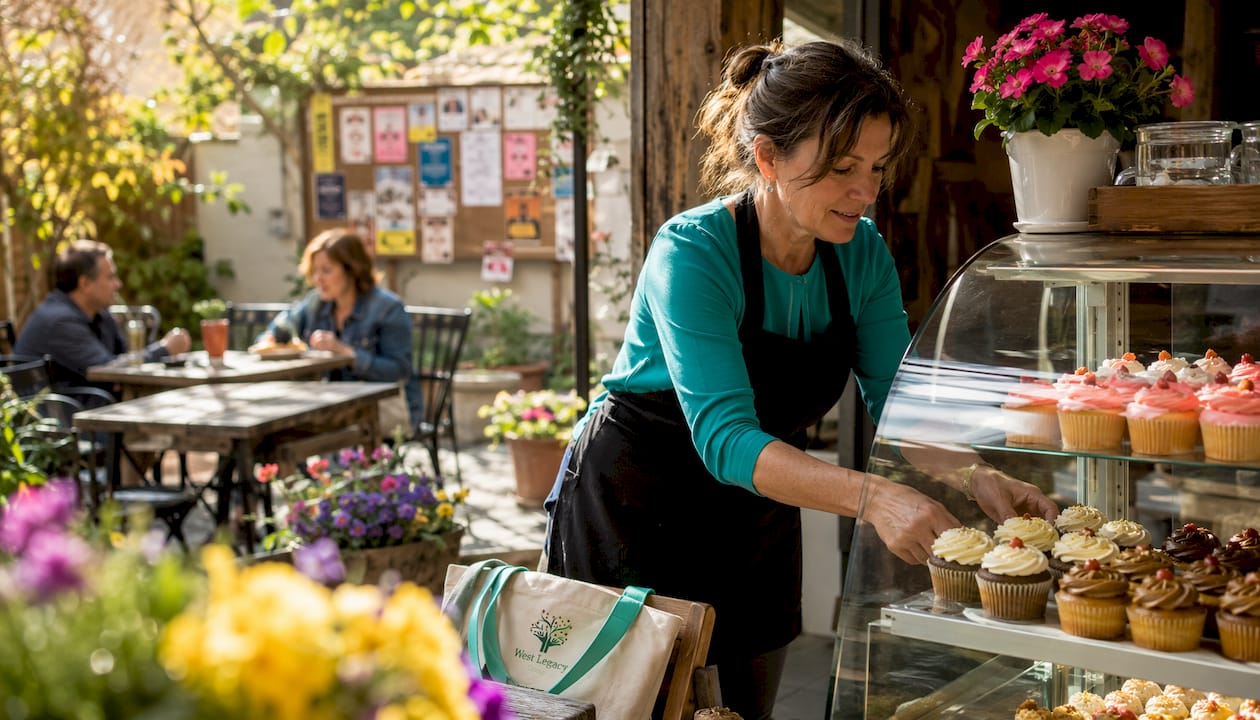
Your best local community content ideas, ready to post this week. Use Canva or Adobe Express to build visuals in under 20 minutes, then publish across Meta (Facebook and Instagram) and your Google Business Profile.
Social media posts (Instagram/Facebook):
- Photo of your team volunteering at a Clean Up Australia day with your suburb tagged
- “Meet our neighbour” spotlight featuring the café next door
- Behind-the-scenes Reel of your Saturday morning market setup
- Customer photo repost with a thank-you caption
- Poll: “Which local event should we sponsor next?”
- Countdown post to a community fundraiser you are hosting
Email newsletter items:
- “What’s on in [suburb] this weekend” roundup with three local picks
- Staff member spotlight tied to a local cause they support
- Exclusive discount for subscribers who bring a friend in-store
In-person activations:
- Host a free community workshop in your space
- Run a cash-mob style shopping event with a neighbouring business
- Set up a community noticeboard in your shopfront window
Pick one idea from this list and schedule it before Friday. That single post, done consistently, compounds into genuine local visibility over weeks.
Table of Contents
- What local community business content is and what it looks like in practice
- Why community-focused content helps small local businesses
- Content pillars that make local planning easier
- 40+ specific local community content examples, channel-tagged and copy-ready
- How to pick, schedule and repurpose community content
- Ready-to-use templates, caption prompts and design resources
- Australian implementation: how to audit your capability and run local examples
- How to measure success, timelines and typical low-budget cost estimates
- Key takeaways
- Why most local businesses underestimate community content
- West Legacy Group helps you turn community content into local leads
What local community business content is and what it looks like in practice
Community content is any content that puts your place, your people, and your neighbours at the centre rather than your products. It prioritises local value over a direct sales message. A post about your team cleaning up Merri Creek is community content; a post about your 20% off sale is not.

The formats that count are broader than most small business owners realise. Event listings, neighbourhood spotlights, volunteer day recaps, customer photo reposts, local tips guides, partnership announcements, and behind-the-scenes looks at your local process all qualify. So does a simple Google Business Profile update about a community event you are attending.

Where this content lives matters as much as what it says. Owned channels (your website and email list) give you full control. Social platforms like Meta’s Facebook and Instagram reach people who are already browsing locally. Google Business Profile posts surface in “near me” searches at the exact moment someone is deciding where to go. In-store signage and community noticeboards reach people who are already physically nearby. Each channel has a different job, and the strongest local businesses use at least three of them together.
Why community-focused content helps small local businesses
Community content increases local visibility and trust in ways that standard promotional posts rarely do. When your content reflects the neighbourhood, local customers recognise themselves in it and share it with people they know. That organic sharing is worth more than most paid reach.
The practical business outcomes are measurable:
- More walk-ins: Consistent local presence on social media and Google Business Profile drives foot traffic, particularly when posts include your address, opening hours, and a local landmark reference.
- Stronger local search presence: Google Business Profile signals such as regular posts, photo uploads, and review responses all improve your ranking for suburb-level searches.
- Higher repeat business: Customers who feel connected to a business through shared community values return more often and spend more per visit.
- Referral networks: Partnerships with neighbouring businesses and local organisations generate word-of-mouth referrals that no ad budget can replicate.
- More reviews: Community activations that ask customers for a specific action (post a photo, leave a review) produce measurable local outcomes without large media budgets.
Meta’s Facebook and Instagram are widely used platforms for local discovery in Australia, especially for businesses targeting nearby customers. Google Business Profile is the strongest channel for capturing intent at the point of search.
Content pillars that make local planning easier
A content pillar is a recurring theme your content returns to. Picking six to eight pillars means you never stare at a blank screen wondering what to post. Each pillar maps to specific channels and gives you a ready prompt when you need one.
1. Community events and activations
Best channels: Facebook Events, Instagram Stories, Google Business Profile posts.
Prompts: “We are hosting a free workshop on [date] — tag a neighbour who would love this” or “We will be at [local market] this Saturday. Come say hello.”
2. Neighbour and business spotlights
Best channels: Instagram feed posts, Facebook, email newsletter.
Prompts: “This week we are shining a light on [business name], our neighbours since [year]” or “Meet [name], the florist two doors down.”
3. User-generated content (UGC) and customer stories
Best channels: Instagram reposts, Facebook, website testimonials page.
Prompts: “Tag us in your photos and we will feature you here” or “Share your story with #[yourbrandname][suburb].”
4. How-to content and local tips
Best channels: Instagram Reels, website blog, email newsletter.
Prompts: “Three things to do in [suburb] this school holidays” or “How to [task related to your service] without leaving the neighbourhood.”
5. Partnerships and sponsorships
Best channels: Instagram, Facebook, in-store signage.
Prompts: “Proud to sponsor [local team/event] this season” or “We partnered with [business] to bring you [offer/event].”
6. Behind-the-scenes and local process
Best channels: Instagram Reels, Facebook Stories, Google Business Profile photos.
Prompts: “Here is how we prepare for a Saturday market” or “A day in the life of our [suburb] shop.”
7. Newsletters and saved resources
Best channel: Email, website resource page.
Prompts: A monthly “what’s on in [suburb]” digest or a downloadable local guide relevant to your industry.
8. Volunteering and community contribution
Best channels: Instagram, Facebook, Google Business Profile.
Prompts: “Our team spent the morning at Clean Up Australia — here is what we picked up” or “We donated [service/product] to [local organisation] this week.”
40+ specific local community content examples, channel-tagged and copy-ready
The examples below are grouped by channel. Each one includes a short caption starter and a note on effort level and business type fit. Use these as copy-ready starting points, not finished posts — add your suburb, your team’s names, and your own voice.
Instagram and Facebook posts and Reels
| Content type | Caption starter | Effort | Best for |
|---|---|---|---|
| Volunteer day recap photo | “Our team spent the morning at [location] giving back to [suburb]. Proud of this crew. #[suburb]cares” | Low | All types |
| Customer spotlight | “Meet [name], a regular since [year]. [One sentence about them]. Tag someone who deserves a shoutout. ❤️” | Low | Retail, hospitality |
| Neighbour business feature | “If you haven’t visited [business] yet, you’re missing out. Here’s why we love having them next door.” | Low | All types |
| Market stall setup Reel | "Saturday morning setup at [market name]. Come find us at stall [number] from [time]. " | Low | Retail, food |
| Community event countdown | “[X] days until [event name]. Here’s what to expect and how to get involved.” | Low | All types |
| Local tip carousel | "5 things to do in [suburb] this weekend (that aren’t on the tourist lists). Save this post. " | Medium | Hospitality, services |
| UGC repost with credit | "We love seeing [product/service] out in the wild. Thanks [customer handle] for sharing! " | Low | Retail, food |
| Cash-mob style event post | “This Friday, bring a friend and shop local with us and [partner business]. Every purchase supports [cause].” | Medium | Retail |
| Sponsorship announcement | "We’re proud to sponsor [local team/event] this season. Come cheer them on with us. " | Low | All types |
| Behind-the-scenes process | “Here’s what happens before we open the doors every morning. [Short description]. What would you like to see next?” | Low | All types |
| Staff introduction | “Meet [name], our [role] and a [suburb] local since [year]. Ask them about [local thing they love].” | Low | All types |
| Community noticeboard post | “We’ve put up a community noticeboard in our window. Drop in to add your event or notice.” | Low | Retail, services |
| Local cause support | “We donated [X] to [local cause] this month. Here’s why it matters to us.” | Low | All types |
| Seasonal local content | “Autumn in [suburb] means [local thing]. What’s your favourite part of this time of year?” | Low | All types |
| Contest or challenge | “Tag a local business you love in the comments. We’ll shout out our favourite answer on Friday.” | Low | All types |
Email newsletter items
A well-structured local newsletter builds an audience that no algorithm can take away from you. For format and subject-line guidance, the local business newsletter guide from West Legacy Group covers the structure in detail.
| Content type | Subject line starter | Effort | Best for |
|---|---|---|---|
| “What’s on in [suburb]” roundup | “This weekend in [suburb]: 3 things worth your time” | Low | All types |
| Staff spotlight | “Meet the person behind your [product/service]” | Low | All types |
| Partner business feature | “Our favourite [suburb] find this month” | Low | All types |
| Exclusive subscriber offer | “[Suburb] locals only: [offer] this week” | Low | Retail, hospitality |
| Community cause update | “How your support helped [cause] this month” | Low | All types |
| Local tips guide | “Our guide to [topic] in [suburb]” | Medium | Services, hospitality |
| Event invitation | “You’re invited: [event name] at [your business name]” | Medium | All types |
Google Business Profile posts
Google Business Profile posts are underused by most small businesses in Australia. A short post with a photo and a local reference can lift your visibility for suburb-level searches within days.
- “We’re open this [public holiday] — come visit us at [address] in [suburb].”
- “New this week: [product/service]. Pop in and ask [staff name] about it.”
- “We hosted [local group] for a community meeting last week. Our space is available for local groups — get in touch.”
- “Proud to be part of [local event/market] this [month]. Find us at [location].”
In-store and in-person activations
- Community noticeboard in your shopfront window for local event flyers
- Free workshop or demonstration open to the public (no purchase required)
- “Bring a neighbour” discount: customers who bring a first-time visitor get a small reward
- Open your space to a local community group for a free meeting or event
- Business tour for local school groups or community organisations
- Partner with a neighbouring business for a joint promotion or shared event
- Host a Clean Up Australia day starting from your premises
Website and blog content
Local blog content is one of the strongest long-term assets for small businesses. Posts that name your suburb, nearby landmarks, and local events signal genuine local relevance to Google. For specific examples of local blog content that generate leads, West Legacy Group has a practical guide.
- “The best [product/service] in [suburb]: what our customers say”
- “[Suburb] community guide: events, markets and local favourites”
- “How [your business] supports [local cause or event]”
- “Behind the scenes: how we source locally in [suburb/region]”
How to pick, schedule and repurpose community content
Choose two to three content pillars, schedule one week of posts across your active channels, then repurpose each piece of content to at least three formats before you move on. That is the whole workflow.
- Capability audit. List what you have: staff time per week, a smartphone camera, any existing community relationships, and a budget (even zero). Be honest. A business with one hour per week needs different ideas than one with a part-time marketing coordinator.
- Pick two to three pillars. Choose pillars that match your capability. If you have a photogenic space, start with behind-the-scenes and UGC. If you have strong community relationships, start with neighbour spotlights and events.
- Build a one-week calendar. Assign one post per active channel per week. Monday: Instagram post. Wednesday: Google Business Profile update. Friday: email newsletter item. That is three pieces of content from one idea.
- Publish and tag. Tag your suburb, your partners, and any relevant local organisations. On Meta, tag the location. On Google Business Profile, include your suburb in the post text.
- Amplify. Ask your team to share the post from their personal accounts. Ask the business or person you featured to share it too. A consistent local presence in the same spaces builds trust and provides ongoing market feedback.
- Repurpose. A Reel becomes a short clip for Stories, then a still image for your feed, then a two-sentence blurb in your newsletter. One piece of content, three channels, minimal extra effort.
- Measure. Check your numbers after two weeks. Track the KPIs listed in the measurement section below and adjust your pillar mix based on what gets engagement.
Miniature weekly calendar example:
| Day | Channel | Content |
|---|---|---|
| Monday | Behind-the-scenes Reel of market setup | |
| Tuesday | Google Business Profile | Short post with market photo and address |
| Wednesday | Repost of Monday’s Reel with a longer caption | |
| Thursday | Email newsletter | Two-sentence blurb linking to the Reel |
| Friday | Instagram Stories | Poll: “What should we feature next week?” |
Ready-to-use templates, caption prompts and design resources
These caption starters work across industries. Swap the brackets for your own details and publish.
Caption starters:
- “We’re proud to be part of [suburb]. This week, we [action]. [suburb] #shoplocal #[suburb]”
- “Meet [name], a [suburb] local and one of our favourite customers. [One sentence about them]. ❤️”
- “Behind the scenes at [business name]. Here’s what [day/time] looks like for our team.”
- “We partnered with [business/org] to [action]. Here’s why it matters to us and our community.”
- “This weekend we’ll be at [event/market]. Come find us and say hello. [address/stall number]”
- “Tag a local business you love. We’ll feature our favourite answer on [day].”
- "Our team volunteered at [location] this [day]. Proud of what we achieved together. "
- “New this week: [product/service]. Ask [staff name] about it next time you’re in.”
- “What’s your favourite thing about [suburb]? Drop it in the comments. We’ll compile the best answers.”
- “Shoutout to [business/person] for [reason]. This is what local community looks like.”
Email subject line starters:
- “This weekend in [suburb]: what’s worth your time”
- “Meet the [suburb] local we’re spotlighting this month”
- “You’re invited: [event name] at [business name]”
- “How we gave back to [suburb] this [month]”
- “Exclusive for [suburb] locals: [offer or news]”
Design tools:
- Canva: Free and paid plans. Use the “Instagram Post” or “Facebook Post” templates, then swap in your brand colours and suburb name. The community engagement ideas resource from Mighty Networks lists specific collateral types that translate well to Canva templates.
- Adobe Express: Strong for event flyers, community noticeboard graphics, and Google Business Profile photo overlays. The free tier covers most small business needs.
Quick customisation checklist:
- [ ] Add your suburb or postcode to the caption
- [ ] Tag any local organisations, businesses, or people featured
- [ ] Include your address or a Google Maps link for in-person events
- [ ] Add an RSVP link or contact detail for events
- [ ] Use 2–3 local hashtags (e.g., #[suburb], #[suburb]eats, #shoplocal[suburb])
Pro Tip: For creative campaign ideas and positioning prompts beyond the basics, the TBE Agency blog covers community-led brand campaigns worth adapting for local Australian contexts.
Australian implementation: how to audit your capability and run local examples
Before you pick a content idea, run a quick capability audit. It takes ten minutes and stops you committing to activations you cannot sustain.
Capability audit checklist:
- Staff time: How many hours per week can one person realistically dedicate to community content?
- Budget: Is there a monthly budget, even a small one, or is this zero-cost only?
- Space: Do you have a physical space that could host a community group, workshop, or event?
- Existing partnerships: Which local businesses, organisations, or community groups do you already have a relationship with?
- Measurable goal: What is the one outcome you want from community content in the next 90 days (more reviews, more foot traffic, more newsletter subscribers)?
The capability-first approach recommended by community marketing experts means auditing what you can offer naturally — time, skills, space — and designing community actions around those strengths rather than paying for generic sponsorship.
Three Australian examples
Clean Up Australia day activation. A local community engagement approach common among Australian small businesses is to register as a Clean Up Australia site and invite customers to join. The activation costs nothing beyond staff time. The content it generates — team photos, before-and-after suburb shots, a short recap post — performs well on Instagram and Google Business Profile because it names a specific local place and a recognisable national programme.
Weekend market stall presence. A consistent stall at a local weekend market functions as informal market research and fuels local audience connections used for later online content. A café in regional Victoria, for example, might run a stall at a Saturday farmers’ market, collect email sign-ups with a free recipe card, and turn the photos into three weeks of Instagram content. The cost is the stall fee and a few hours of staff time.
Chamber of Commerce morning event. Hosting or co-hosting a local Chamber of Commerce breakfast or networking morning positions your business as a community hub. You can host community meetings and open your space to local groups at no cost beyond the coffee. The content output is a recap post, a newsletter item, and a Google Business Profile update.
Pro Tip: Donate your expertise, not just your cash. A bookkeeper who runs a free 30-minute tax-time Q&A for local traders contributes something no generic sponsorship can match. That specificity is what makes the content authentic and shareable.
How to measure success, timelines and typical low-budget cost estimates
The core KPIs for local community content are: local visits (foot traffic or website sessions from your suburb), Google review count and rating, event RSVPs, social engagement rate, and email newsletter open rate. Track these before you start so you have a baseline.
| KPI | How to track | Realistic first-month target |
|---|---|---|
| Google review count | Google Business Profile dashboard | +3–5 new reviews |
| Social engagement rate | Meta Business Suite insights | 3–5% per post |
| Email open rate | Mailchimp, Klaviyo, or similar | — |
| Website local sessions | Google Analytics (suburb filter) | Measurable uplift vs. prior month |
| Event RSVPs or walk-ins | Manual count or Eventbrite | Depends on event size |
| Newsletter subscribers | Email platform dashboard | +10–20 new subscribers |
A creator visit combined with a fresh 5-star review and photos can boost “near me” discovery and foot traffic for weeks. That multiplier effect makes micro-influencer activations one of the highest-return low-cost tactics available to local businesses.
Cost and effort brackets:
- Zero-cost, low effort (under 1 hour): UGC reposts, caption-only social posts, Google Business Profile text updates, community noticeboard in-store.
- Low cost, medium effort (1–3 hours, under $50): Canva or Adobe Express event flyer, email newsletter, market stall recap content.
- Medium cost, medium effort ($50–$200, half a day): Micro-influencer visit with a clear brief and review request, co-hosted community workshop, Clean Up Australia activation with printed materials.
- Higher investment ($200+, multi-day): Sponsored local event, branded community competition, paid Meta promotion of a community post.
For a one-off post, expect results within one to two weeks. For a two-week campaign, measurable engagement shifts typically appear by day ten. For an ongoing monthly activation, allow 90 days before drawing conclusions about foot traffic or review uplift. The Englewood, Colorado case study showed that targeted local rewards can restore customer spend share within a single quarter when activations are consistent and well-targeted — a useful benchmark for setting realistic expectations.
Key takeaways
Community content works when it names a real place, involves real people, and asks for a specific action — that combination drives local search visibility, foot traffic, and reviews without requiring a large budget.
| Point | Details |
|---|---|
| Start with a capability audit | Identify your available time, space, and partnerships before picking content ideas. |
| Pick two to three pillars | Choose pillars that match your capability and map each one to a specific channel. |
| Repurpose every piece of content | Turn one Reel into a feed post, a Stories clip, and a newsletter blurb across three channels. |
| Track five core KPIs | Monitor Google reviews, social engagement, email open rate, local web sessions, and event RSVPs. |
| West Legacy Group supports local content | West Legacy Group provides affordable website design and local SEO packages to help small businesses turn community content into leads. |
Why most local businesses underestimate community content
The conventional advice is to “be consistent” and “post regularly.” That is not wrong, but it misses the more important point: the content has to be genuinely local, not just locally distributed. A post that names your suburb, tags a neighbouring business, and asks a specific question of your community will outperform a polished promotional post every time. Not because the algorithm rewards authenticity in some abstract sense, but because local people share content that reflects their own lives and places.
The other thing most guides skip is the capability audit. Small business owners often pick content ideas that look impressive rather than ideas they can actually sustain. A weekly Reel series sounds great until week three, when the person who was filming it is sick and the idea quietly dies. The businesses that build genuine local presence are the ones that pick two or three things they can do reliably, not ten things they do once.
Local creator visits are worth a specific mention here. Briefing a local micro-influencer with a clear ask (visit the business, post a short video, leave a Google review with photos) creates a ripple effect on local discovery that a single business post rarely achieves. The short-form video resurfaces in nearby feeds while the review strengthens search ranking for “near me” queries. That combination is hard to replicate with any other single tactic at a comparable cost.
West Legacy Group helps you turn community content into local leads
Small businesses that produce consistent community content still need a website and local SEO foundation that captures the traffic that content generates. West Legacy Group provides small business website packages and affordable local SEO services built specifically for Australian small businesses, with no enterprise-level pricing or long-term lock-in.
If you want your community content to drive enquiries rather than just likes, the next step is making sure your website and Google Business Profile are set up to convert that local interest. West Legacy Group’s local SEO plan builder lets you start with exactly what your business needs, at a price that fits a small business budget. Get in touch to book a review of your current local content and website setup.