

Multi-location SEO means treating every physical site as its own verified entity, one that search engines and AI systems can confidently recommend to nearby customers. The single highest-impact first step is building a master data sheet: one spreadsheet holding the verified name, address, phone number, hours, categories, and unique details for every location you operate. Everything else in this guide, from Google Business Profile management to review programs, flows from that one document.
TL;DR:
- Consistency across your master data sheet, website, and citations is crucial for AI and search engine trust signals; mismatches can cause rankings or suspensions.
- Verify each location using Google Business Profile bulk tools once managing ten or more sites to avoid delays and suspensions caused by unverified profiles.
- Build dedicated local pages only when a site has unique staff, hours, phone number, and sufficient search demand; otherwise, consolidate or omit to prevent duplicate content issues.
- Incorporate hyperlocal content, local reviews, and schema markup specific to each location to enhance AI-driven recommendations and ranking visibility.
- Establish clear governance roles for data management, content approval, and process oversight to prevent operational breakdowns as your portfolio scales.
Table of Contents
- How Google and AI evaluate multiple locations
- Managing Google Business Profiles across a growing portfolio
- When does a location deserve its own page?
- NAP consistency, citations, and running a review program
- Tracking performance and choosing the right tools
- Setting up governance so the system doesn’t break
- Common mistakes and a fast remediation checklist
- Templates that make this easier to implement
- Local keyword research for each site, not just the brand
- Structured data markup for every location
- Voice search and mobile behaviour across locations
- Local backlinks and genuine community engagement
- Handling duplicate content across a location network
- Weaving social media into your local presence
- Christopher’s quick priority: the single action to begin this month
- Getting your locations built and managed properly
- Sources
How Google and AI evaluate multiple locations
Google’s local algorithm has run on three signals for over a decade: relevance, distance, and prominence. What has changed is how those signals get read, and who is doing the reading.
Search Engine Journal’s breakdown of multi-location ranking confirms that Google Business Profiles now act as entity anchors, the reference point Google and AI tools use to verify a storefront actually exists where it claims to. Relevance still measures how well your profile and site match the search query. Distance still measures proximity to the searcher. Prominence has grown to include far more than backlinks and star ratings. It now folds in review sentiment, citation consistency, and how confidently third-party sources corroborate your business details.
The bigger shift is who’s reading these signals. Large language models used in AI search increasingly lean on the same entity data to decide which business to recommend in a conversational answer. If your GBP, website, and directory listings tell three different stories about your Bendigo store’s hours or address, an AI system has no reliable way to pick which version to trust, so it often skips you altogether.
Search Engine Journal frames the winning approach as a trust triangle: your business data, your website content, and third-party corroboration all need to say the same thing, consistently, everywhere. That’s the real function of multi location seo done properly. It isn’t a ranking trick. It’s an entity-verification exercise repeated across every site you run.
A few practical implications follow from this:
- Treat your GBP as the primary record of truth, not an afterthought you update once a year.
- Assume any inconsistency between your website and your citations will eventually get noticed, either by a human or a crawler.
- Prioritise review volume and sentiment as ranking inputs, not just reputation management.
- Expect AI-driven local recommendations to reward the most internally consistent business, not necessarily the biggest one.
Pro Tip: Search “your business name plus suburb” in an AI chat tool like Perplexity or ChatGPT with browsing enabled and see what it says about your hours and address. If it’s wrong, that’s a signal worth chasing down immediately.
Managing Google Business Profiles across a growing portfolio
Every additional location multiplies the risk of an inconsistent, unverified, or duplicate Business Profile. Google’s own guidance is blunt on this point: complete and accurate profile information directly improves your odds of appearing in local results, and that requirement doesn’t relax as your footprint grows. It gets stricter.
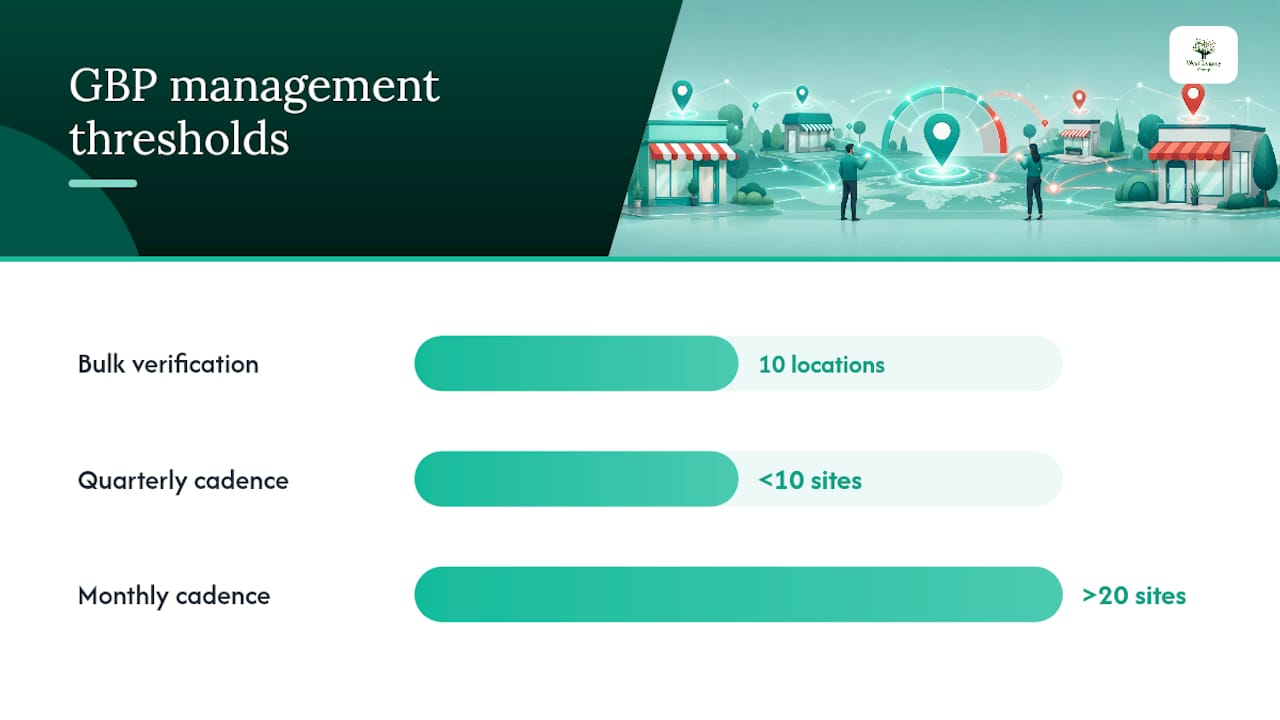
Bulk verification through the Google Business Profile API is available once you’re managing ten or more locations, and it saves real time. Below that threshold, verify each location individually through the standard process, because bulk requests for small portfolios tend to get flagged for manual review and slow everything down.
Follow this sequence when bringing a new location online or auditing an existing one:
- Confirm the legal business name matches exactly across your ABN registration, lease documents, and signage, then use that exact string in the GBP name field.
- Enter the physical address precisely as Australia Post formats it, avoiding suite numbers or descriptors Google’s address validator might reject.
- Select one primary category that matches your core service, then add secondary categories only where they’re genuinely accurate, never to widen your reach artificially.
- Populate every available field, including opening hours, attributes, and a local phone number tied to that specific site rather than a shared 1300 number.
- Cross-check the completed profile against your master data sheet before publishing, and log the verification date in that same sheet.
Naming conventions cause more suspensions than almost anything else. Adding keywords like “best” or a suburb name that isn’t part of your registered trading name breaches Google’s guidelines and risks the entire profile being suspended, not just edited. Keep the name field clean and legally accurate, and let your categories and description carry the local relevance instead.
Pro Tip: Assign one person as the sole editor for each GBP, even across a ten-location group. Shared logins with multiple editors making uncoordinated changes are the single biggest cause of profile suspensions we see in multi-site accounts.
Once verified, every profile needs a recheck cadence. Quarterly is the minimum for a portfolio under ten sites; monthly makes sense once you’re past twenty, simply because the odds of a hijacked listing or a stale hours field rise with scale. Our local SEO checklist for small business walks through the full field list if you want a working template rather than building one from scratch.
When does a location deserve its own page?
Not every site on your master data sheet needs a dedicated URL. Search Engine Land’s guidance on structuring geographic pages at scale is direct: start with your real-world business structure and give every page a job before you create it, not after.
A location earns its own page when it meets a genuine business purpose test. Does it have its own staff, its own opening hours, its own phone number, and enough local search demand to justify a standalone URL? If the answer to all four is yes, build the page. If a location is a satellite office with no separate booking flow and identical hours to the flagship store, folding it into a shared regional page usually serves users and search engines better than a thin, near-duplicate page that competes with its own sibling.
Three structural models cover most small business portfolios:
- Hub-and-spoke, where a central services hub links out to individual location pages, works well for franchises and multi-branch retailers with five or more physical sites.
- Regional pages, covering a metro area or state without naming every suburb, suit businesses with overlapping service areas and no fixed storefront in each one.
- Service-area pages, which suit mobile trades and home-service businesses. Backlinko notes that service-area businesses should hide their street address in GBP settings and rely on the service-area radius instead, since a hidden-address business follows different verification rules to a public storefront.
Whichever model fits, every page that does exist needs elements a duplicate can’t replicate. Search Engine Journal’s research into AI-driven visibility found that hyperlocal content, real staff names, local landmarks, and location-specific social links measurably improve how often LLMs recommend a business over a competitor with a thinner page.
| Page element | Why it matters | Easy to fake? |
|---|---|---|
| Local staff photos and names | Signals a real, staffed premises | No |
| Location-specific reviews embedded | Corroborates GBP review data | No |
| Unique local FAQs | Answers suburb-specific questions | Difficult to fake well |
| Embedded Google Map with correct pin | Confirms address accuracy | No |
| LocalBusiness schema with matching NAP | Machine-readable entity confirmation | No |
| Generic “we service this area too” paragraph | Adds no unique value | Yes, and it shows |
Our guide on the benefits of local area landing pages covers the content brief in more depth if you’re building your first batch.
NAP consistency, citations, and running a review program
Name, address, and phone number consistency sounds like a basic hygiene task until you’re managing it across fifteen directories and eight physical sites simultaneously. Backlinko’s research into scaling multi-location SEO is clear that a centralised master data repository with automated distribution is what prevents mismatched listings at that scale, not manual spot-checks.
Your master sheet should carry, at minimum: legal business name, exact address, primary phone, canonical GBP URL, schema block, and a last-audit date for every location. When something changes, that sheet updates first, then pushes out everywhere else.
- Update the master sheet the moment any location detail changes, including seasonal hours.
- Push the update to your GBP, website, and top-tier aggregators (data providers like Localeze or Foursquare that feed dozens of smaller directories automatically).
- Run a citation audit quarterly using a tool built for multi-location footprints if you’re past ten sites, since manual checking doesn’t scale past that point.
- Flag and correct any mismatch within 48 hours rather than batching corrections monthly.
For review management, treat it as a repeatable program rather than a reactive chore:
- Automate review requests through a post-visit SMS or email trigger, timed within 24 hours of service.
- Respond to every review, positive or negative, within 48 hours using a template that still reads as genuinely personal.
- Track sentiment by location monthly, not just star-rating averages, since sentiment often shifts before ratings do.
- Escalate any location with a sudden negative-review cluster for a manager-level review of what changed on-site.
Our piece on monitoring your small business online reputation covers response templates in more detail than fits here.
Tracking performance and choosing the right tools
You can’t tell which location is actually earning its keep without attribution that separates one site’s traffic from another’s. A generic UTM taxonomy solves most of this: tag every campaign with a consistent structure, such as utm_source=google&utm_medium=organic&utm_campaign=bendigo-store, and assign each physical location a unique ID that maps directly to a field in your CRM.

Call tracking closes the loop that web analytics alone can’t. A unique tracked number per location, dynamically inserted on that location’s page, tells you exactly which site generated a phone enquiry rather than lumping every call into one national total. Pair that with form-fill attribution tagged to the same location ID, and you get a genuine picture of which sites convert and which just generate impressions.
For dashboarding, a tool like Looker Studio connected to Google Analytics 4 and your call-tracking platform gives a small team a single view across every location without custom development work. Filter by location ID, and you can see calls, form fills, and organic sessions side by side for each site.
Tool selection depends entirely on scale:
- Under five locations, GA4, Google Search Console, and a spreadsheet-based dashboard usually cover everything you need.
- Between five and twenty, add a dedicated rank-tracking tool with location-level filtering and a proper call-tracking platform.
- Past twenty, an enterprise local SEO platform starts paying for itself through bulk GBP editing and automated citation monitoring. Search Engine Journal points to tools like Whitespark and GeoRanker for citation discovery once you’re managing that many sites across different cities.
Pro Tip: Build your dashboard around location ID as the primary filter from day one, even if you only have three sites right now. Retrofitting attribution after you’ve opened your tenth location is far harder than building it in from the start.
Setting up governance so the system doesn’t break
Multi-location SEO fails most often not from bad tactics but from no one owning the process once the initial setup is finished. Search Engine Land’s structural guidance puts it plainly: scaling well is a governance problem before it’s a technical one, and the fix is defining who owns what before the second location opens, not the twentieth.
Three roles cover most small businesses:
- A corporate owner who holds the master data sheet, approves new location pages, and signs off on brand-wide template changes.
- A local manager at each site who verifies location-specific facts (hours, staff, local events) but can’t independently edit brand-level content.
- A content approver who checks every new or edited location page against a standard checklist before it publishes, catching duplicate or near-duplicate content before it goes live.
Build your location pages on a modular content model: a set of required fields every page must have (address, hours, schema, primary category) and a set of optional brand fields a local manager can fill in without needing developer help. This keeps pages consistent while still letting each site feel genuinely local.
Finally, write down the procedure for openings, relocations, and closures before you need it. A location that closes without its GBP being marked “permanently closed” and its page redirected properly leaves a stale entity floating around that confuses both customers and algorithms.
Common mistakes and a fast remediation checklist
Most multi-location SEO problems trace back to five recurring errors, and they’re worth hunting down in this order because some carry far more risk than others.
- Doorway pages built purely to rank for a suburb name, with no real staff, hours, or service difference from the flagship location.
- Inconsistent NAP across GBP, website, and directories, often left over from a rebrand or a relocated site.
- Unverified or hijacked GBPs, frequently at locations opened by a since-departed employee who never handed over admin access.
- Missing location-level tracking, which leaves you unable to tell which site is actually driving revenue.
- Duplicate schema or missing schema entirely on location pages, which weakens the entity signals your pages send to search engines and AI tools alike.
Fix these in priority order over four weeks rather than trying to tackle everything at once:
| Week | Focus | Expected outcome |
|---|---|---|
| 1 | Audit every GBP for verification status and admin access | Full list of hijacked or unverified profiles |
| 2 | Reconcile NAP across master sheet, website, and top five citations | Consistent business data across primary sources |
| 3 | Add or repair LocalBusiness schema on every location page | Machine-readable entity data restored |
| 4 | Implement location-level tracking (UTM, call tracking, location ID) | Attribution data flowing into your dashboard |
After each fix, monitor indexing status in Search Console, GBP verification status, and local impressions for that location over the following fortnight. A jump in local impressions without a matching jump in clicks usually means your page is now visible but still needs stronger local content, not a further technical fix.
Templates that make this easier to implement
You don’t need enterprise software to run this properly. A shared spreadsheet and a disciplined process will get a five-to-twenty-location business most of the way there.
Your master data repository should capture, per location: legal name, exact address, primary and local phone numbers, GBP category selections, opening hours, canonical page URL, schema block (as JSON-LD, ready to paste), and a last-audit date. That single sheet becomes the source every other system pulls from.
A modular location page template needs, at minimum:
- A local intro paragraph naming the suburb, nearby landmarks, and what makes that specific site distinct.
- Embedded reviews specific to that location, not a brand-wide review carousel.
- Staff photos or names where privacy allows, since real staff details are hard for a competitor to replicate.
- A local FAQ section addressing questions specific to that site, such as parking or accessibility.
- LocalBusiness schema matching the master data sheet exactly, field for field.
West Legacy Group has built these systems for small business clients running everywhere from two to fifteen physical sites, and the pattern holds regardless of industry: the businesses that treat their data sheet as the single source of truth spend far less time firefighting listing errors later.
Local keyword research for each site, not just the brand
Generic keyword research misses what actually drives foot traffic into a specific location. Each site needs its own research pass, because search behaviour genuinely differs suburb to suburb, even within the same metro area.
Start by pulling Search Console data filtered to each location’s page, if it has traffic history, and look for suburb-specific query variations you haven’t targeted yet. Layer in Google’s “People also search for” and autocomplete suggestions typed from that suburb’s postcode, since local intent often surfaces terms your national keyword list never catches, things like a nearby landmark or a regional nickname for a service.
Competitor analysis needs the same local lens. The business ranking first for “plumber Frankston” isn’t necessarily your national competitor. It’s usually a smaller, hyperlocal operator with a thin website but a strong GBP and dense local reviews. Study what that competitor’s profile and page actually contain, its categories, its review volume, its photo count, rather than benchmarking against a larger rival with no genuine local presence in that suburb.
Build a lightweight keyword map per location: a handful of core service terms, a handful of suburb-plus-service combinations, and any landmark or colloquial local terms that came up in your research. Feed that map into the location page’s headings and FAQ content rather than stuffing it into the intro paragraph, which reads awkwardly and adds nothing an AI system finds credible.
Structured data markup for every location
LocalBusiness schema is the clearest way to tell search engines and AI systems exactly what your location is, where it sits, and how it operates, without them having to infer it from prose.
Every location page needs its own schema block, not a single brand-wide block reused across every site. That block should include the business name, exact address, phone number, opening hours, geo-coordinates, and a link back to that location’s specific GBP profile. Where the business type allows it, add review schema and aggregate rating data pulled from that location’s actual reviews, not a blended brand-wide average.
The most common structured data mistake in multi-location setups is copying one location’s schema block across every page and only changing the business name. Search engines catch this quickly, and it undermines the exact entity-verification signal schema is meant to provide. Validate every block individually using a tool like the schema markup validator from Pingfloat before publishing, since a single malformed field can invalidate the whole block silently.
Keep the schema in sync with your master data sheet. When an address or phone number changes, update the schema at the same time as the GBP and website copy, not weeks later. A mismatch between schema and visible page content is exactly the kind of inconsistency that erodes the trust triangle discussed earlier.
Voice search and mobile behaviour across locations
Voice queries skew heavily toward “near me” and question-based phrasing, and mobile users searching for a physical location are almost always closer to taking action than a desktop searcher browsing from a desk.
Optimising for voice means writing content that answers direct spoken questions naturally: “What time does the Geelong store close on Sunday?” rather than a generic hours table alone. FAQ sections written in that direct, conversational phrasing tend to get pulled into voice answers and AI-generated summaries more often than dense paragraphs written for skimming, not speaking.
Mobile experience matters just as much as the words on the page. A location page that loads slowly or buries the phone number below the fold loses the exact high-intent visitor voice search sends you, someone standing outside deciding whether to walk in. Click-to-call buttons, a tappable map link, and hours displayed above the fold aren’t nice extras on a location page. They’re the difference between a mobile visit converting and bouncing.
Test every location page on an actual phone, not just a browser’s mobile preview, and time how long it takes to find the phone number from a cold load. If it takes more than a couple of seconds of scrolling, that page is losing voice-driven mobile traffic it should be converting.
Local backlinks and genuine community engagement
Backlinks from national directories only go so far. What actually moves the needle for a specific location is a link from a source that’s genuinely, verifiably local, a suburb newspaper, a local business chamber, a school fundraiser page, a sporting club sponsorship listing.
Sponsoring a local junior sports team or community event often earns a link from that organisation’s website, and that link carries real local relevance signal a generic directory listing never will. The same goes for participating in local business awards or chamber of commerce directories, since those sources tend to be well-established, locally trusted, and rarely spammy.
Community engagement compounds this. A location that shows up at local markets, sponsors a school event, or partners with a nearby complementary business builds the kind of organic local mentions and links that no outreach campaign can manufacture at the same quality. Track which of your locations has genuine community ties and which doesn’t, and prioritise link-building effort toward the sites with real relationships to draw on rather than running an identical generic outreach campaign across every location.
Handling duplicate content across a location network
Duplicate content is one of the fastest ways to undermine an otherwise solid multi-location setup, and it usually creeps in through templated copy rather than deliberate shortcuts.
The trap is subtle: a business copies its flagship location page, swaps the suburb name and phone number, and publishes it as a “new” location page. Search engines recognise this pattern quickly, and it weakens every page in the set, not just the newest one, because it signals the pages aren’t independently valuable.
The fix isn’t complicated, but it does take discipline. Every location page needs at least one paragraph of genuinely unique content: local staff details, a specific local FAQ, an actual event or landmark reference, something a templated copy-paste can’t replicate. Where two locations genuinely serve the same audience with no meaningful difference, as covered earlier in the business purpose test, consolidate them into one page rather than maintaining two thin, near-identical ones.
Search Engine Land’s guidance on consolidation is specific here: when merging pages, pick one authoritative URL per intent cluster, redirect the others with a 301, and update the schema to match before checking indexing status over the following weeks. A rushed consolidation without proper redirects loses the entity trust you’d built at the old URL rather than transferring it.
Weaving social media into your local presence
Social profiles aren’t a separate channel from your local SEO work. They’re another entity signal search engines and AI tools cross-reference against your GBP and website.
Location-specific social accounts, or at minimum location-tagged posts from a central account, reinforce the same trust triangle covered earlier: business data, website content, and third-party corroboration. Search Engine Journal’s research into AI visibility specifically flags location-specific social links as a factor that improves how often LLMs recommend a business, separate from the GBP and website signals alone.
Practically, that means linking each location’s GBP to the correct social profile, geotagging posts to the specific suburb rather than a generic brand location, and encouraging customers to tag the specific store or branch when they post about a visit. A single national Instagram account can still work for a small chain, provided posts are consistently geotagged and captioned with the specific location rather than left generic.
Review platforms and social platforms increasingly overlap too. A location with an active, responsive social presence tends to also show stronger review engagement, since customers who see a business actually respond to comments are more likely to leave a review themselves. Treat social consistency as one more field on your master data sheet, not an afterthought handled by whoever has spare time.
Christopher’s quick priority: the single action to begin this month
If you do nothing else this month, build the master data sheet. Every GBP fix, every location page, every citation correction depends on having one accurate source of truth first. Spend week one auditing and documenting; weeks two through four fixing GBPs, NAP mismatches, and missing tracking in that order. Everything else in this guide gets easier once that foundation exists.
— Christopher
Getting your locations built and managed properly
West Legacy Group builds the exact systems this guide describes, location pages, GBP management, and reporting dashboards, without the retainer sizes a national agency typically charges. If you’d rather commission the work than build it yourself, our small business website design packages cover location page architecture from the ground up, built with the modular content model and schema requirements this guide walks through.
Prefer a structured, self-service approach instead? Our build your own SEO plan tool gives you the templates and checklist directly, so you can run the master data sheet and governance process in-house with a clear framework rather than starting from a blank page. If you’re managing five or more locations across Victoria, our Bendigo digital marketing service includes ongoing GBP management and monthly reporting as part of the retainer.
Start by requesting a quick audit of your current location pages and GBPs. It’ll show you exactly which of the fixes in this guide apply to your business first.