

Most professionally built small business websites in Australia cost between $2,000 and $10,000, with ongoing hosting and care running $50 to $400 a month after launch. DIY builds tend to be the least expensive option, freelancers offer a mid-level price point, and agencies generally handle more complex, higher-cost builds. Over multiple years, running costs often approach or exceed the original build cost, so budget for the whole lifecycle, not just the initial expense.
TL;DR:
- Most small business websites in Australia cost between $2,000 and $10,000, with ongoing monthly costs of $50 to $400 for hosting and maintenance.
- Building complexity significantly impacts the total cost, with advanced features or eCommerce functions pushing prices above $6,000 and impacting ongoing expenses.
- Content creation, project scope, and platform choice (DIY, freelancer, or agency) are key factors influencing price and quality; deliberate planning reduces surprises.
- Long-term costs, including hosting, security, and updates, often match or exceed initial build expenses over five years, making website ownership a multi-year investment.
- Proper ownership of domain and hosting in your business name and implementing basic cybersecurity measures are crucial for cost control and site security.
Table of Contents
- What you’ll actually pay: quick price ranges by approach and site type
- Cost breakdown by project phase: where the money actually goes
- Who builds your site: DIY, freelancer or agency
- Ongoing costs after launch: hosting, security and care plans
- Website tiers: what each price band actually buys you
- How to budget: the 5-year view and simple ROI rules
- Tax treatment, ownership and cyber security basics
- Timelines and regional pricing across Australia
- How West Legacy Group prices small business websites
- Why a website is a long-term asset, not a one-off expense
- Get a scoped website quote from West Legacy Group
- Sources
- FAQ
What you’ll actually pay: quick price ranges by approach and site type
Before you get quotes, it helps to know roughly where you should land. Prices swing hard depending on who builds your site and how many moving parts it has.
Here’s a snapshot of what Australian small businesses typically pay, based on aggregated market pricing:
- Landing page (single page, DIY): $0–$500 setup plus $20–$50/month for a template platform
- Landing page (freelancer built): $500–$1,500
- Small brochure site (5–10 pages, DIY/template): $200–$600 in the first year
- Small brochure site (freelancer): $1,500–$8,000
- Custom small business site (agency): $5,000–$15,000
- eCommerce site (freelancer to mid agency): $6,000–$20,000
- Custom web app or booking platform: $15,000–$50,000+
These bands roughly match what Studio Slate’s 2026 Australian pricing guide and WhatsTheDamage’s verified pricing data both report, with most professionally designed small business sites landing between $2,000 and $6,000, and custom or eCommerce builds pushing past $6,000 depending on scope.
After launch, ongoing costs generally run $50 to $400 a month, covering hosting, domain renewal, security monitoring, and any app subscriptions like booking widgets or email marketing integrations.
One thing catches almost every first-time buyer off guard: costs don’t rise in a straight line as you add features. A five-page brochure site with a contact form might cost $2,500. Add online booking, a members’ area, and a product catalogue, and you’re not looking at $3,500. You’re looking at $8,000 or more, because each feature touches design, development, testing, and often a recurring app fee. Complexity compounds. It doesn’t add.
Cost breakdown by project phase: where the money actually goes
Every professional website quote, whether it’s $3,000 or $30,000, breaks down into the same core phases. Understanding what each phase covers helps you interrogate a quote line by line instead of just comparing bottom-line totals.
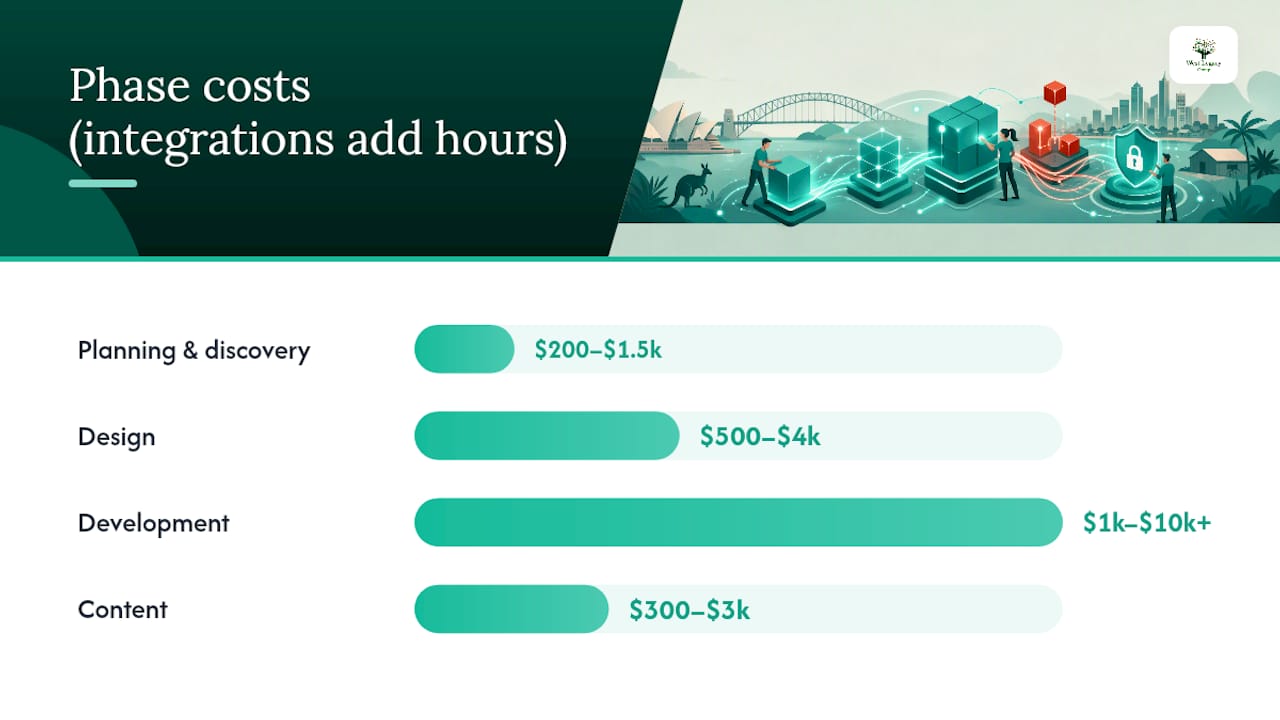
Planning and discovery typically costs $200–$1,500 (or is bundled into the project fee for smaller builds). This covers understanding your business, competitors, target pages, and a sitemap. Skipping this phase is the single biggest cause of scope creep later.
Design runs $500–$4,000 depending on whether you’re getting a templated theme customised with your branding or a fully custom visual design built from scratch. Custom design costs more upfront but tends to convert better because it’s built around your actual customers, not a generic template audience.
Development is usually the biggest line item, at $1,000–$10,000+. This is where pages get built, forms get wired up, and integrations (booking systems, payment gateways, CRM connections) get implemented. Every integration adds hours.
Content (copywriting, photography, product descriptions) costs $300–$3,000 if you’re outsourcing it, or your own time if you’re writing it yourself. Businesses that supply their own high-quality content upfront often save 10 to 20 hours of agency time compared to those who leave content as an afterthought.
Testing and launch typically costs $200–$1,000, covering browser and device testing, speed checks, and go-live support.
Project management is often folded into the overall fee for smaller builds but can be billed separately at 10–15% of total project cost for larger, multi-stakeholder projects.
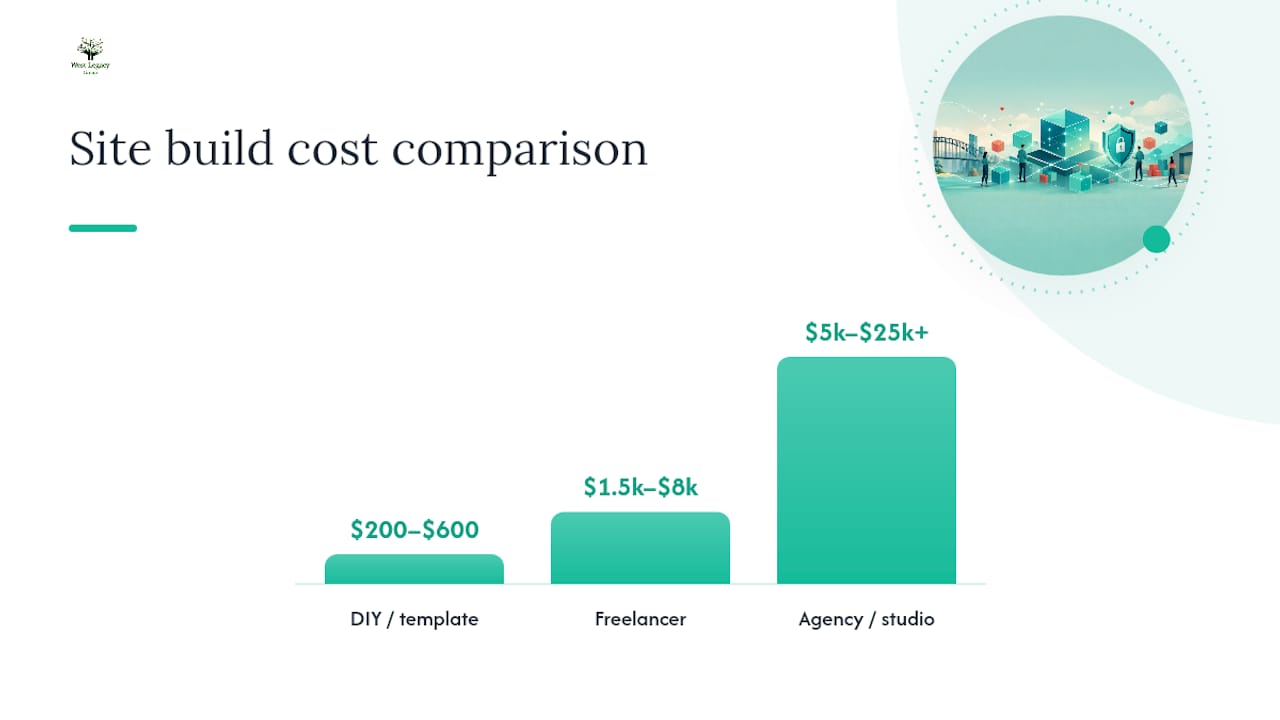
By the numbers: Aggregated Australian market data puts DIY first-year costs at $200–$600, freelancer builds at $1,500–$8,000, and agency projects at $5,000–$25,000 depending on complexity, according to Project Cost Estimator’s 2026 pricing data.
Two realistic examples show how this plays out:
Example 1: A Bendigo plumber wants a 6-page brochure site with a quote request form and Google Maps integration. Planning: $300. Design: $800 (customised template). Development: $1,200. Content: $400 (they write it themselves, agency edits). Testing/launch: $300. Total: roughly $3,000.
Example 2: A regional Victorian homewares retailer wants a Shopify store with 40 products, payment integration, and email marketing connection. Planning: $800. Design: $2,000. Development: $4,500 (product uploads, payment gateway, shipping rules). Content: $1,500 (professional product photography and copy). Testing/launch: $700. Total: roughly $9,500.
Neither business is being ripped off. They’re paying for genuinely different amounts of work.
Who builds your site: DIY, freelancer or agency
Choosing who builds your website is really a decision about how you want to trade money against time, risk, and long-term quality. Each route has a distinct cost and risk profile.
- DIY / template builders (Wix, Squarespace, Shopify’s own builder) cost $200–$600 in the first year, mostly in subscription fees. You supply the labour: design decisions, content, and troubleshooting. GoDaddy’s Australian pricing analysis notes that while these platforms can deliver a functional site under $500, businesses relying on lead generation or paid advertising often need a more capable, professionally built site to actually convert visitors into customers.
- Freelancers typically charge $50–$120 an hour or fixed project fees of $1,500–$8,000 for a small business site. You get more customisation than DIY but less structure than an agency, and quality varies enormously depending on who you find.
- Studios and agencies charge $80–$200+ an hour, or project fees from $5,000 up to $25,000+ for complex builds. You’re paying for a team (designer, developer, project manager) rather than one person wearing every hat, which reduces the risk of a single point of failure.
The DIY route costs the least in dollars but the most in your own time. Building even a simple template site properly, including learning the platform, writing content, and fixing layout issues, commonly eats 20 to 40 hours. If your time is worth $80 an hour in the business, that “free” website just cost $2,000–$3,000 in opportunity cost.
Watch for two red flags regardless of who you hire. First, vague scopes: if a quote doesn’t specify number of pages, revision rounds, or what happens if you need changes after launch, expect the final bill to be higher than the quote. Second, ownership traps: some cheaper providers build your site inside their own hosting account and hold your domain in their name, effectively renting you access to your own business. If they disappear or you stop paying, you lose the site.
Pro Tip: Before you sign anything, ask directly: “Will the domain and hosting account be registered in my business’s name, and will I receive full source files if we part ways?” A legitimate provider answers yes without hesitation.
Ongoing costs after launch: hosting, security and care plans
The build price is only half the budget. Every website carries recurring costs, and these often surprise business owners who budgeted only for the initial build.
Hosting ranges from $10–$30 a month for basic shared hosting to $50–$150 a month for managed WordPress hosting with automatic backups and security scanning, up to $150–$400+ a month for cloud hosting on higher-traffic or eCommerce sites. Domain renewal costs $15–$40 a year for a .com.au domain. Business email through Google Workspace or Microsoft 365 typically runs $8–$15 per user per month.
Care plans (also called maintenance plans or support retainers) cover software updates, security patching, backups, and minor content changes. These typically cost $50–$300 a month depending on scope. A basic plan might just cover plugin updates and backups; a fuller plan includes monthly content edits, uptime monitoring, and priority support if something breaks.
By the numbers: Hosting and maintenance combined typically run $50–$400 a month depending on tier and service level, and WhatsTheDamage’s pricing research notes that over five years, running costs commonly equal or exceed the original build price.
Traffic and functionality both push these numbers up. A brochure site with a few hundred monthly visitors sits comfortably on basic shared hosting. An eCommerce store processing daily orders, or a site running paid traffic campaigns, needs more robust hosting to avoid slowdowns during peak periods, plus higher-tier app subscriptions for things like abandoned cart recovery or inventory syncing.
- Basic hosting + domain: $30–$60/month
- Managed hosting + basic care plan: $100–$250/month
- Cloud hosting + full care plan + apps/integrations: $250–$500+/month
Website tiers: what each price band actually buys you
Matching your budget to the right tier matters more than chasing the cheapest quote. Here’s what you genuinely get at each level.
A landing page ($500–$2,000) gets you one focused page: headline, offer, contact form, maybe a testimonial section. It suits businesses running a single campaign, testing a new service, or needing a placeholder while a bigger site is built. It’s not designed to rank well in search or serve multiple customer journeys.
A small brochure site ($2,000–$8,000) typically includes:
- 5 to 10 pages (home, about, services, contact, and a few service or location pages)
- A content management system (commonly WordPress) so you can edit text yourself
- Mobile-first responsive design
- Basic on-page SEO: title tags, meta descriptions, and a sitemap submitted to Google
This tier suits most trades, local services, and single-location retailers who need a credible online presence without complex functionality.
A custom-built site ($6,000–$20,000) adds proper information architecture (mapping how customers actually navigate your site, not just a generic template structure), custom-designed templates rather than off-the-shelf themes, and dedicated performance work: image compression, caching, and Core Web Vitals optimisation. This tier fits businesses where the website is a primary sales channel, not just a digital business card.
An eCommerce site ($6,000–$25,000+) includes product catalogue setup, payment gateway integration, shipping configuration, and often ongoing app subscriptions for things like reviews, upselling, or email automation. Platforms like Shopify or WooCommerce charge their own monthly fees on top of the build cost, typically $30–$100 a month depending on the plan and app stack.
How to budget: the 5-year view and simple ROI rules
A single build quote tells you almost nothing about what a website actually costs your business. The number that matters is total cost of ownership over several years, because that’s the figure that determines whether the investment was worth it.
Here’s a working example for a $5,000 custom small business build:
- Year 1: $5,000 build + $1,200 hosting/care ($100/month) = $6,200
- Years 2–5: $1,200/year hosting and care × 4 years = $4,800
- 5-year total: approximately $11,000
That means the ongoing costs roughly equal the original build price over five years, which lines up with the pattern WhatsTheDamage’s pricing data shows across the broader market. Businesses that budget only for the build and forget the running costs routinely underestimate their true spend by close to half.
A $5,000 professional WordPress or Shopify build with solid conversion basics often pays for itself within 6 to 12 months if it generates even one or two new clients, particularly for service businesses with a decent average job value.
By the numbers: Budgeting should account for expected traffic and growth, since visitor volume and sales activity drive hosting, backup, and app fees more than the base build complexity does, per Project Cost Estimator’s pricing analysis.
When prioritising where to spend, put conversion-focused features first: a clear call to action, fast load times, and mobile usability beat decorative animations or a fifth stock photo gallery every time. Extra spend is justified when it removes friction between a visitor and a booking, purchase, or enquiry, not when it just makes the site look busier.
Tax treatment, ownership and cyber security basics
Three practical issues shape your real cost beyond the invoice: how the ATO treats the expense, who legally owns the site, and what basic security hygiene you need to budget for.
On tax treatment, the ATO’s guidance on website costs explains that some website expenses may be immediately deductible, while more substantial development work can be treated as capital expenditure depreciated over time. The distinction generally comes down to whether the spend is ongoing running cost (hosting, minor updates) or a significant new asset (a full rebuild or major new functionality). Because this varies by circumstance, check the ATO’s own guidance or talk to your accountant before assuming a large build is fully deductible in the year you pay for it.
On ownership, insist that your domain and hosting account sit in your business’s name, not a developer’s personal or agency account. Studio Slate’s analysis notes that websites treated as owned assets, with domain, hosting, and code genuinely under the business’s control, avoid recurring vendor lock-in and typically cost less over three years than sites where you’re renting access from a provider. Ask for exportable backups and confirm you can move hosting providers without losing the site, particularly when a care plan bundles hosting and support together.
On security, budget for basic protections from day one rather than treating them as optional extras. Cyber lists practical, low-cost actions every business website should have: strong unique passwords for admin accounts, multi-factor authentication, regular software updates, and automated backups. These usually cost little beyond what a decent care plan already includes, but skipping them is one of the more expensive mistakes a small business can make, since a hacked site can mean lost sales, damaged reputation, and unplanned recovery costs that dwarf the original build price.
- Confirm domain registration details show your business as the registrant
- Ask whether backups are automated, and how often
- Check whether multi-factor authentication is enabled on your hosting and CMS logins
- Clarify who patches security vulnerabilities and how quickly
Timelines and regional pricing across Australia
Realistic timelines matter as much as price when you’re planning a launch date around a campaign or busy season. A template-based DIY site can go live in a few days to two weeks. A freelancer-built brochure site typically takes three to six weeks. A custom agency build runs six to twelve weeks, and a full eCommerce store with product catalogue setup often takes eight to sixteen weeks depending on how many products need uploading.
Regional pricing genuinely differs. Bark’s commentary on Australian web design costs notes that regional pricing often sits 15 to 30% lower than metro rates, though specialised technical talent and niche agency expertise are more commonly found in capital cities. Hiring remotely, which most web design work supports easily, often lets regional businesses access metro-quality work without paying metro overheads.
- DIY: days to 2 weeks
- Freelancer brochure site: 3 to 6 weeks
- Agency custom build: 6 to 12 weeks
- eCommerce store: 8 to 16 weeks
Pro Tip: Write down every page, feature, and integration you want before requesting quotes, and send the identical brief to every provider. A clear, detailed brief reduces vendor quote variance because agencies price unknowns as contingency. The less they have to guess, the tighter and more comparable your quotes will be.
How West Legacy Group prices small business websites
We build small business websites and manage the SEO, content, and digital marketing that goes with them, so we see the full cost picture from build through to years of ongoing running costs. That vantage point shapes how we scope every quote.
Two anonymised project sketches show the range we typically work within. A regional trades business needed a 7-page brochure site with a quote request form and local SEO basics; the project landed in the $3,000-to-$4,500 range with a six-week turnaround, and organic enquiries picked up within the first quarter after launch. A Victorian retailer moving from a marketplace-only presence to their own Shopify store needed product uploads, payment integration, and email marketing setup; that project sat closer to $9,000, reflecting the volume of product data and integration work involved.
When we scope a quote, we work through a consistent checklist so clients know exactly what they’re paying for:
- How many pages, and what does each page need to achieve for the business
- Which integrations are essential now versus “nice to have later”
- Who supplies content (copy, photos, product data) and what that means for timeline
- What ongoing care and hosting tier actually matches expected traffic
- Whether domain and hosting will sit in the client’s business name from day one
That last point comes up more than you’d expect. Plenty of business owners have never checked who actually owns their domain, and it’s the cheapest five-minute check that can save a very expensive headache later.
Why a website is a long-term asset, not a one-off expense
The biggest mistake I see in how small businesses think about website cost is treating it like a single transaction instead of an asset with a multi-year lifespan. A $5,000 site that you own outright, with your domain in your name and exportable code, is worth more to your business over five years than a $2,000 site that locks you into someone else’s hosting account indefinitely. The cheaper option often costs more once you factor in the switching costs if that provider disappears or raises prices.
The right amount to spend isn’t a fixed number. It’s a function of your business model. A tradie relying on word-of-mouth referrals needs a credible, fast-loading brochure site far more than a flashy custom build. A retailer competing on price and convenience needs a frictionless checkout more than beautiful photography. Match the spend to what actually drives revenue in your specific business, not to what looks impressive to competitors.
— Christopher
Get a scoped website quote from West Legacy Group
If you’ve read this far, you already know the real cost of a small business website depends on scope, not guesswork, and getting that scope right the first time is where West Legacy Group earns its keep. Unlike hiring a generalist freelancer or gambling on a DIY template, Some providers scope builds using frameworks designed around trust signals recognised by search engines and AI platforms. They aim to create websites that perform effectively, not just exist.
Our Small Business Website Design Packages cover the full range this article has walked through, from brochure sites to custom builds and eCommerce stores, with transparent scoping before any quote is finalised. An initial enquiry typically includes a discovery conversation about your goals, a review of your current site (if you have one), and a written scope covering pages, features, timeline, and ongoing care options.
For businesses wanting the website and the marketing that drives traffic to it handled together, our Sapling, Oak, and Redwood plans pair website work with SEO and local visibility, including Google Business Profile management for businesses relying on local search. If you’re running or planning a Shopify store, our Shopify eCommerce SEO service is built specifically for that platform’s quirks.
Ready to find out what your project would actually cost? Get in touch through the Small Business Website Design Packages page and we’ll scope it properly before you commit to anything.
Sources
For readers who want to verify figures or dig deeper into specific rules, the following sources back the pricing and compliance guidance in this article. The ATO’s website costs guidance covers deductible treatment of website expenses. cyber.gov.au publishes small business cyber security guidance covering passwords, backups, and multi-factor authentication. For pricing verification, WhatsTheDamage’s 2026 Australian web design pricing survey, Studio Slate’s Australian cost guide, and Project Cost Estimator’s 2026 pricing data all provided the market ranges used throughout this article. For a look at how agencies frame pricing conversations more broadly, Chrome Cactus Studio’s insights page is worth a read.
- Web Design Cost Australia 2026: $2,000–$15,000 Verified Pricing
- Cyber
- Small Business Website Cost 2026 — Real Pricing Data
FAQ
How much should I pay for a small business website?
Most Australian small businesses should budget $2,000 to $10,000 for a professionally built website, depending on complexity, with most landing between $2,000 and $6,000 for a standard brochure site. eCommerce and custom builds typically sit higher, and you should also budget $50 to $400 a month for ongoing hosting and care after launch.
How much does it cost to host a website in Australia?
Basic shared hosting costs $10 to $30 a month, while managed WordPress or cloud hosting for busier sites runs $50 to $400 a month depending on traffic and service level. Domain renewal adds $15 to $40 a year on top of hosting.
What is the best website builder for small businesses in Australia?
There’s no single best platform. It depends on your needs: WordPress suits businesses wanting full content control and flexibility, Shopify suits product-based eCommerce sellers, and template builders like Wix or Squarespace suit very simple sites on tight budgets. Some agencies build primarily on WordPress and Shopify for small business clients, as both platforms support SEO and growth efforts commonly needed by Australian small businesses.
How much should I pay someone to host my website?
If a developer or agency is hosting your site as part of a care plan, expect to pay $50 to $300 a month depending on the level of support included, such as backups, updates, and monitoring. Always confirm the domain and hosting account are registered in your business’s name, not the provider’s, to avoid losing access if you switch providers later.