

Geo-targeted content delivers different marketing messages or assets to users based on their detected geographic location. A plumber in Parramatta sees a landing page about blocked drains in Western Sydney; a shopper in Melbourne gets a promotional email for same-day delivery from the Southbank store. You use location-based content when your offer, pricing, or service area genuinely differs by geography — not simply to personalise for its own sake.
Table of Contents
- What is geo-targeted content and how does it work?
- Real-world use cases: how businesses apply location-based content
- How to create geo-targeted content campaigns: a step-by-step checklist
- Legal and privacy considerations for geo-targeting in Australia
- Best practices and common mistakes in geo-targeted content
- Key takeaways
- A practitioner’s perspective on geo-targeted content
- Why most geo campaigns underperform before they even launch
- West Legacy Group can help you build and measure geo-targeted campaigns
- Useful sources for further reading
What is geo-targeted content and how does it work?
Geo-targeting delivers different content, experiences, or redirects to visitors based on their detected physical location, using IP lookup databases, device signals, and geolocation data. Understanding the signal chain helps you choose the right method and set realistic accuracy expectations.
Core location signals:
- IP geolocation resolves a visitor’s approximate location from their IP address. It is the most common signal for web content and typically accurate to city level in metro Australia, though it can misplace rural users by hundreds of kilometres.
- GPS and Wi-Fi on mobile provide far greater precision, down to street level, but require explicit device permission from the user.
- Device and system localisation uses language, time zone, and currency settings as soft signals when harder data is unavailable.
- CRM and first-party address data is the most reliable signal you have. A customer’s billing postcode or delivery address removes the guesswork entirely.
- Ad platform radius targeting (Google Ads, Meta Ads) lets you draw a radius around a physical location and serve ads only within it.
How systems resolve location: When a visitor lands on your site, the server queries an IP lookup database to assign a country, state, and city. On mobile, if the user has granted location permission, GPS coordinates override the IP estimate. Ad platforms layer their own identity graphs on top, matching device IDs and logged-in account data to known addresses.
Types of geo-targeting by granularity:
- Country level (e.g. Australia vs New Zealand pricing)
- State or territory level (e.g. Queensland summer promotions)
- City level (e.g. Sydney vs Brisbane service pages)
- Postcode or radius level (e.g. 5 km around a store)
- Behavioural location patterns (e.g. users who frequently visit a suburb)
Accuracy varies across Australia. Metro areas like Sydney, Melbourne, and Brisbane typically resolve to suburb level via IP. Regional and rural areas are less predictable — a user in Broken Hill may resolve to a city hundred of kilometres away. For campaigns where precision matters, rely on first-party data or GPS-enabled mobile signals rather than IP alone.
Pro Tip: In Google Ads, always choose “Presence” targeting rather than “Presence or interest” for local service campaigns. “Interest” targeting includes users who search for your location but live elsewhere, which wastes budget on people who cannot actually use your service.
Real-world use cases: how businesses apply location-based content
Geo-targeted content works across a wide range of industries. The five examples below show what it looks like in practice.
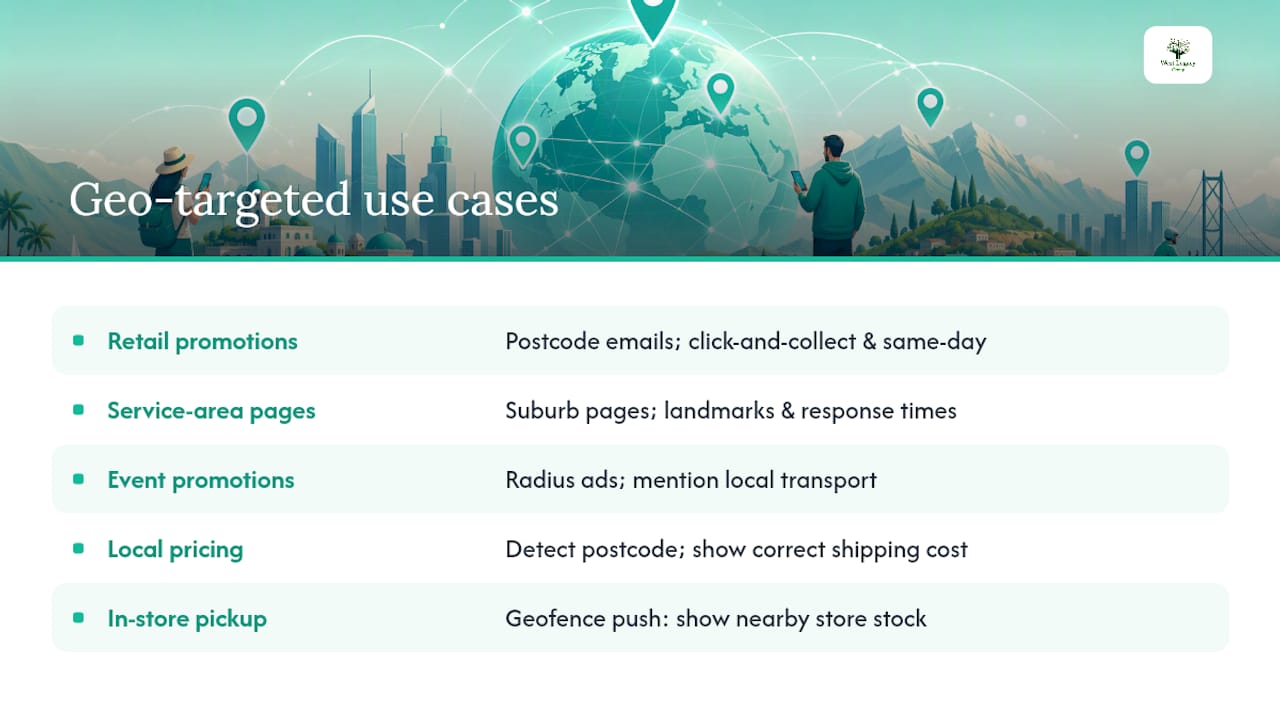
Retail promotions tied to store proximity. A national retailer creates postcode-specific email campaigns promoting in-store events at the nearest branch. Customers near a store receive messaging about click-and-collect availability and same-day pickup, while customers outside that radius see standard online delivery messaging. The offer matches what the customer can actually act on.
Service-area pages for tradies and local service providers. A plumbing business in Greater Sydney builds separate landing pages for Parramatta, Penrith, and the Hills District. Each page references local landmarks, typical job types in that area, and response times. This is more than swapping a suburb name — effective geo-targeted content requires local research, service-area proof, and optimised on-page signals to rank and convert. See how local area landing pages can lift conversions for small businesses.
Event promotions with radius targeting. A venue in Fitzroy, Melbourne runs Facebook and Instagram ads targeting users near the venue for an upcoming gig. The creative references the suburb and public transport options from the CBD. Users outside Victoria see a different ad, or no ad at all.
Local pricing and shipping thresholds. An eCommerce business offers free shipping to metro postcodes in Sydney and Melbourne but applies a flat rate to regional and rural addresses. The website detects the visitor’s postcode and displays the correct shipping cost before checkout, reducing cart abandonment caused by surprise fees at the final step.
In-store pickup and inventory messaging. A hardware retailer uses GPS-enabled geofencing to push a notification to app users who enter close proximity to a store. The message shows current stock of a product the user browsed online. This kind of in-app geofencing is particularly effective for considered purchases where stock availability is a deciding factor.
Combining geo-targeting with local social proof — Google reviews from customers in the same suburb, or testimonials naming a specific area — strengthens trust further. Local community content is one of the most underused assets in this kind of campaign.
How to create geo-targeted content campaigns: a step-by-step checklist
A structured approach prevents the two most common failures: targeting too broadly and launching without a measurement plan.
-
Define your objective. Are you driving foot traffic, generating local leads, or reducing cart abandonment from shipping surprises? The objective determines which channels and geo granularity make sense.
-
Select your geographies. Ask: where are your existing customers concentrated? Where do you have physical capacity to serve? Use Google Analytics location reports or your CRM to identify your top-performing postcodes or cities before you spend a dollar.
-
Map offers to locations. Not every location needs a different offer. Identify where the message genuinely needs to change — different pricing, different availability, different seasonal relevance — and build content only for those differences.
-
Choose your channels. Match channel to signal quality. For high-precision local campaigns, GPS-enabled mobile or first-party CRM data outperforms IP-based web targeting. For broad state-level awareness, search and social ads are sufficient.
-
Assemble your data sources. Confirm you have consent to use location data (see the privacy section below). Gather postcode lists, CRM segments, or store location coordinates before building campaigns.
-
Build location-specific assets. Create landing pages, ad creative, and email content that reflects the local context. Reference local landmarks, service response times, or community-specific details. A page that only swaps a suburb name in the title is not geo-targeted content — it is a template.
-
Configure tracking before launch. Set up UTM parameters with a location dimension (e.g.
utm_content=sydney-north). Tag conversion events in Google Analytics 4 or your ad platform so you can compare performance by geography from day one. -
Run a controlled test. Launch in two or three locations first. Use one as a control (no localisation) and the others as treatment variants. A minimum of two to four weeks of data per location gives you enough signal to make budget decisions.
-
Review, refine, and scale. Shift budget toward the locations showing the lowest cost per acquisition. Refine radius or postcode segments based on actual conversion geography, not assumed catchment areas. The local SEO checklist from West Legacy Group covers the on-page and technical steps that support this kind of campaign.
Legal and privacy considerations for geo-targeting in Australia
Location data is personal information under the Privacy Act 1988 (Cth) and the Australian Privacy Principles (APPs). If you collect, use, or disclose location data about identifiable individuals, you must handle it in accordance with those principles.
Key obligations under the APPs:
- Consent and notice: Tell users what location data you collect, why you collect it, and how it will be used. This must happen at or before the point of collection — a buried privacy policy is not sufficient notice for GPS-level data.
- Purpose limitation: Use location data only for the purpose you disclosed. Collecting postcode at checkout for shipping and then using it to build a retargeting audience is a secondary use that requires separate consent.
- Data minimisation and retention: Collect only the location granularity you need. A postcode is sufficient for most email segmentation; GPS coordinates are only justified for geofencing use cases. Delete or de-identify location data when it is no longer needed.
- Security: Store location data securely, with access controls. Precise GPS data combined with a name and contact details is sensitive personal information.
Practical consent steps:
- Use a clear, plain-English permission prompt for any GPS or device location access in your app or website.
- Include a location data clause in your privacy collection notice at sign-up or checkout.
- Give users a way to opt out of location-based personalisation without losing access to the service.
Risk areas to watch: Geotargeting is subject to legal limits in various jurisdictions. In Australia, the highest-risk scenarios involve using third-party location data brokers (where the original consent chain may be unclear), cross-border data flows to ad tech platforms outside Australia, and targeting based on sensitive inferred attributes derived from location patterns (e.g. inferring health conditions from visits to medical facilities). For these use cases, get legal advice before you build the campaign.
This article provides general information, not legal advice. Confirm current obligations under the Privacy Act and APPs with a qualified privacy professional or the Office of the Australian Information Commissioner.
Best practices and common mistakes in geo-targeted content
The gap between a geo campaign that converts and one that wastes budget usually comes down to a handful of avoidable decisions.
Do:
- Use first-party data (CRM postcodes, delivery addresses) as your primary location signal wherever possible.
- Build genuinely local content — local landmarks, service response times, community references — not just a city name in the H1.
- Add LocalBusiness schema and PostalAddress structured data to every location-specific page so search engines can reliably associate your content with your service area.
- Set up location-level conversion tracking before launch, not after.
- Test presence targeting before adding interest targeting in Google Ads.
Don’t:
- Target the whole country when you can only service three states.
- Assume IP geolocation is accurate enough for postcode-level campaigns in regional Australia.
- Launch location-specific pages without unique, locally relevant content — thin duplicate pages can harm your organic rankings.
- Ignore privacy consent requirements because “everyone does it.”
Presence vs interest targeting: a direct comparison
| Setting | Who it reaches | Best for |
|---|---|---|
| Presence | People physically located in the target area | Local service providers, retail, tradies |
| Interest | People who search for or show interest in the area | Tourism, relocation services, national brands |
| Presence or interest | Both groups combined | Broad awareness campaigns with national reach |
For most small businesses and local service providers in Australia, presence targeting prevents budget leakage by excluding users who are researching your location from interstate or overseas but cannot actually use your service.
Pro Tip: If your Google Ads campaign is generating clicks but low-quality leads, check your location report. Filter by “user location” rather than “location of interest” to see where your actual clickers are physically located. You may find a significant portion of your spend is going to users outside your service area.
For guidance on ranking in local Google searches, the technical and on-page factors that support geo-targeted pages are closely aligned with local SEO best practice.
Key takeaways
Geo-targeted content works when the message, offer, or page genuinely reflects the local context — not just the location name.
| Point | Details |
|---|---|
| Definition | Geo-targeted content delivers different messages or assets to users based on their detected geographic location. |
| Choose presence targeting | For local service campaigns in Google Ads, presence targeting prevents wasted spend on users outside your service area. |
| Measure by location from day one | Set up UTM parameters and conversion tracking with a location dimension before launching any geo campaign. |
| Privacy compliance is mandatory | Location data is personal information under the Privacy Act 1988 and APPs — collect only what you need and disclose how you use it. |
| West Legacy Group | West Legacy Group builds location-specific landing pages, local SEO, and campaign measurement set-up for small businesses across Australia. |
Three actions to take now:
- Open Google Analytics 4 and pull a location report for the past 90 days. Identify your top three converting cities or postcodes.
- Choose one high-traffic page and rewrite it with genuine local content: local references, service response times, and a LocalBusiness schema tag.
- Run a small radius test in Google Ads using presence targeting only, with a dedicated UTM tag, for two weeks.
A practitioner’s perspective on geo-targeted content
Why most geo campaigns underperform before they even launch
The most common mistake is treating geo-targeting as a distribution setting rather than a content decision. Marketers tick the location box in Google Ads or Meta, point it at a generic landing page, and wonder why the CPA is no better than their national campaign.
The location signal is only half the equation. The content on the other end of the click has to earn the trust of someone who lives in that postcode. That means referencing what they actually experience: local traffic, local competitors, local pricing norms, local weather if it’s relevant. A tradie in Geelong is not convinced by a page that says “serving Geelong” in the title and then reads identically to the Melbourne version.
The businesses that see real results from location-based content are the ones who treat each geography as a distinct audience with distinct concerns, not a copy-paste template with a suburb swap. That requires more upfront work, but the conversion rate difference between a genuinely local page and a templated one is substantial enough to justify it every time.
Start with your one or two highest-value service areas. Build those pages properly. Measure them for four weeks. Then scale the model to the next tier of locations. That sequenced approach consistently outperforms launching ten thin pages at once.
West Legacy Group can help you build and measure geo-targeted campaigns
Small businesses that want to compete on local search and location-based advertising need more than a location tick-box in an ad platform. West Legacy Group builds the full stack: location-specific landing pages with proper schema markup, local SEO set-up and Google Business Profile management, campaign configuration for Google Ads and Meta Ads with presence targeting and conversion tracking, and clear reporting so you can see CPA by geography from week one.
The difference between a geo campaign that pays for itself and one that leaks budget is usually in the setup: the right targeting settings, genuinely local content, and tracking that actually captures location-level conversions. West Legacy Group handles all of that as part of a monthly retainer or project engagement, with packages built to be affordable for small businesses and tradies. If you need location-specific landing pages fast, the small business website packages are a practical starting point. Get in touch to scope what a geo-targeted campaign looks like for your service area.
Useful sources for further reading
- What Is Geo-Targeting? The Complete Guide for 2026 | GeoSwap — Free Geo-Targeting
- Geotargeting Guide: How It Works in 2026 — AI Digital
- Google Ads location targeting guidance — Benly.ai learn centre
- The content corner: location-aware content | Digital.gov
- Geo‑Targeted Content: Creating Content for Local Audiences – LSEO
- What Is Geotargeting and Why It’s an Important Advertising … | Mailchimp
- Geotargeting – Quantcast