

Neighbourhood content pages are the most efficient tool a local business has for winning hyperlocal search, earning community trust, and getting cited by AI answer engines. The role of neighbourhood content pages goes well beyond a simple location landing page: done properly, they function as the authoritative local source that Google, ChatGPT, and Perplexity pull from when generating overviews.
- SEO impact: Neighbourhood pages face significantly lower competition than city-level queries and can outrank large portal pages by answering specific lived-experience questions those portals omit.
- Engagement value: Pages that lead with resident-focused value — schools, commute times, local events — convert at materially higher rates for local intent queries than generic city pages.
- Authoritativeness requirement: AI engines extract the first 60–120 words into overviews, so your lead paragraph and data freshness cadence directly determine whether you get cited or ignored.
Table of Contents
- Why neighbourhood pages give local businesses a real edge
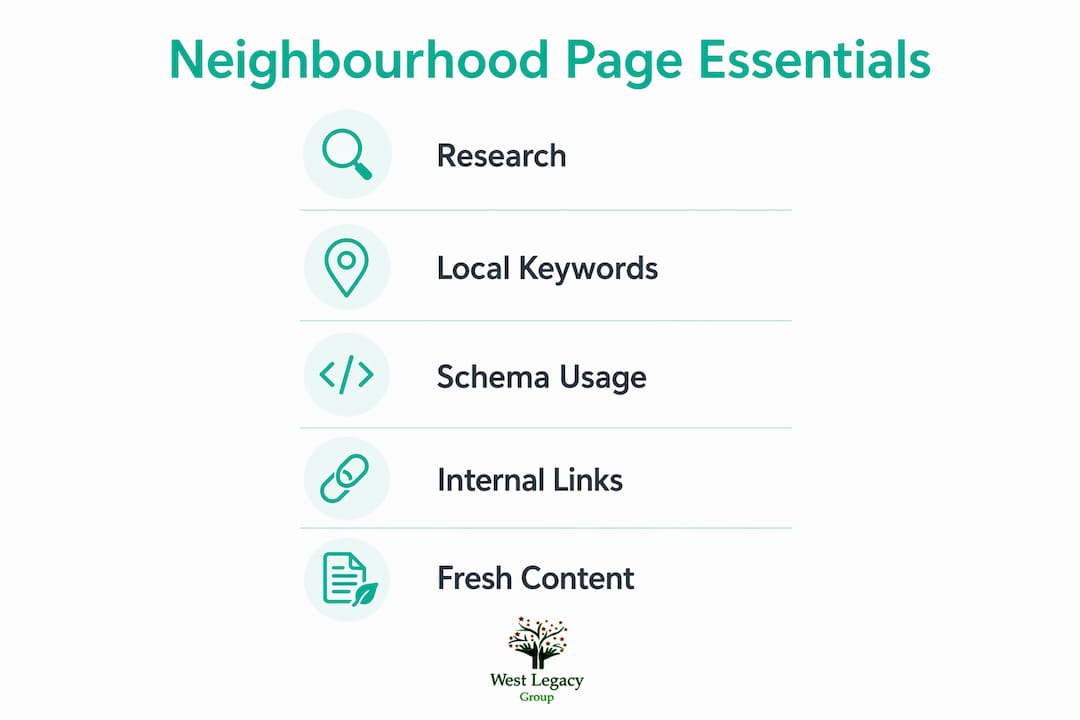
- What every effective neighbourhood page must include
- How to make neighbourhood pages rank: structure, links, and technical tactics
- Common mistakes that make neighbourhood pages fail
- How to measure success and what it realistically costs
- Your copy-ready neighbourhood page template
- How West Legacy Group builds neighbourhood pages
- Key takeaways
- Why neighbourhood pages keep delivering — a founder’s perspective
- West Legacy Group’s neighbourhood content services
- Useful sources
Why neighbourhood pages give local businesses a real edge
City-level and portal queries are crowded. A search for “real estate Melbourne” puts you against Domain, REA Group, and every major agency with a national budget. Search for “buying in Thornbury” or “living in Grange SA” and the competition thins dramatically. Neighbourhood pages can outrank large portal programmatic pages because they answer specific lived-experience questions portals omit — noise levels, flood risk streets, parking realities, school catchment boundaries.
The conversion benefit compounds this. A visitor landing on a neighbourhood-specific page already knows the suburb they want. Their intent is sharper, their decision timeline shorter, and their tolerance for generic copy lower. Pages tailored to the neighbourhood rather than the city convert at materially higher rates for local intent queries.
AI answer engines (AEO/AIO) amplify the advantage further. When someone asks ChatGPT or Perplexity “what’s it like to live in Fitzroy North?”, the engine scans for front-loaded, factual, hyperlocal sources. Luxury real estate agents who structured neighbourhood guides for AEO/AIO formats saw up to 3x organic traffic improvements in reported client examples. That signal is hard to ignore.
- Focus on one suburb per page, not a regional cluster.
- Use the suburb name in the H1, opening paragraph, and at least two subheadings.
- Attribute the page to a named author with local credentials to satisfy E-E-A-T requirements.
- Update market data on a defined cadence (more on this below).
Pro Tip: Add a short “About the author” line at the bottom of each neighbourhood page naming the author’s years of local experience or specific area knowledge. Google’s quality rater guidelines reward this kind of first-hand expertise signal.
What every effective neighbourhood page must include
AI engines extract the first 60–120 words into overviews, so your opening paragraph must be a tight, factual summary of the suburb — not a welcome message. Think: location, character, price range, and one distinctive fact.
Beyond the lead, these content blocks make a page substantive enough to rank and convert:
- Market snapshot: median prices, recent sales trends, and inventory levels. Market data requires a maintenance cadence — ideally every six months in fast markets, at least annually otherwise.
- Property types: house, unit, townhouse split; typical block sizes; heritage overlays if relevant.
- Schools and catchments: named primary and secondary schools with their catchment boundaries. Named schools are among the strongest hyperlocal signals AI engines and users value.
- Transport and commute: train lines, tram routes, bus frequency, and realistic drive times to the CBD.
- Amenities and lifestyle: named cafés, parks, sporting clubs, and shopping strips — not generic descriptions.
- Trade-offs and honest observations: flood-prone streets, traffic noise near arterials, limited parking near the station. AI engines favour nuance over brochure copy.
- Local events and community groups: farmers’ markets, council events, neighbourhood Facebook groups.
- FAQ block: Area FAQ pages are among the highest-performing formats for AI citation because they mirror the question-answer shape AI overviews extract.
For schema, apply LocalBusiness with areaServed set to the suburb name, and FAQPage schema on your FAQ block. Both increase the probability of rich results and AI extraction.
How to make neighbourhood pages rank: structure, links, and technical tactics
Start with keyword targeting. Your primary target is the neighbourhood head query (“living in Newtown Geelong”) plus long-tail question variants (“is Newtown Geelong good for families?”). Use the suburb name in the title tag, H1, and opening sentence.
- Title tag: “Living in [Suburb] — [City] | [Brand]” keeps it under 60 characters and signals intent.
- H1: Match the title tag closely; include the suburb name and a benefit phrase.
- Opening paragraph: Front-load the 60–120 word summary. This is your AI citation window.
- Subheadings: Use question-format H2s and H3s (“What are the schools in [Suburb]?”) to capture featured snippets.
- Internal linking: Build a hub-and-spoke model. Your city hub page links out to each suburb spoke; each spoke links back to the hub and to relevant service pages. A hub-and-spoke model helps scale topical authority while preventing keyword cannibalisation. This local SEO checklist covers the broader audit steps.
- Schema:
LocalBusiness+areaServed,FAQPage, andBreadcrumbListas a minimum. - Images and maps: Embed a Google Map of the suburb boundary; use descriptive alt text with the suburb name.
- Minimum substance: Each page needs roughly 600 words of unique, location-specific content to avoid thin-content or doorway-page signals.
Pro Tip: Assemble your local inputs first — recent sales data, Google reviews that mention the suburb, school catchment PDFs — then use an AI tool to draft headings and structure. AI drafts typically need 60–80% rewriting to incorporate street-level nuance, so treat the AI output as a scaffold, not a finished page.
For local search rankings, bidirectional internal links between hub and spoke pages are one of the fastest wins you can implement today.

Common mistakes that make neighbourhood pages fail
Most neighbourhood pages fail for one of five reasons:
- Templated near-duplicate copy: swapping the suburb name into an identical page structure triggers thin-content filters and confuses users who notice the copy is identical to the next suburb over.
- Programmatic listing-only content: a page that is just an IDX feed with no editorial context provides no unique value and ranks accordingly.
- Stale market data: publishing median prices that are two or more years old harms credibility with both users and search engines.
- No author attribution: anonymous pages score poorly on E-E-A-T, particularly for YMYL-adjacent topics like property and community safety.
- Business promotion before local value: pages that open with “We are the number one agent in [Suburb]” before delivering any resident-useful information convert poorly and earn high bounce rates.
Red flag audit: Open five of your neighbourhood pages side by side. If the structure, sentence openings, and paragraph lengths look identical except for the suburb name, you have a duplication problem. Quick fix: add at least three facts that are true only for that suburb — a named street, a specific school, a local event — and rewrite the lead paragraph from scratch for each page.
How to measure success and what it realistically costs
Track these KPIs from day one: ranking position for the neighbourhood head term, organic impressions and clicks in Google Search Console, referral traffic from AI overview sessions in GA4, lead-source attribution in your CRM, and conversion rate on the page’s primary CTA.
| Timeline | Expected outcome |
|---|---|
| Weeks 1–4 | Page indexed; impressions begin in Search Console |
| Months 1–3 | Initial ranking movement for long-tail question queries |
| Months 3–6 | Head-term ranking improvement; first AI overview citations possible |
| Months 6 | Stable rankings; measurable lead attribution; conversion data available |
Cost varies by scope. A single well-researched neighbourhood page typically requires 3–6 hours of research and writing, plus 1–2 hours for schema, images, and internal linking. Ongoing data maintenance — the item most businesses underestimate — adds roughly 1–2 hours per page every six months. Subscription maintenance packages from providers like West Legacy Group spread this cost predictably. For reporting and analytics setup, instrument Google Search Console, GA4 (with a neighbourhood-page segment), and a lead-source field in your CRM from the start.
Neighbourhood pages convert at materially higher rates for local intent queries, which means the cost-per-lead calculation tends to favour them over broad city-level campaigns.
Your copy-ready neighbourhood page template
Use this outline as a starter for every page you build.
- H1: “[Suburb Name]: living, buying, and what locals actually think”
- Lead paragraph (60–120 words): Location, character, median price, one distinctive fact, and who the suburb suits.
- Market snapshot block: Median house and unit prices, recent trend direction, days on market.
- Who it suits (and the trade-offs): Honest two-paragraph section covering lifestyle fit and known drawbacks.
- Amenities: Named cafés, parks, shopping, sporting clubs.
- Schools: Named schools with catchment note.
- Transport: Train/tram/bus lines and realistic CBD commute time.
- Current listings link: Internal link to your live listings filtered by suburb.
- FAQ block: 3–5 questions in
FAQPageschema. - Author bio and update log: Author name, credentials, and last-updated date.
Publication standards checklist:
- Minimum 600 words of location-specific content (not boilerplate).
- At least three facts true only for this suburb.
- Market data no older than six months in fast markets; twelve months maximum otherwise.
- Named author with a local credential or stated area experience.
LocalBusiness,FAQPage, andBreadcrumbListschema applied.- Bidirectional internal links to city hub and at least one service page.
Sample lead paragraph (Fitzroy North, Victoria):
Fitzroy North sits 4 km north of Melbourne’s CBD, bordered by the Merri Creek trail and Rushall Station on the Hurstbridge line. The suburb draws young families and long-term renters with its mix of Victorian terraces, post-war semis, and a tight-knit café culture centred on St Georges Road. Median house prices sit above the inner-north average, reflecting demand that has stayed consistent through recent market cycles. The trade-off: street parking near the station is genuinely difficult, and the Edinburgh Gardens precinct draws weekend crowds that some residents find disruptive.
Sample FAQ Q&A:
Q: Is Fitzroy North good for families?
A: Yes — the suburb has strong primary school options within catchment, direct tram access to secondary schools, and Edinburg Gardens as a major green space. The main consideration for families is the limited off-street parking and higher entry price compared with neighbouring Northcote.
For home-services businesses targeting new residents, how landscaping companies target new homeowners shows how neighbourhood-level content can be paired with direct outreach to reach buyers at the right moment.
How West Legacy Group builds neighbourhood pages
West Legacy Group’s approach to neighbourhood content starts with boots-on-the-ground research before a single word is written. The methodology covers:
- Pulling current sales data and listing snapshots from publicly available sources.
- Collecting Google reviews that mention the suburb by name for authentic sentiment signals.
- Sourcing school catchment maps, council event calendars, and transport timetables.
- Drafting structure with AI tools, then rewriting 60–80% of the copy to incorporate local specifics.
- Applying
LocalBusiness,FAQPage, andBreadcrumbListschema on every page. - Setting a six-month data refresh reminder for fast-moving markets.
The result is pages that satisfy both the importance of local content for E-E-A-T and the structural requirements AI answer engines use when selecting sources for overviews.
West Legacy Group’s guiding principle: build each neighbourhood page as if a local resident wrote it — because that is exactly the standard AI engines and Google’s quality raters are applying. Generic copy, no matter how well-structured, will not hold a ranking when a genuinely local source exists.
West Legacy Group has been building digital assets for small businesses for over 20 years. If you want a neighbourhood content audit or a page build scoped to your market, get in touch via the West Legacy Group website.
Key takeaways
Neighbourhood content pages work because they combine lower competition, higher conversion intent, and AI citation potential in a single asset — but only when built with genuine local specificity and maintained on a regular data cadence.
| Point | Details |
|---|---|
| Lower competition wins | Suburb-level queries face far less competition than city-level searches, making ranking achievable for small businesses. |
| Front-load your lead | AI engines extract the first 60–120 words, so your opening paragraph must be factual and suburb-specific. |
| 600-word minimum | Each page needs at least 600 words of unique, location-specific content to avoid thin-content signals. |
| Maintain data freshness | Update market data every six months in fast markets; stale data harms both credibility and rankings. |
| West Legacy Group | Offers affordable neighbourhood page builds and maintenance packages for Australian small businesses. |
Why neighbourhood pages keep delivering — a founder’s perspective
There is a pattern West Legacy Group has observed across two decades of working with small businesses: the businesses that build focused, suburb-level pages consistently outperform those that try to rank for an entire city with one broad page. The maths is straightforward. A narrower target with genuine local detail beats a wide target with shallow content, every time.
What has changed recently is the AI layer. When ChatGPT or Perplexity generates a local overview, it is pulling from the most factual, front-loaded, locally specific source it can find. If your neighbourhood page is that source, you get cited. If it is not, a competitor’s page does. The businesses that understood this early are already seeing the traffic signals.
My advice: start with two to four suburb pages, build them properly, and measure for six months before scaling. Depth beats volume at this stage of the game.
West Legacy Group’s neighbourhood content services
West Legacy Group offers small businesses an affordable alternative to agency-priced content work. Rather than paying for a large retainer, you can commission individual neighbourhood page builds or subscribe to a maintenance plan that keeps your data current and your rankings stable.
Services include page builds with full schema implementation, six-monthly data refresh packages, GA4 and Search Console reporting setup, and web design integration for businesses that need neighbourhood pages built into a new or redesigned site. Every package is priced to be accessible for small businesses and sole traders. If you need a single page or a suburb-by-suburb rollout across a whole city, the scope is flexible.
Ready to build neighbourhood pages that actually rank? Explore small business website packages from West Legacy Group, or build your own SEO plan if you prefer a self-directed approach.
Useful sources
The following sources informed this guide and are worth bookmarking for ongoing reference:
- Hyperlocal SEO for real estate: neighbourhood pages that AI engines cite — AiSeoShift — covers front-loading, AI extraction windows, and the 60–80% rewrite rule for AI-drafted content.
- Hyperlocal content strategy for AI SEO — AiSeoShift — explains the hub-and-spoke model, minimum substance thresholds, and FAQ page performance for AEO/AIO.
- Best practices for neighbourhood guide pages updated for AEO/AIO — DMR Media — documents traffic uplift examples from AEO-structured neighbourhood guides.
- How to write neighbourhood pages that rank on Google — Lori Ballen — practical guidance on market data cadence and update schedules; directly relevant to the maintenance cost section.
- Ultimate guide to neighbourhood pages that rank and convert — ContempoThemes — covers conversion signals, local evidence types, and named-entity requirements.
- Real estate neighbourhood pages — Closedaily — useful for understanding competition dynamics at the suburb versus city level.