

The top picks for Australian ecommerce stores are Loop Returns for high-volume Shopify brands prioritising exchanges, Narvar for enterprise retailers needing branded post-purchase portals, AfterShip Returns for multi-carrier tracking automation, Happy Returns for hybrid physical-plus-digital reverse logistics, ReturnLogic for configurable rules engines, and Refundid for enterprise-scale returns orchestration with local relevance. Here is the full shortlist with one-line verdicts:
- Loop Returns — best for high-volume Shopify brands that want exchange-first workflows to retain revenue instead of issuing refunds.
- Narvar — best for large retailers needing enterprise-grade integrations, branded portals, and deep post-purchase communication.
- AfterShip Returns — best for brands managing multiple carriers who need automated return notifications and tracking in one place.
- Happy Returns — best for retailers wanting a physical Return Bar network combined with AI-powered fraud prevention and faster restocking.
- ReturnLogic — best for merchants who need a configurable rules engine to automate approvals and inventory dispositions.
- Refundid — best for Australian enterprise retailers seeking a purpose-built returns orchestration platform with local market focus.
- LateShipment.com — best for merchants who want to cut return-related customer support volume quickly.
- Return Prime — best for Shopify-first stores that want a straightforward app-style returns flow.
- parcelLab — best for brands that want a tailored post-purchase communication journey that includes returns.
- Minimal AI — best for brands exploring AI-driven triage and automated routing decisions for returns.
Pro Tip: Before evaluating any platform, confirm it supports exchange-first logic and can integrate with your order management system (OMS) or warehouse management system (WMS). A returns tool that sits outside your OMS creates manual data entry and slows restocking — the two biggest margin killers in reverse logistics.
Table of Contents
- Which returns management software suits your store?
- How do you choose the right returns management software?
- Why does returns software matter for margin and repeat purchases?
- Tool-by-tool breakdown: what each platform actually does
- How to integrate returns software with your OMS and helpdesk
- What support and training do returns software providers offer?
- Security and compliance standards for returns management
- Key takeaways
- Returns software works best when the whole system is connected
- West Legacy Group can help you scope and connect your returns platform
- Useful sources and further reading
Which returns management software suits your store?
The table below covers all 18 platforms across the key decision dimensions. Use it to shortlist two or three vendors for a deeper demo.
| Platform | Best for | Platform integrations | Key features | Pricing model | Setup effort | Australia relevance |
|---|---|---|---|---|---|---|
| Loop Returns | High-volume Shopify brands | Shopify (native), API | Exchange-first, instant refunds, self-service portal, analytics | Subscription tiers | Low–medium | Shopify AU merchants; no AU-specific carrier network |
| Narvar | Enterprise retailers | Shopify, WooCommerce, BigCommerce, custom API | Branded portal, post-purchase comms, returns tracking | Enterprise licence | Medium–high | Broad carrier support; enterprise AU retailers |
| AfterShip Returns | Multi-carrier tracking needs | Shopify, WooCommerce, BigCommerce, API | Automated labels, tracking, notifications, analytics | Subscription tiers | Low | Supports AU carriers; widely used locally |
| Happy Returns | Hybrid physical + digital | Shopify, custom API | Return Bar network, AI fraud tools, item scanning, analytics | Enterprise / volume-based | Medium | Return Bar network primarily US-based; software available AU |
| ReturnLogic | Rules-engine automation | Shopify, API | Configurable rules, automated dispositions, analytics | Subscription | Medium | Platform-agnostic; AU merchants via API |
| Refundid | AU enterprise retailers | Shopify, WooCommerce, BigCommerce, API | Instant refunds, returns orchestration, branded portal | Enterprise / custom | Medium | Built with AU market focus |
| LateShipment.com | Reducing CX ticket volume | Shopify, WooCommerce, API | Returns tracking, proactive notifications, CX deflection | Subscription | Low | AU carrier integrations available |
| Return Prime | Shopify-first merchants | Shopify (native) | Self-service portal, exchange workflows, labels | Freemium / subscription | Very low | Shopify AU App Store listed |
| parcelLab | Post-purchase journey brands | Shopify, BigCommerce, custom API | Post-purchase comms, returns integration, analytics | Enterprise licence | Medium–high | Supports AU carriers and localisation |
| Minimal AI | AI-driven returns triage | Shopify, API | AI routing, automated decisions, fraud triage | Subscription / usage-based | Low–medium | API-first; AU merchants via integration |
| ReturnZap | App-platform add-on users | Shopify, WooCommerce | Self-service portal, label generation, basic analytics | Subscription | Very low | Available on Shopify AU App Store |
| ShippyPro | Multi-carrier label routing | Shopify, WooCommerce, BigCommerce, API | Carrier orchestration, label automation, tracking | Subscription tiers | Low–medium | Supports AU carriers including Australia Post |
| ReturnGO | Regional / local retailers | Shopify, WooCommerce | Self-service portal, exchange workflows, analytics | Subscription | Low | Suitable for AU regional merchants |
| ReadyReturns | Managed returns consolidation | Shopify, WooCommerce, API | Consolidated returns handling, managed workflows | Subscription | Low–medium | Available to AU merchants |
| Sorted Returns | Structured return pipelines | Shopify, API | Structured workflows, carrier integration, analytics | Enterprise / subscription | Medium | Carrier integrations include AU options |
| Returnista | Simple platform add-on | Shopify, WooCommerce | Basic portal, label generation | Subscription | Very low | App-store available; limited AU-specific features |
| Returnless | Return avoidance workflows | Shopify, WooCommerce, API | Refund/repair alternatives, resolution workflows, analytics | Subscription | Low | Available to AU merchants; return avoidance focus |
| Re:Do | Portal and workflow automation | Shopify, API | Returns portal, workflow automation, exchange support | Subscription | Low | Shopify AU merchants |
A few patterns worth noting before you go deeper. Exchange-first capability is now table stakes for Shopify brands, with Loop Returns and Refundid leading that segment locally. Multi-carrier label automation is where AfterShip Returns and ShippyPro differentiate. For merchants with physical retail footprints, Happy Returns’ Return Bar model is the only hybrid option in this list, though its physical network is concentrated in the United States.
How do you choose the right returns management software?
The single most important principle: choose a platform that enforces exchange-first logic and integrates directly with your OMS or WMS. A returns tool that operates as a standalone app creates a data gap between your returns portal and your inventory system, which means slower restocking and no feedback loop into product decisions.
Step-by-step evaluation checklist
- Map your data capture needs. Confirm the platform captures return reason codes at SKU level, not just at order level. SKU-level reason codes are what let you identify whether a sizing issue, a product description problem, or a quality defect is driving returns on a specific item.
- Define your automation rules — Decide which return scenarios should be auto-approved, which need manual review, and which should trigger an exchange offer. Platforms like ReturnLogic and Loop Returns let you encode these as rules rather than relying on staff decisions.
- Assess fraud prevention — Look for item-level condition capture at intake, photo upload requirements, and any AI-based fraud scoring. Happy Returns uses item scanning at Return Bars; software-only platforms should at minimum require photo evidence.
Questions to ask vendors during demos
- Does your platform capture return reason and condition codes at SKU level, or only at order level?
- How does your OMS/WMS integration work — push, pull, or webhook — and what is the typical sync latency?
- Which Australian carriers do you support natively for return label generation?
- What is your exchange conversion rate across your customer base, and how is that measured?
- How do you handle return fraud, and what controls exist for high-risk SKUs?
Red flags to watch for
- No documented API or webhook support (manual CSV exports only).
- Return reason capture at order level only, with no SKU-level granularity.
- Manual-only returns intake with no self-service portal option.
- No native integration with Shopify, WooCommerce, or BigCommerce if those are your platforms.
- Pricing that scales purely on return volume with no cap, which punishes merchants during seasonal spikes.
Pro Tip: Pilot the platform on a single product line or SKU range before rolling out company-wide. This lets you validate the OMS integration, test the self-service portal UX, and measure exchange conversion rate without disrupting your full catalogue.
Why does returns software matter for margin and repeat purchases?
Returns software converts a cost centre into a retention and recovery lever. The mechanism is straightforward: exchange-first workflows keep revenue inside your store, faster restocking recovers inventory value sooner, and SKU-level reason capture feeds directly into product and content improvements that reduce future return rates.
Optoro’s reverse logistics research shows that purpose-built returns systems can reduce transportation costs and improve inventory recovery by routing returned items to their highest-value disposition channel — resale, refurbishment, or liquidation — rather than defaulting to a single processing path. The difference between a returns platform that simply generates labels and one that actively dispositions inventory is measurable in gross margin.
Exchange-first logic is where the revenue retention case is clearest. Swap’s commerce platform treats returns as a core commerce system, prioritising exchanges and store credit over cash refunds. Their Checkout+ feature, which customers can fund at checkout to cover future returns, reports opt-in rates above 60% where deployed. That figure illustrates how much of your refund leakage is actually recoverable if you present the exchange option at the right moment.
Happy Returns reports that its Return Bar network and AI-powered item scanning deliver 34% faster restocking and 80% fewer customer service contacts in documented use cases. Faster restocking means less dead inventory time, which directly affects cash flow for stores carrying seasonal or trend-sensitive product lines.

Pro Tip: Use return reason codes to fix upstream problems. If a specific SKU shows “too small” as the top return reason, update the product page sizing guide and check your photography. Product page copy and sizing updates driven by return data are among the highest-ROI content improvements you can make.
AI-driven platforms push this further. EcoReturns by Saara AI reports reducing refunds by approximately 30% and converting 25–40% of refund requests into exchanges through automated recommendations. These are vendor-reported figures, so treat them as directional benchmarks rather than guarantees, but the conversion range is consistent with what exchange-first platforms report across the category.
Tool-by-tool breakdown: what each platform actually does
Exchange-first and Shopify-native platforms
Loop Returns is the benchmark for exchange-first returns on Shopify. Its self-service portal presents exchange options before the refund path, and its Shopify-native architecture means setup is typically low-effort for AU merchants already on that platform. Analytics cover exchange conversion rate, return reason by SKU, and revenue retained. Pricing is subscription-based with tiers by return volume.
Return Prime suits Shopify merchants who want a simpler, lower-cost entry point. It handles self-service returns, exchange workflows, and label generation, and it is listed on the Shopify AU App Store. The trade-off is less configurability compared to Loop Returns.
Re:Do covers portal and workflow automation for Shopify stores, with exchange support included. Setup is low-effort and pricing is subscription-based.
Enterprise and post-purchase platforms
Narvar is the enterprise standard for post-purchase experience. Its branded returns portal, deep carrier integrations, and post-purchase communication suite make it the natural choice for large AU retailers with complex fulfilment networks. G2 reviews confirm its strength in enterprise integrations. Setup effort is medium to high, reflecting the configuration depth available.
parcelLab takes a similar post-purchase-first approach, with returns integrated into a broader communication and tracking platform. It suits brands that want a single vendor for post-purchase messaging, delivery tracking, and returns, with AU carrier localisation available.
Refundid is the most locally relevant enterprise option on this list. Built with the Australian market in mind, it covers instant refunds, returns orchestration, and a branded portal, with integrations across Shopify, WooCommerce, and BigCommerce.
Multi-carrier and label automation platforms
AfterShip Returns handles multi-carrier tracking and return label automation across a wide carrier network that includes Australian providers. Its notification automation reduces inbound support contacts, and its analytics dashboard covers return rates and carrier performance. Subscription pricing scales by shipment volume.
ShippyPro focuses on carrier orchestration and label generation, supporting Australia Post among others. It suits merchants whose primary pain point is label routing across multiple carriers rather than exchange-first workflows.
AI and automation-focused platforms
Minimal AI applies AI routing and automated triage decisions to returns, which suits brands dealing with high return volumes where manual review is a bottleneck. Pricing is subscription or usage-based, and integration is primarily API-first.
EcoReturns (Saara AI) is worth noting here as an AI-powered returns product that automates RMA workflows and presents exchange recommendations. While not in the primary 18-platform list, its vendor-reported figures for refund reduction and exchange conversion are referenced in the research and provide useful benchmarks for evaluating AI-tier platforms like Minimal AI.
Hybrid physical and digital
Happy Returns is the only platform on this list with a physical return location network (Return Bars). Its AI-powered Return Vision uses item scanning at intake to prevent fraud and accelerate condition assessment. The Return Bar network is primarily US-based, so AU merchants benefit mainly from the software layer, including the fraud tools and analytics.
Structured workflows and regional options
ReturnLogic gives merchants a configurable rules engine for approvals, dispositions, and routing. It suits mid-market merchants who need more automation logic than a basic portal provides, without the full enterprise overhead of Narvar.
ReturnGO is a practical option for Australian regional retailers who need a straightforward self-service portal and exchange workflow without complex configuration.
Sorted Returns provides structured return pipelines with carrier integration, suited to merchants who want defined workflow stages rather than open-ended configuration.
ReadyReturns handles managed returns consolidation, useful for merchants who want a more hands-off approach to returns workflow management.
ReturnZap and Returnista are app-style add-ons for Shopify and WooCommerce merchants who need basic portal and label generation without deep integration requirements. Both have very low setup effort and suit lower-volume stores.
Returnless takes a different angle: it focuses on return avoidance, offering refund or repair alternatives to physical returns where possible. For merchants with high return rates on low-cost items, this can reduce logistics costs significantly.
Pro Tip: For Australian merchants, always verify AU carrier support before signing a contract. Platforms built primarily for the US market sometimes list “international carriers” but require custom configuration to generate compliant Australia Post or Sendle labels.
How to integrate returns software with your OMS and helpdesk
Integration with your OMS, WMS, and helpdesk is the highest-impact implementation move, and it is where most rollouts stall. The reason is straightforward: warehouse systems are built for outbound fulfilment. Returned items arriving without condition codes and reason data get processed slowly because staff have to make disposition decisions manually at intake.
The nShift Returns approach to this is instructive: it captures return reason and condition codes per SKU at the point the customer initiates the return in the self-service portal, then syncs that data to the ERP before the item arrives at the warehouse. Staff scanning items at intake already know the expected condition, which speeds triage and restock decisions.
Implementation checklist
| Step | Action | Why it matters |
|---|---|---|
| 1. Map data flows | Document every system that needs to receive return data (OMS, WMS, helpdesk, ERP) | Prevents manual rekeying and data gaps |
| 2. Confirm API coverage | Verify the returns platform has maintained webhooks or APIs for each system | Ensures real-time sync, not batch delays |
| 3. Define reason code taxonomy | Agree on SKU-level reason codes before go-live (e.g. “too small”, “faulty”, “not as described”) | Enables product and content improvements downstream |
| 4. Set condition codes | Define condition grades (e.g. A: resaleable, B: refurbish, C: liquidate) for warehouse intake | Speeds disposition and recovery value |
| 5. Pilot on one product line | Run the full returns flow on a single SKU range for 30 days | Validates integration before full catalogue exposure |
| 6. Connect helpdesk | Link return status to Zendesk, Gorgias, or your helpdesk via API | Reduces inbound “where is my refund?” contacts |
A practical example of what this looks like in operation: a mid-market apparel merchant that integrates returns reason codes into its helpdesk sees a measurable drop in inbound contacts within the first month, because customers receive proactive status updates rather than chasing the team. The same reason code data, fed into the product team’s weekly review, identifies sizing inconsistencies across a specific supplier’s range within two to three return cycles. That feedback loop is the compounding value of SKU-level data capture that standalone returns apps simply cannot deliver.
Integrating returns data into your onsite search and behavioural analytics also surfaces patterns you would otherwise miss, such as customers searching for “size guide” immediately before initiating a return on a specific product.
What support and training do returns software providers offer?
Support quality varies significantly across this category, and it is worth asking direct questions during procurement rather than assuming enterprise pricing means enterprise support.
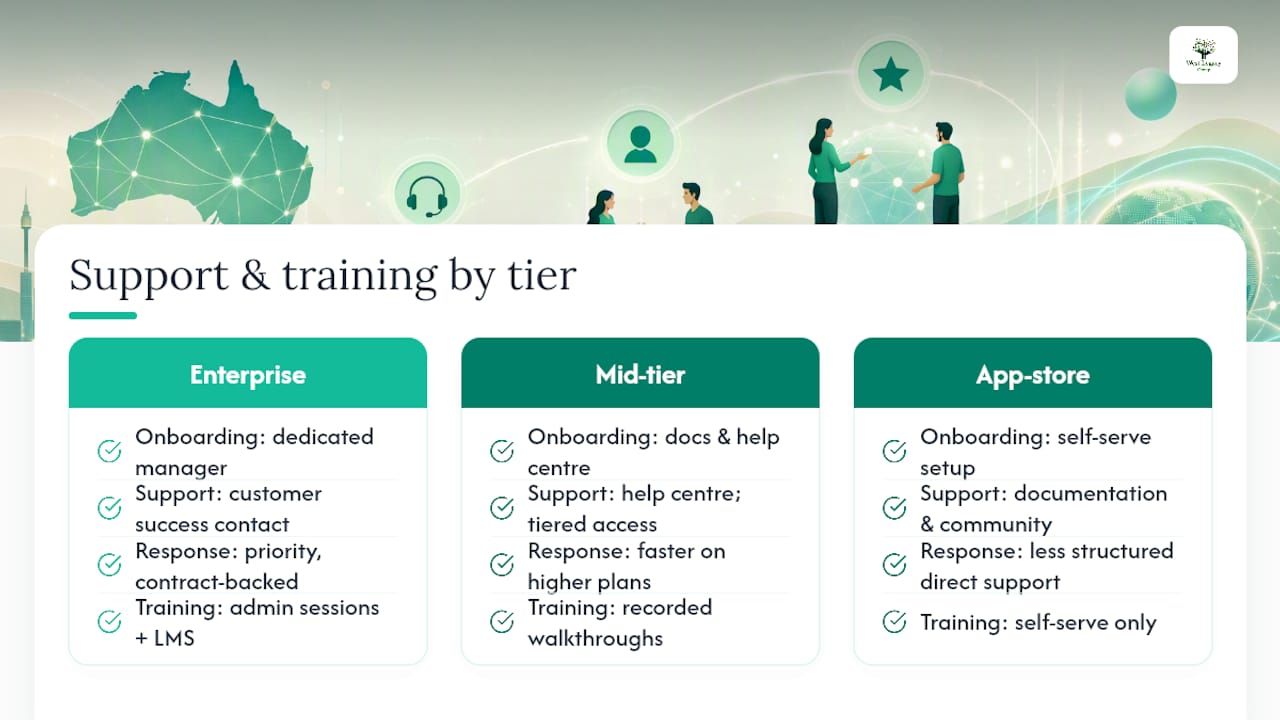
Narvar and parcelLab, as enterprise-tier platforms, typically provide dedicated implementation managers, structured onboarding programmes, and ongoing customer success contacts. That level of support is reflected in their pricing and contract structures. Loop Returns offers documentation, a help centre, and tiered support access depending on your plan, which is standard for subscription-tier Shopify-native tools.
AfterShip Returns and LateShipment.com both maintain self-serve knowledge bases and email or chat support, with faster response times on higher-tier plans. Return Prime, ReturnZap, and Returnista, as app-store products, rely primarily on documentation and community support, with direct support available but less structured.
For Australian merchants, the time-zone gap matters. US-headquartered vendors with US-only support hours can mean a 12–16 hour delay on urgent issues during peak return periods (post-Christmas, end-of-financial-year sales). Ask vendors specifically about APAC support coverage or whether they have an Australian or Singapore-based support team before committing.
Training availability follows a similar pattern. Enterprise platforms typically include onboarding sessions, admin training, and access to a learning management system. Mid-tier subscription platforms offer recorded walkthroughs and documentation. App-store tools are generally self-serve.
Security and compliance standards for returns management
Returns platforms handle customer personal data, payment refund triggers, and in some cases biometric or image data (item scanning). That makes security and compliance non-negotiable selection criteria, not afterthoughts.
The minimum standard for any platform processing Australian customer data is compliance with the Privacy Act 1988 and the Australian Privacy Principles (APPs). If a vendor cannot confirm APPs compliance and explain where Australian customer data is stored and processed, that is a procurement red flag. Data residency matters: some US-based platforms store all data on US servers, which may create obligations under the APPs’ cross-border disclosure provisions.
For payment refund processing, confirm the platform integrates with your payment gateway (Afterpay, Zip, Stripe, PayPal, or your acquirer) via a compliant API rather than storing card data directly. PCI DSS compliance is the relevant standard here. Most reputable platforms do not store card data themselves but instead trigger refunds via your gateway’s API, which is the correct architecture.
SOC 2 Type II certification is the benchmark for SaaS data security in this category. Enterprise platforms like Narvar and parcelLab typically hold SOC 2 Type II. For mid-tier and app-store platforms, ask for their security documentation directly, as public certification pages are not always maintained.
GDPR compliance is relevant for Australian merchants selling into the EU, and most established platforms support it. For AU-only operations, APPs compliance is the primary obligation.
Key takeaways
The best returns management software for ecommerce combines exchange-first workflows, OMS/WMS integration, and SKU-level reason code capture to convert returns from a cost into a retention and margin recovery tool.
| Point | Details |
|---|---|
| Exchange-first is the revenue lever | Platforms like Loop Returns and Refundid that prioritise exchanges over refunds retain more revenue per return event. |
| OMS/WMS integration is non-negotiable | Returns tools that sit outside your inventory system create manual rekeying and slow restocking, directly hurting margin. |
| SKU-level reason codes drive improvement | Capturing return reasons at SKU level lets you fix product pages, sizing guides, and supplier issues before they compound. |
| AU carrier support must be verified | Confirm Australia Post, Sendle, or StarTrack support before signing; US-centric platforms often require custom configuration. |
| West Legacy Group supports platform selection | West Legacy Group helps AU ecommerce operators scope integrations, plan data capture, and connect returns platforms to their existing tech stack. |
Returns software works best when the whole system is connected
Most articles on this topic focus on feature checklists. The more useful frame is this: the returns platform you choose is only as good as the data it feeds back into your business. A tool that generates labels and issues refunds but captures no reason codes is a cost-reduction tool at best. A platform that captures SKU-level reason data, syncs it to your OMS, and surfaces it in your helpdesk is a margin and retention tool.
The platforms that consistently deliver measurable outcomes, in my observation, are the ones where the merchant has done the integration work upfront. The exchange conversion rates and restock speed improvements that vendors cite in their case studies almost always come from merchants who connected the returns platform to their OMS and helpdesk on day one, not from merchants who installed an app and left it running in isolation.
The other underappreciated point: return reason data is some of the most valuable product intelligence you can collect. A customer who tells you why they returned an item is giving you a free product audit. Most merchants collect that data and do nothing with it. The ones who route it into their product team’s weekly review and their ecommerce SEO content updates are the ones who see return rates fall over time.
West Legacy Group can help you scope and connect your returns platform
All 18 platforms in this article are legitimate options, and the right one depends on your platform, volume, and integration requirements. What most AU ecommerce operators find, though, is that selecting the software is the easy part. Connecting it to your existing Shopify or WooCommerce store, wiring up the OMS integration, and building the data capture taxonomy that actually feeds your product team — that is where the work is.
West Legacy Group works with Australian ecommerce businesses on exactly this: scoping the integration requirements before you sign a contract, setting up the data capture framework so return reason codes flow into your reporting, and updating your self-service portal UX so customers complete returns without contacting support. We are a digital services provider, not a returns software vendor, which means our advice is platform-neutral.
If you want help evaluating which platform fits your tech stack, or you need someone to wire up the integration properly, get in touch with the West Legacy Group team or review our small business website and integration packages to see how we can support your next step.
Useful sources and further reading
- Ecommerce Returns Management Software & Solutions | Swap
- Returns Management Software | nShift Returns
- Returns Management System for Retailers and 3PLs – Optoro
- Returns software and reverse logistics for e-commerce merchants
- EcoReturns – #1 Ecommerce Returns Solution | Saara AI
- Loop Returns
- g2.com
- g2.com