

Ecommerce personalisation reliably lifts conversion, average order value and repeat purchases when it is built on clean data and measured properly. A large field experiment reported by the FTC found personalised ranking on Wayfair increased conversion by roughly 1.4%, cut returns by about 10%, and lifted repeat purchase probability by 2.3%. Statista tracks worldwide retail ecommerce sales as a growing share of total retail, which means even small percentage gains from personalisation compound into real revenue at scale. West Legacy Group works with small and midsized online retailers who want these gains without hiring a data science team.
The numbers matter more than the buzzwords here. You do not need machine learning wizardry to see a return. You need a clear hypothesis, one surface to test, and a way to measure what happens.
Here is what personalisation typically improves when it is done properly:
- Conversion rate — more browsers become buyers because what they see matches what they want.
- Average order value and revenue per visitor — relevant cross-sells and bundles lift basket size.
- Repeat purchase rate and customer lifetime value — tailored follow-up keeps customers coming back.
- Return rate — better product matching before purchase means fewer wrong-fit returns.
Quick stat: Personalised experiences on Wayfair increased basket visits by 1.4% and add-to-cart actions by 1.1%, according to the Wayfair field experiment analysed by the FTC.
Key Takeaways
Ecommerce personalisation raises conversion, average order value and repeat purchase rate simultaneously, but only when it’s built on clean product data and measured with proper holdout testing.
| Point | Details |
|---|---|
| Conversion and returns both improve | The Wayfair field experiment recorded a 1.4% conversion lift and roughly 10% fewer returns from personalised ranking. |
| Repeat purchase is the durable win | A 2.3% higher repeat purchase probability shows personalisation’s value extends well past the first sale. |
| Data quality comes before tools | A clean product feed and structured attributes matter more than which platform you buy. |
| Test one surface, measure properly | Use a holdout group and a four to eight week window before rolling out sitewide. |
| West Legacy Group starts with the groundwork | Product feed clean-up and measurement design set up the personalisation gains this article describes. |
Pro Tip: Watch revenue per visitor as your first KPI. It combines conversion and order value into one number, making it the fastest way to see whether a personalisation change is actually working.
Privacy restrictions and browser changes have made first-party data capture more important than ever, so treat consented email signups and logged-in browsing as assets worth building deliberately, not side effects of your checkout flow.
Table of Contents
- What are the core benefits of ecommerce personalisation?
- What technology powers ecommerce personalisation?
- Which personalisation tactics should you test first?
- How do you measure the ROI of personalisation?
- What are the privacy and data limits on personalisation?
- How do small teams get started with personalisation?
- Sources
What are the core benefits of ecommerce personalisation?
The commercial case for personalisation rests on four measurable outcomes: more sales, bigger baskets, more loyal customers, and fewer costly returns. Each one shows up in a different part of your reporting dashboard, and each responds to a different tactic.
Conversion uplift
Personalised product recommendations, search results and homepage content help shoppers find what they actually want faster. The Wayfair experiment cited by the FTC recorded a 1.4% lift in conversion from personalised ranking alone, tested at genuine scale across live traffic. That might sound modest, but on a site doing $2 million in annual revenue, a 1.4% conversion lift can translate into tens of thousands of dollars without spending a cent more on traffic.

The mechanism is straightforward: personalisation reduces the friction of irrelevant choice. A shopper who lands on a generic category page has to do the filtering work themselves. A shopper who lands on a page already sorted by their likely preferences converts faster because you did that work for them.
AOV and revenue per visitor increases
Average order value climbs when personalisation surfaces genuinely relevant add-ons rather than generic “customers also bought” clutter. Revenue per visitor (RPV) is the metric that ties conversion and AOV together, and it is the number most worth watching if you can only track one thing.
Repeat purchase and lifetime value
This is where personalisation pays its longest dividend. Personalised post-purchase email flows, tailored replenishment reminders, and loyalty-tier offers all feed this number. Academic research on AI-driven personalisation in fashion retail found that perceived usefulness and trust are the two factors that most strongly predict whether a customer keeps engaging with personalised experiences over time, according to a study published in Information Systems.
Lower returns and reduced cart abandonment
Fewer returns is arguably the most underrated benefit of personalisation because it rarely gets reported alongside conversion figures.
Pro Tip: Don’t try to personalise everything at once. Pick one surface, either product recommendations or a single abandoned-cart email, run it for six to eight weeks, and measure the outcome before expanding. Small, measured wins build the internal case for bigger investment.
Over-personalisation carries real risk. Recommending too aggressively, reusing browsing data in ways customers find creepy, or letting a biased algorithm keep showing the same narrow product set can erode trust faster than generic merchandising ever would. The MDPI research on integrated AI and AR commerce found that platform trust moderates how much customers value personalised recommendations, meaning the same tactic can help or hurt depending on how transparently it is deployed, per MDPI’s analysis.
What technology powers ecommerce personalisation?
Personalisation runs on three layers, and most merchants underinvest in the first one while overspending on the third.
The data foundation comes first. This means your product feed, customer identifiers, and a customer data platform (CDP) or CRM that can actually connect a browsing session to a customer profile. Without accurate, structured product data, no recommendation engine or AI model has anything useful to work with. NIQ’s analysis of AI-mediated shopping argues that structured, machine-readable product data is becoming a genuine competitive moat, because AI shopping assistants and recommendation systems can only surface products they can accurately parse, per NIQ’s research.
The modelling layer decides how personalisation gets applied. This ranges from simple rules (“show category X to visitors who viewed category X”) through to machine learning models that predict individual preference scores. Most small teams start with rules and graduate to machine learning once they have enough data volume to make it worthwhile.
The orchestration layer delivers the personalised experience: recommendation widgets, personalised homepages, triggered emails, and tailored onsite search results.
Category-level platforms illustrate how these layers typically get assembled:
| Platform category | Typical role |
|---|---|
| Sitecore | Content management system with personalisation modules for tailoring on-page content by segment |
| Salesforce | CRM and commerce cloud combining customer data with marketing automation |
| Bloomreach | Commerce-focused personalisation layer specialising in product discovery and search relevance |
| Twilio/Segment | Customer data platform for identity stitching and cross-channel event tracking |
Each plays a different role in the stack. A CMS like Sitecore handles content personalisation; a CRM/commerce platform like Salesforce ties customer records to purchase history; a commerce-focused layer like Bloomreach tunes search and recommendations specifically; and an identity and data pipeline tool like Twilio/Segment stitches together the events that feed everything else. Most merchants do not need all four. Smaller operations often get further faster with one clean data source and one well-built recommendation surface than with a full enterprise stack they cannot properly configure.
Here are four low-effort data improvements worth making before you invest in any platform:
- Audit your product feed for missing attributes (size, colour, material, category tags).
- Deduplicate customer records so repeat visitors are recognised as one person, not several.
- Standardise product titles and descriptions so search and recommendation engines can match them accurately.
- Set up basic event tracking (add-to-cart, product views, checkout starts) if it is not already in place.
Pro Tip: If you fix only one thing this quarter, fix your product feed. A well-optimised product feed underpins every recommendation engine, every personalised search result and every AI shopping assistant that might eventually surface your products.
Which personalisation tactics should you test first?
Not every personalisation tactic delivers equal value for equal effort. The tactics below are roughly ordered from easiest to hardest to implement, which is also roughly the order most merchants should test them in.
- Product recommendations on PDP and cart pages. Widgets showing “you might also like” or “frequently bought together” are the lowest-effort, highest-adoption tactic. Shopify’s guidance on AI personalisation recommends starting exactly here, particularly for returning visitors, per Shopify’s 2026 guide.
- Personalised onsite search ranking. Reordering search results based on a shopper’s browsing history or purchase patterns keeps them from bouncing when the default sort doesn’t match their intent.
- Dynamic homepage content. Swapping hero banners and featured categories based on visitor segment (new vs returning, or by inferred category interest).
- Behavioural remarketing emails. Cart abandonment and browse abandonment emails triggered by specific product interactions convert far better than generic newsletters.
- Replenishment flows. For consumable products, a well-timed “running low?” email captures repeat revenue almost automatically.
- Personalised promotions and dynamic CTAs. Offering a relevant discount or urgency message based on browsing behaviour rather than a blanket sitewide sale.
- Conversational or agentic assistants. Chat-based product finders that ask a few questions and narrow recommendations, useful for complex catalogues.
| Tactic | Complexity | Primary KPI | Best starting point |
|---|---|---|---|
| PDP/cart recommendations | Low | Conversion rate, RPV | Returning visitors |
| Personalised search ranking | Medium | Search conversion, bounce rate | High-traffic categories |
| Dynamic homepage | Medium | Homepage click-through | New vs returning segments |
| Behavioural emails | Low | Email conversion, cart recovery rate | Abandoned cart flow |
| Replenishment flows | Low | Repeat purchase rate | Consumable product lines |
Pro Tip: Sequence your tests. Start with returning visitors on product recommendations because you already have behavioural data on them, then move to new-visitor personalisation once you have a working model to lean on.
A reasonable first hypothesis: “Adding a personalised ‘recommended for you’ carousel to the cart page will increase average order value by making relevant add-ons visible before checkout.” Run it as an A/B test with a holdout group, not a blanket rollout, so you can attribute any lift to the change itself.
The Wayfair field experiment behind much of this data didn’t just show personalisation works in a lab setting. It measured genuine commercial outcomes across live traffic at scale, including a durable increase in repeat purchase probability and a meaningful drop in returns, evidence that these effects hold up outside a controlled trial.
Quick stat: Personalised buyers in the Wayfair study showed a 2.3% higher repeat purchase probability, a signal that personalisation pays off well beyond the first transaction, per the FTC’s analysis.
How do you measure the ROI of personalisation?
The KPIs that matter for personalisation are the same ones you already track, just watched more closely around the specific change you tested: conversion rate, average order value, revenue per visitor, repeat purchase rate, customer lifetime value, return rate, and cart abandonment rate.
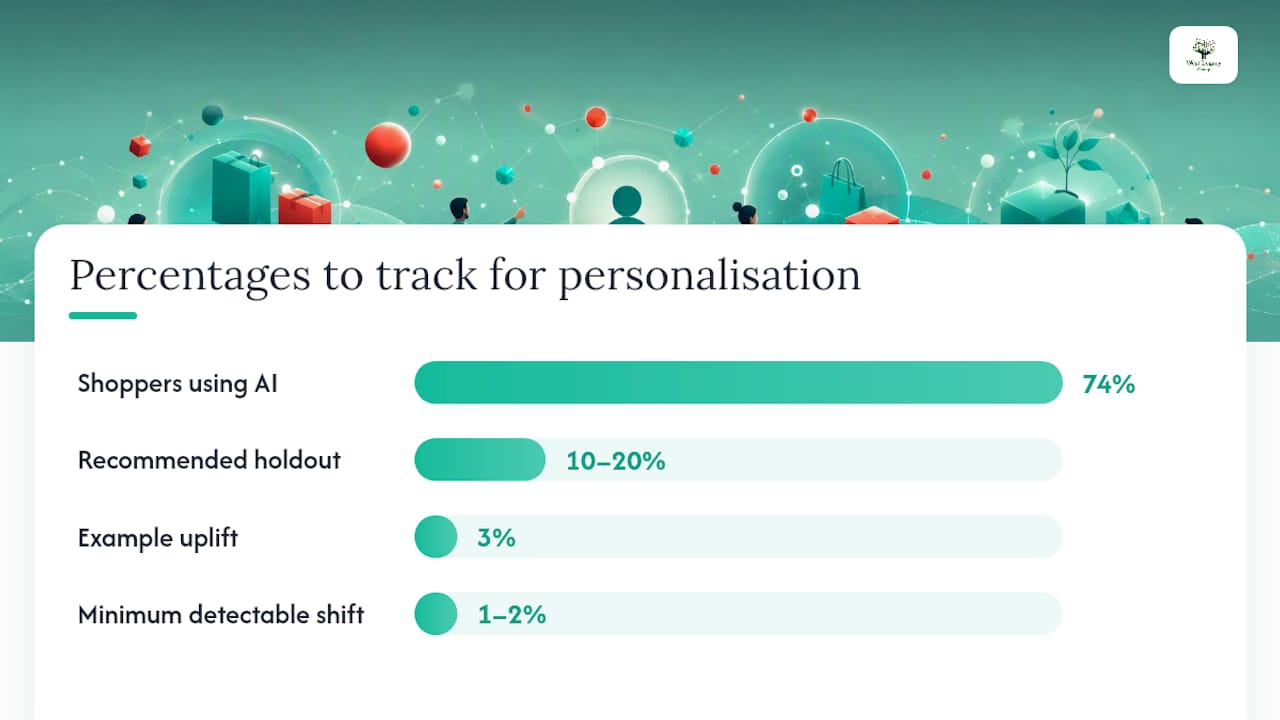
Good experiment design separates a real result from noise. You need a large enough sample size that a 1 to 2% shift isn’t just random variance, a holdout group that never sees the personalised experience so you have a genuine comparison, and a test duration long enough to smooth out day-of-week and seasonal effects, typically four to eight weeks minimum. Watch for two common traps: seasonality (running a test across a sale period will inflate or distort your numbers) and novelty effects (a new feature often gets an initial bump simply because it’s new, which fades within a few weeks).
Here’s a worked example using hypothetical numbers to show how a small uplift scales:
A 3% relative uplift on a modest baseline conversion rate adds up to an extra $2,550 a month in this example, or roughly $30,600 annually, before accounting for any AOV or repeat-purchase gains on top. That’s the maths that makes a seemingly small percentage lift worth chasing.
Your measurement playbook should include:
- Set your primary KPI before you launch the test, not after.
- Run a holdout group of at least 10 to 20% of eligible traffic.
- Let the test run for a full four to eight week cycle to capture weekly buying patterns.
- Check for statistical significance before declaring a winner, not just a directional trend.
- Track secondary metrics (returns, repeat rate) even if they take longer to show effect.
Pro Tip: *Small teams without a dedicated analyst can still measure well.
Quick stat: NIQ research found nearly 74% of shoppers now use AI in some part of their product discovery process, which is pushing merchants toward new measurement categories like share of recommendation alongside traditional conversion tracking.
What are the privacy and data limits on personalisation?
Personalisation doesn’t work in a vacuum, and the biggest constraint on it right now isn’t technology, it’s data availability. Browser privacy changes in Safari and Chrome have reduced the reliability of third-party cookies and cross-site tracking, which means the signal quality behind many personalisation engines has degraded even as customer expectations for relevance have risen.
The Wayfair field experiment offers a useful counterpoint here: even under real-world constraints, personalisation delivered measurable benefits at scale, not just for large retailers but distributed across sellers of different sizes, according to the FTC’s writeup of the trial. The lesson isn’t that privacy restrictions make personalisation pointless, it’s that first-party data strategies matter more now than they did five years ago.
When third-party signals degrade, the retailers who invested early in first-party data capture, email opt-ins, loyalty programs, logged-in browsing, are the ones who keep most of their personalisation upside. Everyone else is personalising on guesswork.
NIQ’s research on agentic commerce adds another layer to this. As AI shopping assistants increasingly mediate product discovery, the structured quality of your product data becomes as important as your marketing spend, because an AI assistant can only recommend what it can accurately understand about your catalogue, per NIQ’s findings.
Practical mitigations worth prioritising:
- Build first-party data capture into every touchpoint (account creation, email signup, loyalty programs).
- Treat product feed hygiene as an ongoing task, not a one-off project.
- Get explicit, clear consent for personalised messaging rather than relying on implied consent.
- Where legal and ethical, test probabilistic recognition methods that don’t require sharing precise identifiers, which can recover some of the personalisation value lost to cookie restrictions without compromising customer privacy.
Pro Tip: Audit your consent language this quarter. A study on AI personalisation in fashion retail found that clear, simple data-use notices materially improved customer acceptance of personalised experiences, more than technical sophistication did.
How do small teams get started with personalisation?
You don’t need a data science team or an enterprise platform to start seeing results. You need a disciplined, staged approach.
- Audit your data sources and product feed. Check for missing attributes, duplicate customer records, and gaps in event tracking before you build anything.
- Pick one surface to personalise. Product recommendations on the cart page or a browse-abandonment email are both good first choices because they’re low effort and easy to measure.
- Set a measurable hypothesis. Write down exactly what metric you expect to move and by roughly how much.
- Run a holdout test for four to eight weeks. Don’t roll out to 100% of traffic on day one.
- Measure, then iterate. Expand what works, kill what doesn’t, and move to the next surface.
Prioritise low-effort, high-impact tactics first. Cart-page recommendations and abandoned-cart emails almost always outperform complex homepage personalisation in the early stages, simply because they’re easier to set up correctly and easier to measure cleanly.
- Start with your existing email platform’s automation features before buying a dedicated personalisation tool.
- Use free or low-cost A/B testing tools built into most modern ecommerce platforms rather than a separate testing suite.
- Keep a simple spreadsheet log of every test, hypothesis, result and decision, it becomes your internal case study library.
Pro Tip: Build a one-page checklist template covering audit, hypothesis, test window and result, then reuse it for every personalisation experiment. Consistency in how you test is what makes results comparable over time.
| Point | Details |
|---|---|
| Audit before you build | Fix product feed gaps and duplicate records before choosing a personalisation tool. |
| Start with one surface | Cart recommendations or abandoned-cart emails deliver the fastest measurable wins. |
| Test with a holdout group | Run four to eight week tests against a control group to isolate real impact. |
| Watch repeat purchase rate | It often shows personalisation’s biggest, most durable payoff. |
A note from West Legacy Group
West Legacy Group has spent over 20 years helping small businesses build digital presences that actually convert, from the first client website through to eCommerce SEO engagements for stores running on Shopify and WooCommerce.
Most of the merchants we work with don’t need a full personalisation platform on day one. They need a clean product feed, a clear hypothesis, and someone who can set up a measurement framework that tells them honestly whether a change worked.
If you’re not sure where your product data or measurement setup stands right now, that’s usually the right place to start a conversation. A quick audit tells you more than another quarter of guessing.
How West Legacy Group supports your personalisation efforts
Getting personalisation right starts well before you pick a recommendation engine, it starts with the data feeding it. West Legacy Group focuses on the groundwork that most personalisation vendors skip: clean product feeds, honest measurement, and websites built to actually support the tests you want to run.
Three services map directly onto what this article has covered. Product feed clean-up and optimisation fixes the missing attributes and inconsistent titles that quietly sabotage recommendation engines and search relevance before you even test anything. Measurement and experiment design gets your holdout groups, KPIs and reporting set up properly, so a test result actually means something rather than a lucky week. Lightweight on-site personalisation implementation covers the practical build work, whether that’s a redesigned homepage with dynamic content zones or a properly tracked recommendation widget on your product pages.
Unlike an enterprise platform contract that locks you into a year of fees before you’ve proven a single result, West Legacy Group scopes personalisation work as a project or a flexible retainer, sized to what your store actually needs right now. If you want a straight answer on where your data and measurement setup currently stand, reach out for a website review and we’ll tell you exactly where to start.
Sources
The following sources back the figures and claims used throughout this article, and are worth a closer read if you want the full methodology behind the numbers.
- NIQ — How AI in personalized shopping transforms product discovery
- FTC — Balancing user privacy and personalization (Wayfair field experiment findings)
- Shopify — AI personalisation in ecommerce: how to use it to drive growth (2026)
- MDPI — The impact of integrated AI and AR in e‑commerce
Quick stat: Nearly 74% of shoppers already use AI in some part of their product discovery journey, per NIQ’s research, which is reshaping what merchants need to measure beyond conversion rate alone.
If you want implementation-level detail beyond what’s covered here, West Legacy Group’s guides on product feed optimisation and onsite search analytics go deeper into the two foundations most personalisation projects depend on.