

Most Australian small businesses should budget between $1,000 and $3,000 per month (ex-GST) for professional SEO, depending on how competitive your industry and location are. On top of that, expect a one-off setup fee for a technical audit if your site has never had one, and give the campaign 3 to 12 months before judging results. The sections below break down exactly what each price band buys, why quotes vary so much between agencies, and how to budget for it properly.
TL;DR:
- Agency quotes vary greatly because SEO scope ranges from automated content to full technical rebuilds, affecting costs and deliverables.
- Small business retainers typically allocate around 60% of hours to content and technical fixes, with higher budgets needed for multi-location or highly competitive markets.
- A technical audit costs between $1,500 and $5,000, and SEO work generally shows measurable results after 4 to 6 months, with significant growth by 12 months.
- Search engine optimization expenses should be tailored to specific business needs and current website health, not fixed industry tiers, to avoid underperformance or overpayment.
- Transparent communication, detailed scope, and flexible contracts are key before signing an SEO agency, especially regarding link-building tactics and progress tracking.
Table of Contents
- What each monthly price band actually buys for a small business
- What’s actually inside a small business SEO retainer
- Why do SEO quotes vary so much between agencies?
- How should you budget SEO spend and set realistic timelines?
- What questions should you ask before signing an SEO contract?
- Is DIY SEO worth it for a small business on a tight budget?
- West Legacy Group’s approach to small-business SEO pricing
- Get a realistic SEO plan built around your actual budget
- Sources
What each monthly price band actually buys for a small business
Ask five agencies for a quote and you’ll get five different numbers. That’s not agencies being cagey. It’s because “SEO” covers everything from a bot-generated blog post to a full-scale technical rebuild with dedicated account management. Understanding the bands helps you match a quote to what it’s actually supposed to deliver.
Under $500 a month buys automated or templated work. Think AI-generated content with light editing, generic monthly reports, and minimal human oversight. This tier can suit a sole trader with almost no competition in a small country town, but for most small businesses it’s a false economy. Traditional Australian agency pricing puts this bracket firmly in “low-value automated” territory, and it’s rarely enough to move rankings in any market with real competitors, according to LINK Marketing’s 2026 pricing guide.
$500–$1,500 a month is the entry point for genuine human-led work. You’ll typically get a part-time specialist, one or two pieces of content monthly, basic Google Business Profile upkeep, and standard reporting. Odin Digital’s research on the Australian market puts single-location local campaigns at $990 to $2,500 a month, which overlaps this band and the next, reflecting how much scope varies even at similar price points, per Odin Digital’s 2026 city pricing guide.
$1,500–$3,000 a month is where most competitive small businesses land. This buys full account management: a dedicated strategist, consistent content production, technical fixes, link outreach, and detailed monthly reporting tied to actual business metrics rather than vanity ranking screenshots. Feature comparisons across Australian agencies for 2026 show SME retainers clustering at $1,500 to $3,500 a month, with the top of that range including AI/AEO optimisation and more hands-on account management, according to ROI’s 2026 SEO pricing breakdown.
$3,000 and above is for aggressive growth campaigns, multi-location businesses, or industries where every competitor is also spending heavily. At this level you’re paying for volume: more content, more locations covered in Google Business Profile management, dedicated technical resourcing, and often a strategist who reports directly rather than through a account manager layer.
A few patterns worth noting across these bands:
- Local, single-suburb campaigns sit at the lower end of each band; metro-wide or national campaigns push toward the top.
- Hourly consulting for one-off strategy work in Australia typically runs from $150 to $300 an hour, useful if you only need direction rather than execution.
- One-off technical audits (separate from an ongoing retainer) commonly cost $1,500 to $5,000 depending on site size and platform complexity, per Odin Digital’s research.
- AI-first tools can produce high content volume for $200–$600 a month, but link building and technical repairs still need human specialists, according to LLaMaRush’s cost comparison.
That last point matters more than most owners realise. AI tools have genuinely lowered the cost of content production, but they haven’t touched the two most labour-intensive parts of SEO: earning quality backlinks and fixing structural problems on your website. Any quote that promises full-service SEO for $300 a month is almost certainly automating the parts that need a human and skipping the parts that don’t automate well at all.
What’s actually inside a small business SEO retainer
A retainer isn’t one thing, and working with a Scottsdale SEO Company can help clarify what specific services your budget actually covers. It’s a bundle of activities, and the mix between them tells you more about value than the total price does. Before you sign anything, ask the agency to itemise where the hours go.
Content usually eats the biggest single chunk of a retainer’s time budget. Expect two to four articles a month in a typical SME package, with Australian writing rates for high-quality, locally relevant content sitting around $0.10 to $0.35 a word according to Talons Marketing’s 2026 cost breakdown. A 1,200-word article at those rates costs $120 to $420 in raw writing alone, before strategy, editing, and optimisation.
Technical work starts with an audit. This checks site speed, mobile usability, crawlability, structured data, and any platform-specific issues if you’re on Shopify, WooCommerce, or an older WordPress build. Skipping this step is one of the most common reasons cheap retainers underperform: you can publish brilliant content on a site Google can barely crawl, and it won’t rank.
Google Business Profile management matters enormously for local businesses, and it scales with your footprint. A single-location tradie needs profile optimisation, review management, and regular posts. A five-location retail chain needs all of that repeated per location, which is why multi-location businesses see GBP work become a predictable, line-item cost rather than a flat inclusion.
Link building should be transparent. Ask what “outreach” actually means: guest posts on relevant Australian sites, digital PR, supplier and industry directory listings, or something vaguer. If an agency doesn’t describe a single link tactic in plain language, that’s worth noting for later.
Reporting should show real numbers, not just ranking positions. A solid retainer includes:
- Monthly reporting against Google Search Console and Google Analytics 4 data
- Ranking movement on tracked keywords, contextualised against competitors
- Traffic and conversion trends, not just visit counts
- Clear attribution of what work was completed that month
Roughly 60% of a typical SME retainer’s hours go into content and technical work combined, with the remainder split between links, GBP management, and reporting, based on the feature breakdowns in ROI’s 2026 pricing analysis. If a proposal doesn’t roughly match that split, ask why.
Our own local SEO checklist for 2026 covers the specific GBP and on-page items worth checking before you sign anything.
Why do SEO quotes vary so much between agencies?
Two businesses in the same city can get wildly different quotes for what sounds like the same service. The gap usually comes down to five variables.
Competition and keyword difficulty drive cost more than anything else. A plumber in a regional town competing against three other listings needs a fraction of the work a Sydney conveyancer needs against forty competing firms.
Geography compounds that. A single-suburb campaign costs less than a city-wide push, which costs less than national coverage. Every additional location that needs its own Google Business Profile, localised landing page, and citation cleanup adds a predictable per-location cost, particularly relevant if you’re running more than one storefront or service area, as covered in our guide to improving local search rankings in 2026.
Site health is the hidden variable most owners underestimate. A tired legacy WordPress build with years of unused plugins costs more to fix than a clean modern site, and that repair work happens before ranking gains even begin.
Industry changes the risk profile. Legal, finance, and real estate fall under Google’s “Your Money or Your Life” scrutiny, meaning content needs stronger expertise signals and more careful sourcing, which pushes retainers higher. Trades and hospitality businesses generally sit lower, per the industry breakdown in ROI’s pricing guide.
AI and AEO work is the newest driver. Optimising for AI-generated answers in tools like Google’s AI Overviews is increasingly part of standard scope rather than a premium add-on, and our piece on the future of Google search in Australia explains why that shift matters for how your content gets found from 2026 onward.
- Ask specifically whether AEO/AI search optimisation is bundled or billed separately.
- Request the number of locations covered and whether GBP work is priced per site.
- Get a written scope of the technical audit before assuming it’s included.
Pro Tip: Get two quotes for the exact same scope document, not two open-ended proposals. Write down your locations, competitors, and current site issues, and send the identical brief to each agency. It’s the only way to compare like with like.
How should you budget SEO spend and set realistic timelines?
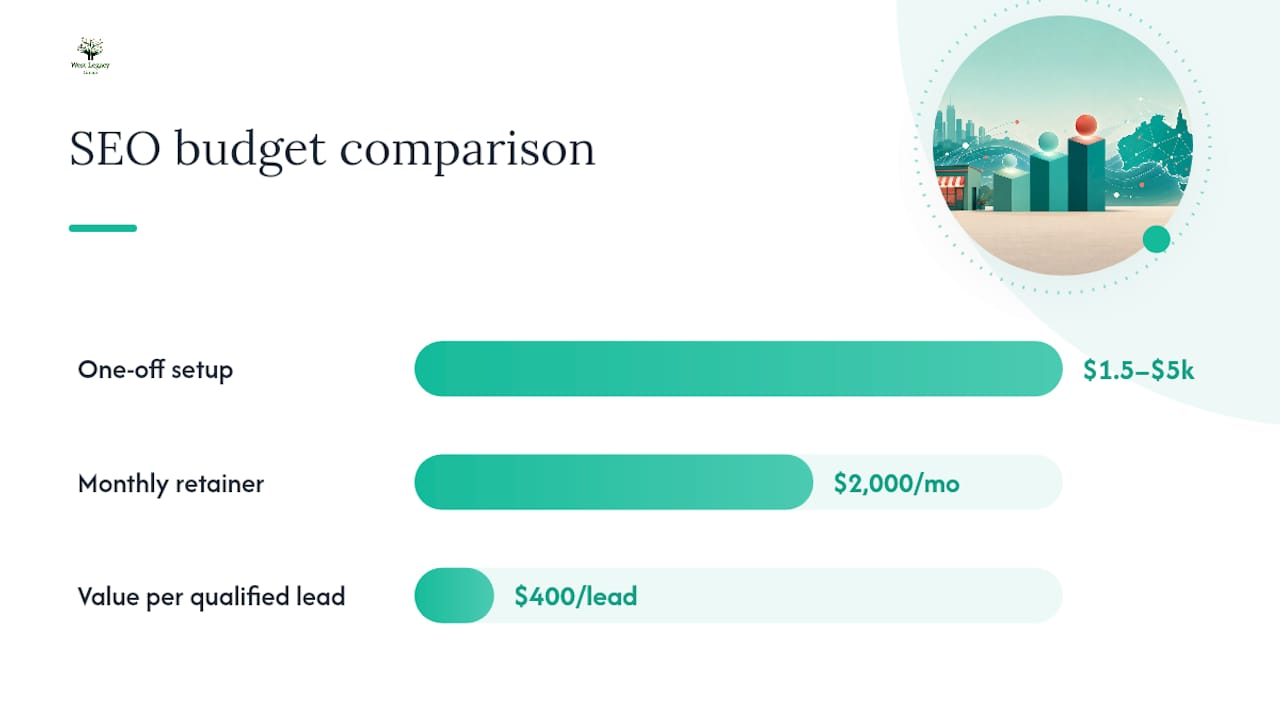
Treat SEO as two separate costs: a one-off setup and an ongoing monthly commitment. The setup, if you need a technical audit or a migration to fix legacy platform issues, typically runs $1,500 to $5,000 depending on site size, per Odin Digital’s pricing research. That’s a separate line from your monthly retainer, and a good agency will tell you upfront whether you need it.
From there, set expectations against a realistic timeline:
- Months 1 to 3: technical fixes get implemented, priority content gets published, and Google Business Profile gets optimised. Don’t expect meaningful ranking movement yet.
- Months 4 to 6: rankings begin stabilising on target keywords, and you should see an early lift in organic traffic, particularly for local search terms.
- Months 7 to 12: returns compound. Content published in month two starts ranking properly, links accumulate authority, and traffic growth typically accelerates rather than plateauing.
To decide whether a monthly spend makes sense, work out your lead value. If your average customer is worth $2,000 and you close one in five leads, each qualified lead is worth roughly $400 to you. A $2,000 monthly retainer that generates five qualified leads a month breaks even; anything beyond that is profit. This calculation is the single most useful thing you can do before committing to a budget, because it turns an abstract marketing cost into a number you can actually judge against your own business.
If you’re not seeing any traffic movement by month six, that’s the point to review scope with your provider, not necessarily switch. Genuine underperformance after 12 months, with no explanation and no adjusted strategy, is the point to look elsewhere.
What questions should you ask before signing an SEO contract?
The proposal call matters more than the price sheet. Most red flags show up in how an agency answers direct questions, not in the numbers themselves.
Ask for the scope itemised by task and hours, not a vague bundle of “SEO services.” You want to know exactly how many hours go to content, technical work, and outreach each month, and who on the team actually does that work. If the answer is evasive, that’s your first flag.
Be wary of any agency promising guaranteed rankings, particularly “#1 on Google” language. No legitimate provider controls Google’s algorithm, and a reputable agency should be transparent about who does the work and give you direct access to your own reporting rather than gatekeeping it, based on the procurement guidance in Odin Digital’s Australian pricing research.
Long lock-in contracts without performance clauses are increasingly unnecessary in the Australian market. Reputable agencies now favour month-to-month arrangements tied to measurable outcomes rather than locking clients in for 12 months with no exit.
Before you sign anything, check for these specifics:
- Full visibility into Google Search Console and GA4, not just a monthly PDF summary
- A named person doing the work, not an unnamed “team” or offshore outsourcing with no local oversight
- A clear description of link-building tactics, not vague references to “outreach” or “authority building”
- A cancellation clause you can actually exercise, not one buried in fine print
Our guide to choosing the right local SEO company covers the full version of this checklist if you want to go deeper before your next proposal call.
Is DIY SEO worth it for a small business on a tight budget?
Most owners underestimate what DIY SEO actually costs them, because they only count the cash they’re not spending. AI content tools have made the writing side genuinely cheap, sometimes as little as $200 to $600 a month for high output, according to LLaMaRush’s comparison of DIY, AI, and agency costs. But your own time isn’t free, and the same research estimates the founder time cost of running SEO yourself at roughly $2,250 a month once you account for the hours spent learning, writing, and troubleshooting instead of running your business.
Link building is where DIY SEO usually stalls completely. Writing content is learnable. Earning genuine backlinks from relevant Australian publications takes relationships, outreach systems, and time most owners simply don’t have. A hybrid approach, where you handle Google Business Profile updates and social content yourself while paying for technical work and link outreach, is often the most realistic middle ground for a genuinely tight budget. Our roundup of ways to grow your local online presence in 2026 has practical steps you can run yourself while deciding whether to bring in help for the harder parts.
West Legacy Group’s approach to small-business SEO pricing
We built our small business services division because most SEO pricing in Australia is designed for enterprise clients, then awkwardly repackaged for a tradie or a local retailer who just needs their phone to ring. That mismatch is exactly what pushes so many small business owners toward the $300 automated packages that never move the needle, or scares them off SEO entirely.
Our approach starts the same way for every client: a proper technical audit before we quote anything long-term, because I’ve seen too many retainers fail simply because nobody checked whether the website could actually be crawled properly in the first place. From there, we scope a retainer or a build-to-budget plan around what a business genuinely needs, whether that’s Google Business Profile management for a single location or a full content and technical program for a growing eCommerce store on Shopify or WooCommerce.
The conventional industry wisdom treats price bands as fixed tiers you slot into. I’d argue the more useful question is always what specific problem your website has right now, because that determines whether $1,000 a month is plenty or nowhere near enough.
— Christopher
Get a realistic SEO plan built around your actual budget
West Legacy Group is the alternative to the one-size-fits-all agency proposal: instead of quoting you a fixed package before we’ve looked at your site, we start with a straight technical audit and build a plan around what your business can genuinely justify spending each month, whether that starts at $1,000 or scales into a full growth retainer.
If you’d rather map out your own numbers first, our build-your-own SEO plan tool lets you structure a realistic budget before you ever talk to us. If you already know you need both a stronger website and ongoing SEO, our small business website design packages combine the two so you’re not paying twice to fix the same underlying platform issues. Either way, the next step is simple: get in touch and we’ll tell you honestly what your budget buys, not what sounds good on a proposal.
Sources
- How much does SEO cost in Australia? The 2026 price guide | LINK Marketing
- How much does SEO cost in Australia in 2026? (City-by-City Pricing Guide) | Odin Digital
- How much does SEO cost for a small business | LLaMaRush blog
- SEO Pricing in Australia – 2026 | ROI