

Internal linking in ecommerce is defined as the practice of connecting pages within the same website to direct both visitors and search engines to key products, categories, and content. The role of internal linking in ecommerce extends well beyond simple navigation. It distributes ranking authority across your site, builds topical relevance, and directly influences which pages Google crawls and ranks. Unlike external backlinks, internal linking is the only link-building lever fully under your control, meaning you decide exactly where link equity flows. Ecommerce sites that restructure internal links to improve crawl paths have seen organic traffic gains of up to 25% without adding a single new page.
How does internal linking improve ecommerce site navigation?
Internal links create logical pathways between your categories, products, and supporting content. Without them, visitors land on a page and have no clear direction forward. With them, you guide shoppers through the buying process from awareness to purchase.
Effective navigational linking takes several forms:
- Breadcrumb links show visitors where they are in your site hierarchy and let them step back to broader categories without hitting the back button.
- Menu and footer links connect your highest-priority pages to every other page on the site, passing consistent link equity across the board.
- Contextual links appear within product descriptions, blog posts, and category introductions, pointing visitors to related products or deeper content.
- Related product modules on product pages keep shoppers browsing rather than bouncing after viewing a single item.
Each of these link types serves a different purpose. Breadcrumbs and menus handle structural navigation. Contextual links handle intent-based navigation, connecting a visitor reading about running shoes to a category page for running socks. Together, they reduce bounce rate and increase the time visitors spend on your site. Both of those signals matter to search engines and to your conversion rate.
Pro Tip: Balance your navigational links with contextual links. Menus and breadcrumbs alone are not enough. Contextual links within body content carry more SEO weight because they appear in relevant surrounding text, which helps Google understand the relationship between pages.

What is the SEO impact of internal linking on ecommerce websites?
Internal links help search engines discover and crawl every page on your site. Google’s crawlers follow links to move between pages. If a page has no inbound internal links, crawlers may never find it, and it will not rank regardless of how good its content is.
Beyond discovery, internal links distribute PageRank, which is Google’s measure of a page’s authority. Every page on your site holds some PageRank. Internal links pass a portion of that authority to the pages they point to. Your homepage typically holds the most authority. Linking from your homepage to your top category pages channels that authority where it matters most for revenue.
Pages that receive 40–44 internal links perform four times better in search traffic than pages with fewer than five internal links. That gap is significant. It shows that pages you consistently link to from across your site earn far more organic traffic than pages you leave isolated.
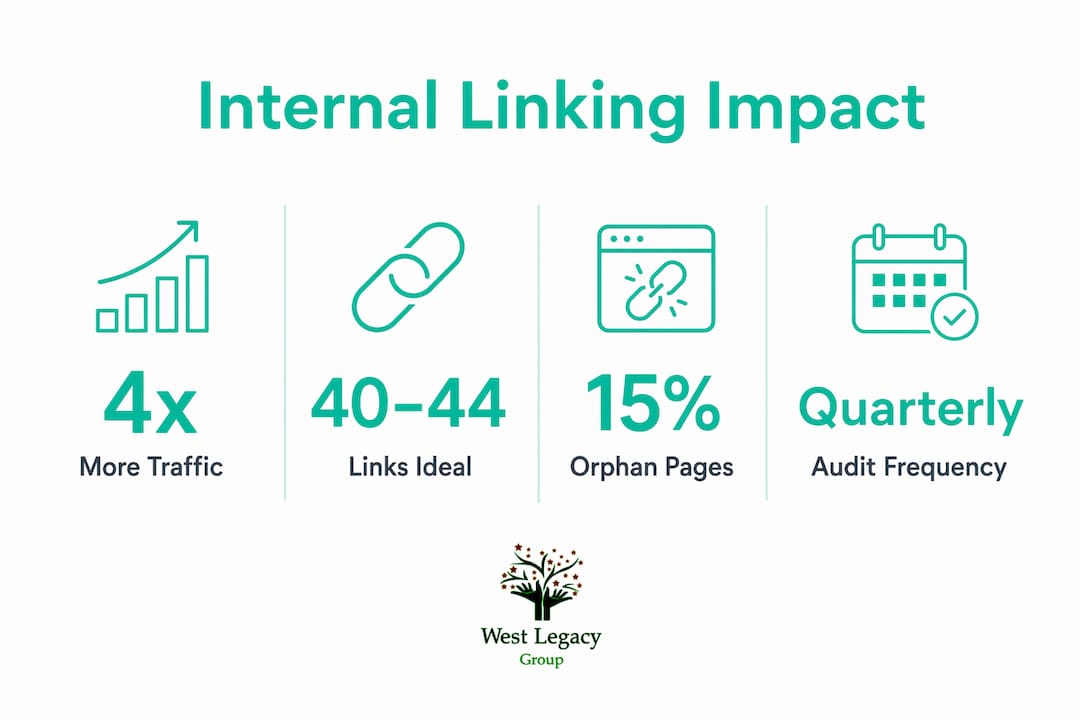
A pillar-cluster architecture takes this further. You create a central “pillar” page covering a broad topic, then link it to multiple “cluster” pages covering specific subtopics. A Semrush case study showed that cluster-structured internal linking produced a 4x traffic improvement for a marketplace client. Each cluster page links back to the pillar, reinforcing topical authority across the whole group.
Pro Tip: Use your blog content as a linking engine. Every new blog post you publish should link to at least two or three category or product pages. This passes authority from fresh content to your revenue-generating pages and helps Google understand what your store sells.
Which internal linking strategies work best for ecommerce SEO?
A structured approach to internal linking produces better results than ad hoc linking. The following steps give you a repeatable process.
-
Audit your current link structure. Use Screaming Frog to crawl your site and identify which pages receive the most inbound internal links and which receive none. This tells you where authority is currently concentrated and where it is missing.
-
Identify your priority pages. Your highest-value pages are typically top-level category pages and your best-converting product pages. These pages should receive the most internal links from across your site.
-
Keep priority pages within three clicks of your homepage. Pages buried four or more clicks deep receive less crawl attention and less link equity. Restructure your navigation or add contextual links to bring important pages closer to the surface.
-
Use diverse, natural anchor text. Anchor text variety matters more than link count alone. Linking to a category page with the same phrase every time looks unnatural. Use variations: the category name, a product type, a descriptive phrase, and occasionally the URL itself.
-
Apply the pillar-cluster model to your content. Group your blog posts and category pages into topic clusters. Link each cluster post back to its pillar page and link the pillar page to each cluster post. This builds topical authority across the whole group.
-
Reduce links on high-authority pages. Every link on a page splits the PageRank that page passes outward. A homepage with 180 links passes very little authority per link. Pruning that to 38 links, as one audit demonstrated, improved rankings significantly within weeks by concentrating equity on fewer, more important destinations.
-
Integrate internal linking into your content workflow. Every time you publish a new page, immediately link to it from at least five existing pages. This prevents new content from becoming an orphan page from day one.
Pro Tip: Add an internal linking checklist to your content publication process. Before any page goes live, confirm it links to two or three existing pages and that at least three existing pages link back to it. This takes five minutes and prevents months of lost ranking potential.
What common internal linking mistakes should ecommerce sites avoid?
Most ecommerce sites make the same internal linking errors repeatedly. Knowing what to look for saves you significant ranking potential.
- Orphan pages. Orphan pages make up 15% or more of content sites and are invisible to search engines. A page with zero inbound internal links cannot rank well, even if it is indexed. Check for orphan pages in every audit.
- Excessive links on key pages. Packing your homepage or category pages with dozens of links dilutes the equity each link passes. Fewer, more deliberate links concentrate authority more effectively.
- Repetitive exact-match anchor text. Linking to the same page with identical anchor text every time looks manipulative to Google. Vary your phrasing naturally across different linking pages.
- Ignoring new content. New pages published without immediate internal links from existing pages become orphans by default. This is one of the most common and easily preventable ecommerce SEO mistakes.
- Under-linking revenue pages. Category and product pages that generate the most revenue often receive fewer internal links than blog posts. Reverse this. Your money pages deserve the most internal link support.
- Broken internal links. A broken link wastes link equity and delivers a poor experience. Audit for broken links quarterly and fix them immediately.
Crawl budget is a related concern for large ecommerce sites. Sites with tens of thousands of pages benefit from a clean internal link structure because it helps Google allocate crawl resources to your most important pages rather than wasting them on low-value or duplicate URLs.
How can you measure and improve your internal linking results?
Measuring the impact of your internal linking work requires tracking the right metrics before and after making changes.
Screaming Frog is the standard tool for internal link audits. It shows you inbound link counts per page, identifies orphan pages, flags broken links, and maps your site’s link depth. Run a full crawl before making any changes to establish a baseline.
After implementing changes, track the following metrics in Google Search Console and your analytics platform:
| Metric | What it tells you |
|---|---|
| Organic clicks per page | Whether linked pages are gaining search visibility |
| Average position | Whether target pages are moving up in rankings |
| Crawl coverage | Whether previously orphaned pages are now being indexed |
| Bounce rate | Whether contextual links are keeping visitors on site longer |
| Pages per session | Whether internal links are encouraging deeper browsing |
Internal link audits that address broken links, orphan pages, and equity distribution consistently produce ranking improvements within weeks. The timeline is faster than most external SEO tactics because you are working with authority your site already holds. You are simply redirecting it more effectively.
Revisit your internal link structure every quarter. Your product catalogue changes, new blog content goes live, and seasonal categories come and go. Each of these events creates new linking opportunities and potential gaps.
Key takeaways
Internal linking is the most controllable SEO lever available to ecommerce sites, and consistent attention to link structure produces measurable ranking and traffic gains.
| Point | Details |
|---|---|
| Control over link equity | Internal links let you direct PageRank to your highest-converting pages without relying on third parties. |
| Link count and traffic | Pages with 40–44 inbound internal links receive four times more search traffic than pages with fewer than five. |
| Anchor text variety | Diverse, natural anchor text outperforms repetitive exact-match phrases for both rankings and click-through rates. |
| Orphan page risk | At least 15% of ecommerce pages have zero inbound internal links and cannot rank effectively without them. |
| Audit frequency | Quarterly internal link audits that fix broken links and orphan pages produce ranking improvements within weeks. |
Why I think most ecommerce sites are leaving easy wins on the table
After working with ecommerce businesses across a range of industries, I keep seeing the same pattern. Owners invest heavily in content and product pages, then publish them without linking to anything or from anything. The pages sit there, indexed but invisible, because no internal authority flows to them.
The uncomfortable truth is that internal linking is one of the highest-return SEO activities available, and most sites treat it as an afterthought. You do not need a bigger budget or more content. You need to look at what you already have and connect it properly.
I have seen sites improve their local ecommerce SEO performance significantly just by linking their existing blog posts to relevant category pages. No new content. No new backlinks. Just better connections between pages that were already live.
The other thing I would push back on is the idea that internal linking is a one-time task. Your site changes constantly. New products, new posts, seasonal promotions. Each change creates new linking opportunities and new gaps. Build a quarterly audit into your workflow and treat it as non-negotiable. The sites that do this consistently outperform those that do it once and forget it.
— Christopher
West Legacy Group can strengthen your ecommerce site structure
If your ecommerce site is publishing content without a clear internal linking plan, you are likely leaving organic traffic behind. West Legacy Group works with small businesses and ecommerce stores to build well-structured websites that support both user navigation and search engine performance from the ground up.
Our custom SEO plans include internal link audits, pillar-cluster architecture, and ongoing content integration so your site keeps improving over time. Every package is built to be affordable for small businesses, with no lock-in contracts and clear reporting on what is working. Reach out to West Legacy Group to find out how we can help your ecommerce store rank higher and convert better.
FAQ
What is the role of internal linking in ecommerce?
Internal linking in ecommerce connects pages within the same website to guide visitors through the buying process and help search engines discover and rank key pages. It distributes PageRank from high-authority pages to priority category and product pages.
How many internal links should a product page have?
Pages with 40–44 inbound internal links receive four times more organic traffic than pages with fewer than five. Aim to build internal links to your most important product and category pages consistently over time.
What is an orphan page and why does it matter?
An orphan page is a page with zero inbound internal links. Orphan pages make up 15% or more of content sites and are effectively invisible to search engines, limiting their ability to rank regardless of content quality.
How often should I audit my internal links?
A quarterly internal link audit is the standard practice. Audits that fix broken links, resolve orphan pages, and redistribute link equity produce ranking improvements within weeks of implementation.
Does anchor text variety really affect rankings?
Analysis of over 23 million links shows that diverse anchor text outperforms repetitive exact-match phrases for both Google rankings and click-through rates. Vary your anchor text naturally across different linking pages.