

Digital shelf analytics (DSA) continuously monitors your product’s presence, pricing, content accuracy, and customer sentiment across every online channel so your team can protect revenue and improve conversions before problems compound. Think of it as operational infrastructure rather than a periodic report: the signals it surfaces connect directly to daily decisions across pricing, restocking, content updates, and media spend.
When a DSA alert fires, your team can act immediately on issues like:
- A stockout on Woolworths Online that needs a restock request and a media pause
- A MAP breach where a retailer has dropped your price below the agreed minimum
- A product description that has reverted to an older, non-compliant version
- A sudden spike in one-star reviews that needs a response and root-cause investigation
- A competitor promotion that has pushed your search rank down two positions
Pro Tip: Treat DSA the same way you treat your ERP or CRM: it should be always-on, integrated into your ticketing system, and owned by named people with SLAs, not checked occasionally when someone remembers to log in.
Key takeaways
Digital shelf analytics is operational infrastructure: brands that monitor continuously and act on alerts same-day protect more revenue than those that review weekly dashboards after the damage is done.
| Point | Details |
|---|---|
| DSA is infrastructure, not reporting | Treat alerts as operational triggers with named owners and SLAs, not as weekly summaries to review. |
| Australian retailer coverage is critical | Confirm your vendor crawls Woolworths, Coles, Chemist Warehouse, and Amazon AU before signing. |
| Link fixes to commercial outcomes | Report recovered revenue, margin protected, and conversion uplift, not just compliance score improvements. |
| Start with your top SKUs | Pilot on your highest-revenue 20% of SKUs first; prove ROI before scaling to the full catalogue. |
| West Legacy Group can help you act | West Legacy Group’s SEO, feed optimisation, and reporting services turn DSA alerts into executed fixes for Australian brands. |
Table of Contents
- What does the digital shelf actually cover?
- Why digital shelf analytics matters for Australian brands
- What KPIs does DSA actually monitor?
- How does DSA collect and process data?
- What are the primary use cases for DSA?
- How do you choose a DSA solution for the Australian market?
- How do you implement DSA and govern it well?
- How do you link DSA activity to commercial outcomes?
- What are the most common DSA mistakes to avoid?
- What types of DSA vendors are available in Australia?
- When should a small-to-medium Australian brand adopt DSA?
- West Legacy Group supports your digital shelf goals
- Sources
What does the digital shelf actually cover?
The digital shelf is every online surface where a shopper can discover, evaluate, or buy your product. That includes retailer product detail pages (PDPs) on Woolworths, Coles, Chemist Warehouse, and JB Hi-Fi; marketplaces like Amazon Australia and eBay; category and search results pages; Google Shopping; social commerce surfaces on Meta and TikTok Shop; and price-comparison engines.
DSA covers the full scope of signals across those surfaces: product presence and discoverability, content accuracy and completeness, pricing and promotional compliance, availability and in-stock status, ratings and review velocity, and competitive context. That is a materially different scope from standard site analytics, which only tells you what happens on your own domain, or from broader ecommerce BI, which aggregates sales data after the fact. DSA works at the product level, distributed across channels you do not own.
Signal categories and channel types that fall inside DSA scope:
- Presence signals: indexed listings, Buy Box eligibility, assortment gaps
- Discoverability signals: keyword rank, share of search, category page position
- Content signals: title compliance, image count, description accuracy, rich content status
- Pricing signals: current price, MAP breaches, promotional price, competitor price index
- Availability signals: in-stock rate, out-of-stock duration, fulfilment method
- Sentiment signals: review count, star rating, review velocity, flagged negative themes
- Competitive signals: share of voice, competitor assortment, promo calendar
Why digital shelf analytics matters for Australian brands
The commercial case for DSA comes down to four outcomes: protecting revenue, improving conversion, reducing wasted media spend, and responding to competitors faster than they can respond to you.

eCommerce accounts for around 20% of retail sales and is projected to grow to approximately 24% by 2026, which means the digital shelf is now a primary revenue channel for most Australian consumer brands, not a secondary one. Losing a search position on Woolworths Online or going out of stock on Amazon Australia during a peak period costs real margin, and without continuous monitoring you often find out days later from a sales report rather than hours later from an alert.
The Australian market adds specific complexity. Retailer algorithms on Woolworths, Coles, and Amazon AU update frequently, regional availability varies by distribution centre, and promotional calendars shift without notice. A brand relying on weekly manual audits will consistently miss the window to fix issues before they affect sales. Nimble estimates the global DSA market at approximately $1.68 billion in 2025, with projections toward $4.48 billion by 2033, reflecting how quickly brands across every category are recognising that continuous shelf monitoring is no longer optional.
Pro Tip: Link your DSA alerts directly to your retail media campaigns. If a SKU goes out of stock on a retailer where you are running sponsored product ads, pause that campaign automatically or via a same-day workflow. Spending media budget to drive traffic to an unavailable product is one of the most common and avoidable wastes in ecommerce.
What KPIs does DSA actually monitor?
DSA tracks a specific set of metrics that map directly to visibility, conversion, and margin. Each one has a commercial consequence if it moves in the wrong direction.
| KPI | What it measures | Business action triggered |
|---|---|---|
| Share of search | Your brand’s proportion of search results for key category terms | Adjust content, bids, or retailer relationship if share drops |
| Search position / keyword rank | Where your PDP appears for target keywords on a retailer site | Optimise title, copy, and attributes to recover rank |
| Content completeness score | Whether titles, images, descriptions, and attributes meet retailer standards | Push updated content via PIM or direct feed |
| Price and MAP compliance | Current price vs. agreed minimum advertised price | Escalate to retailer or pricing team for correction |
| Availability / in-stock rate | Percentage of time a SKU is purchasable | Trigger restock request and pause associated media |
| Buy Box share | Percentage of time your listing wins the Buy Box (marketplace-specific) | Investigate competing sellers, pricing, or fulfilment method |
| Ratings and review velocity | Star rating trend and rate of new reviews | Flag for response, investigate product or fulfilment issue |
| Share of voice | Your brand’s presence relative to competitors in a category | Adjust promotional or content strategy |
Secondary signals worth tracking alongside the core KPIs:
- Image count and quality compliance against retailer specifications
- Rich content status (A+ content, enhanced brand content, video)
- Promotional timeline accuracy (is your promotion live when it should be?)
- Assortment coverage (are all your SKUs listed where they should be?)
How does DSA collect and process data?
Most DSA platforms collect data through a combination of web crawlers, retailer APIs where available, direct feed integrations, and partner data agreements. Crawlers visit retailer and marketplace pages at set intervals, extract structured data from PDPs, and feed it into a normalisation layer that cleans, deduplicates, and validates the output before it reaches your dashboard.
Geolocation matters more than most teams realise. A product might show as in-stock nationally but be unavailable in Western Australia or Queensland due to distribution centre gaps. Store-level granularity and comprehensive coverage beat sampling for accuracy: brands that rely on sampled data risk missing regional or retailer-specific issues that cost sales. Full-coverage crawling, even at a higher cost, is usually worth it for brands with national distribution.
Validation and auditing steps are what separate reliable DSA outputs from noisy ones. Good platforms apply human-validated data cleaning alongside automated checks, flag anomalies for review, and maintain auditable collection logs that show when each data point was captured and from which URL. That audit trail matters for compliance and for proving to internal stakeholders that the data is trustworthy.
Common integrations that make DSA operationally useful:
- PIM systems (Akeneo, Salsify, inriver) for pushing content fixes back to retailers
- Commerce platforms (Shopify, Magento, WooCommerce) for syncing availability and pricing
- ERP systems for connecting inventory signals to supply chain decisions
- BI tools (Power BI, Tableau, Looker) for blending shelf data with sales and margin data
- Marketing automation and retail media platforms for pausing campaigns on out-of-stock SKUs
- Ticketing systems (Jira, ServiceNow, Asana) for routing alerts to owners with SLAs
Pro Tip: When evaluating DSA vendors, ask specifically for evidence of their Australian retailer coverage. Request sample crawl data for Woolworths, Coles, Chemist Warehouse, and Amazon AU before signing. A vendor with strong US or European coverage may have significant gaps in the Australian market that only become visible after onboarding.
What are the primary use cases for DSA?
DSA’s value is clearest when you map it to specific job functions and the decisions those teams make daily.
- Stockout detection (supply chain, category manager): an alert fires when a SKU drops below a threshold in-stock rate, triggering a restock request and a media pause on that retailer
- MAP enforcement and pricing monitoring (pricing manager, commercial team): continuous price tracking flags breaches within hours rather than days, enabling faster retailer conversations
- Content compliance and optimisation (marketing, ecommerce team): content scores identify which PDPs are missing images, have truncated titles, or carry outdated copy, feeding directly into a product page SEO optimisation workflow
- Review management and sentiment alerts (brand team, customer experience): velocity alerts flag a sudden drop in star rating or a cluster of negative reviews on a specific issue, enabling a same-day response
- Competitive promo monitoring (insights team, marketing): tracking competitor promotional calendars and price moves lets you respond with counter-promotions or adjust your own timing
- Share of search optimisation (SEO, ecommerce): keyword rank data across retailer search engines informs which product attributes and copy changes will recover lost visibility
The cross-functional play is where DSA creates the most value. A stockout alert on Amazon AU, for example, should simultaneously trigger a supply chain restock request, a pause on any sponsored product campaigns running on that retailer, a pricing review to check whether competitors have moved on the gap, and a category manager notification to assess whether the gap affects promotional commitments. Without DSA, each of those teams finds out separately and at different times.
How do you choose a DSA solution for the Australian market?
Selection criteria for Australian brands differ from the generic global checklist because your retailer mix is specific. The platforms that matter most here are Woolworths, Coles, Big W, Chemist Warehouse, JB Hi-Fi, Kmart, Amazon AU, and eBay Australia, and not every DSA vendor crawls all of them with the same depth or frequency.
Key criteria to evaluate:
- Retailer and marketplace coverage in Australia: confirm which specific retailers are crawled, at what frequency, and whether store-level data is available
- Refresh cadence: real-time or near-real-time alerts for pricing and availability; daily or weekly for content and share of search
- Store-level granularity: national averages mask regional problems; insist on postcode or distribution-centre-level data for availability
- PIM and ERP integrations: can the platform push fixes back to your content system automatically, or does it only report?
- Alerting and playbook features: are alerts configurable by threshold, SKU, retailer, and metric? Can you assign ownership and SLAs within the platform?
- Data accuracy and compliance: does the vendor provide auditable collection logs and explain their validation methodology?
- Pricing model and scalability: per-SKU, per-retailer, or flat-fee models each suit different catalogue sizes; understand how costs scale as you add SKUs or retailers
The core trade-off for most Australian brands is breadth versus depth. A platform with broad retailer coverage but shallow crawl frequency will miss intraday pricing moves. A platform with deep crawl frequency but limited retailer coverage will leave gaps in your monitoring. Brands that treat DSA as foundational infrastructure gain compounding advantages over time: the longer you monitor, the richer your baseline and the faster you can detect anomalies.
Pro Tip: Prioritise measurable actionability over raw reporting depth. A platform that delivers an alert with a named owner, a suggested fix, and an SLA is worth more than one that produces a beautiful dashboard nobody acts on.
Questions to ask vendors during a trial: Which Australian retailers do you crawl, and how often? Can you show me sample data for my top 20 SKUs across Woolworths and Amazon AU? What is your SLA for data freshness? Do you have case studies from Australian CPG or FMCG brands?
How do you implement DSA and govern it well?
Implementation works best in three phases: pilot, scale, and embed. The pilot phase typically runs four to eight weeks, covering your top 20 SKUs across two or three priority retailers. The goal is to validate data accuracy, confirm integrations work, and establish baseline metrics before expanding coverage.
Governance is where most implementations succeed or fail. Every alert type needs a named owner, a defined response SLA, and an escalation path. Pricing alerts might go to the commercial team with a four-hour SLA; content compliance alerts might go to the ecommerce team with a 24-hour SLA; stockout alerts might go simultaneously to supply chain and the retail media team.
Recommended governance artefacts:
- A RACI matrix mapping each alert type to responsible, accountable, consulted, and informed roles
- A weekly ops ritual (15–30 minutes) where alert owners review open issues, close resolved ones, and flag blockers
- Playbooks for the five most common alert types: stockout, MAP breach, content failure, review spike, and rank drop
- Routing rules that push alerts into your existing ticketing system (Jira, Asana, or similar) so they live alongside other operational work rather than in a separate DSA dashboard
Pro Tip: Avoid dashboard fatigue by routing only actionable alerts to operational teams. Reserve the full dashboard for weekly leadership reviews and monthly strategic sessions. The daily operational layer should be alert-driven, not dashboard-driven.
A typical implementation timeline runs: weeks one to two for onboarding and data validation; weeks three to four for alert configuration and integration testing; weeks five to eight for pilot monitoring and playbook refinement; month three onward for full catalogue rollout and governance embedding.
How do you link DSA activity to commercial outcomes?
Proving DSA’s ROI requires connecting fix timestamps to sales data, not just reporting that alerts were resolved. The most credible attribution method is a before-and-after cohort: take a group of SKUs where a specific fix was applied (a content update, a restock, a MAP correction), compare their sales trajectory in the two weeks before and after the fix, and control for seasonality and promotional activity.
Pragmatic metrics to report to leadership:
- Recovered revenue from restocks: units sold in the 14 days after a stockout was resolved, compared to the 14-day average before the outage
- Margin protected from price drift: the difference between the MAP-compliant price and the breached price, multiplied by units sold during the breach period
- Conversion uplift from content fixes: PDP conversion rate before and after a content compliance update, isolated by SKU and retailer
- Media cost saved from paused campaigns: ad spend that would have been wasted on out-of-stock SKUs, calculated from campaign logs and stockout timestamps
Connecting shelf intelligence to commercial KPIs like sales, margin, and velocity is what separates teams that can justify DSA investment from those that cannot.
Reporting cadence and dashboards:
- Daily: alert resolution rate and open issues by owner (operational layer)
- Weekly: KPI movement by retailer and SKU group (team layer)
- Monthly: commercial impact summary linking fixes to revenue, margin, and media efficiency (leadership layer)
What are the most common DSA mistakes to avoid?
The most damaging mistake is treating DSA as passive reporting. NIQ frames DSA as infrastructure that should drive same-day fixes, not a weekly summary to review on Friday afternoon. Teams that check dashboards reactively will always be behind the revenue curve.
Common mistakes and their corrections:
- Treating DSA as a reporting tool, not an operational system: route alerts into ticketing systems with SLAs; measure time-to-fix as a primary KPI
- Over-relying on compliance scores without commercial linkage: connect content scores and availability rates to sales and margin data so you know which fixes actually move the needle
- Using sampled data that masks regional problems: insist on full-coverage crawling for your priority retailers, particularly for availability data where regional gaps are common in Australia
- Ignoring integration with operational workflows: a DSA alert that sits in a separate platform and requires manual checking will be missed; integrate with the tools your teams already use
- Monitoring everything equally: DSA maps to the shopper funnel and the SKUs that drive most of your revenue deserve the highest alert sensitivity and fastest SLAs
A content fix on a hero SKU that sells 500 units a week has a measurably different impact than the same fix on a tail SKU that sells five. Build your alert thresholds and SLAs around commercial weight, not catalogue position.*
What types of DSA vendors are available in Australia?
DSA vendors fall into four broad categories, each with different strengths and trade-offs for Australian brands.
Enterprise omnichannel analytics platforms offer the broadest retailer coverage, the deepest feature sets, and the most sophisticated alerting and scorecard capabilities. NielsenIQ’s Digital Shelf product sits in this category, combining broad retailer coverage with customisable scorecards, automated alerts, and human-validated data cleaning. These platforms typically suit larger CPG brands with complex multi-retailer, multi-category portfolios and the internal resources to manage a sophisticated implementation.
PIM-integrated solutions connect product information management directly to shelf performance monitoring. Inriver is a representative example: it frames DSA as the link between product data and online performance, emphasising how content accuracy in your PIM translates to search visibility and conversion on retailer sites. This approach suits brands where content governance is a primary pain point and where a single source of truth for product data is already a strategic priority.
Advisory-led analytics providers combine data with consulting support, helping brands interpret signals and build action plans rather than just delivering dashboards. Merkle operates in this space, bringing data and experience strategy together for brands that need both the measurement infrastructure and the expertise to act on it. The trade-off is typically higher cost and a longer engagement model.
Scraping and data-only providers offer lower-cost access to raw shelf data without the full platform layer. They suit brands that have internal analytics capability and want to build their own dashboards and workflows on top of a data feed.
Evaluation checkpoints specific to the Australian market:
- Confirm which Australian retailers are crawled and at what refresh frequency
- Ask for sample data covering Woolworths, Coles, Chemist Warehouse, and Amazon AU
- Verify whether store-level or postcode-level availability data is available
- Check whether the vendor has local support or an Australian account team
- Request references from Australian CPG, FMCG, or consumer electronics brands
When should a small-to-medium Australian brand adopt DSA?
The honest answer is: earlier than most SMEs think, but not before a few conditions are in place. DSA delivers the most value when you have multiple SKUs listed across several retailers, recurring lost sales from stockouts or content failures, meaningful retail media spend that could be wasted on unavailable products, or a fragmented catalogue presence that is hard to audit manually.
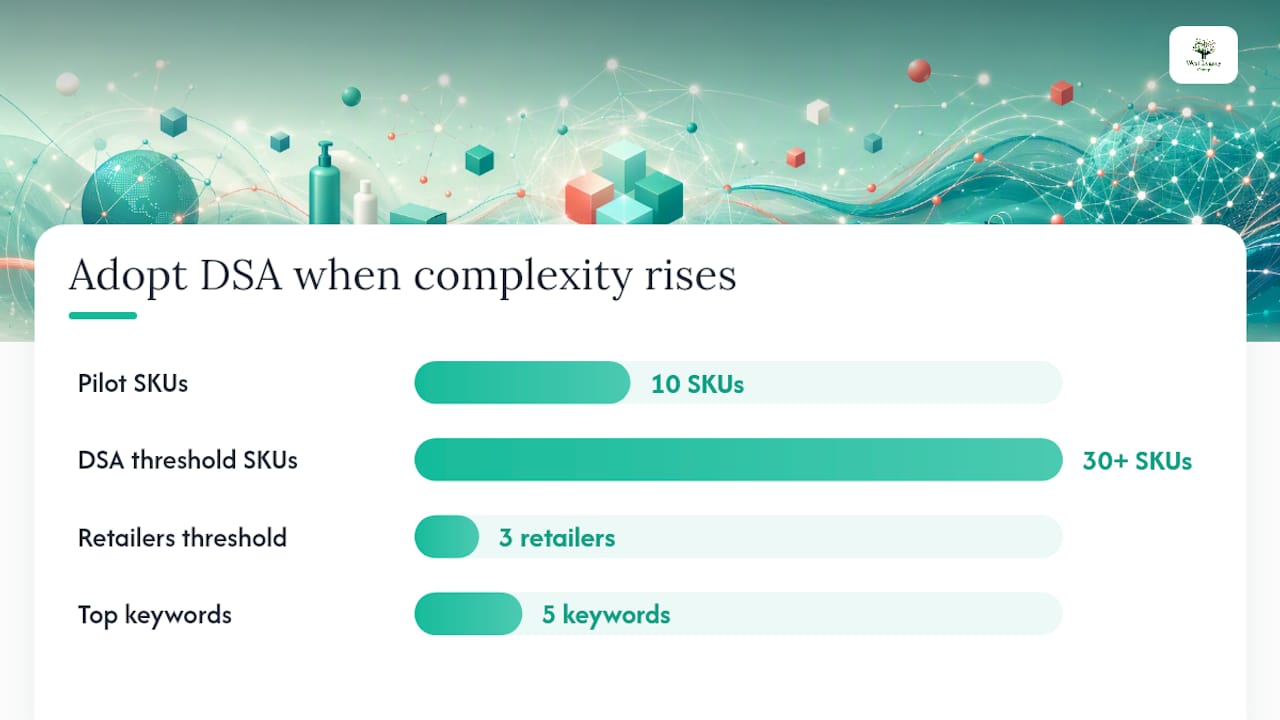
If you are selling 10 SKUs on two retailers and running no paid media, a manual weekly audit of your top listings is probably sufficient for now. But the moment you cross into 30-plus SKUs, three or more retailers, and any retail media budget, the manual approach starts costing you more in missed revenue than a lightweight DSA tool would cost in subscription fees.
A pragmatic starter approach:
- Pilot on your top 10 SKUs across your two highest-revenue retailers; establish baseline metrics for availability, content score, and search rank
- Use free or low-cost tools for initial content audits (retailer portals, manual PDP checks, onsite search analytics) before committing to a full DSA platform
- Build a simple reporting template that tracks the core KPIs weekly: in-stock rate, content completeness, average star rating, and search position for your top five keywords
- Prove ROI on the pilot by linking one specific fix (a content update or a restock) to a measurable sales change before scaling
Low-cost first steps that do not require a full DSA platform:
- Manual weekly audit of your top 10 PDPs across priority retailers
- Set up Google Alerts for your brand name and top product names to catch review spikes
- Use retailer portals (Woolworths Supplier Hub, Amazon Seller Central) for basic availability and content data
- Track your online reputation manually using a simple spreadsheet before investing in automated sentiment monitoring
West Legacy Group supports your digital shelf goals
Getting DSA insights is one thing. Acting on them quickly is another. For small and medium Australian brands, the gap between a shelf alert and a fixed product page often comes down to whether you have the SEO and content capability to execute fast.
West Legacy Group works with Australian ecommerce brands and small businesses to close that gap. Our services map directly to the fixes DSA surfaces: product page SEO and copy optimisation, product feed improvements for marketplaces and shopping engines, technical audits that identify content compliance failures, and reporting setup that turns shelf data into leadership-ready dashboards. We also offer structured SEO planning through our build-your-own SEO plan, which is a practical starting point for brands that want a structured approach to product page and feed improvements tied to DSA insights.
If you are ready to move from monitoring to fixing, reach out to the West Legacy Group team for a no-obligation conversation about where to start.
Sources
- What are digital shelf analytics? – NIQ
- What is Digital Shelf Analytics: The Ultimate Guide | DataWeave
- Turning AI‑powered shelf analytics into commercial advantage | Fuld