

Conversion rate optimisation (CRO) is the systematic process of increasing the percentage of website visitors who complete a desired action, whether that’s making a purchase, submitting an enquiry form, or signing up for a newsletter. Rather than spending more money to attract new visitors, CRO focuses on getting more value from the traffic you already have. It combines user behaviour analysis, hypothesis-driven testing, and experience improvements to turn more browsers into buyers.
The core elements of any CRO programme include:
- Generating improvement ideas based on real user data and behaviour patterns
- Forming testable hypotheses about what changes will lift conversions
- Running A/B or multivariate tests to validate those hypotheses before committing
- Refining the user experience across landing pages, forms, and checkout flows
- Measuring and iterating continuously as visitor behaviour and market conditions evolve
CRO is not a one-off project. It’s a discipline that compounds over time, and for Australian small businesses competing in a tighter digital environment in 2026, it’s one of the highest-return activities you can invest in.
How do you calculate conversion rate, and what benchmarks should you aim for?
The formula is straightforward. Divide your total conversions by your total visitors, then multiply by 100 to get a percentage.

Conversion Rate = (Total Conversions ÷ Total Visitors) × 100
A “conversion” is whatever action you define as valuable. Common examples include:
- Completing an online purchase
- Filling out a contact or quote request form
- Signing up for an email list
- Downloading a resource or brochure
- Booking a call or appointment
The number you get only means something when you compare it to a relevant benchmark. Industry benchmarks typically show conversion rates ranging from 1.5% to 5% across most industries. Rates above 5% are widely considered strong performance. However, the right target depends heavily on your sector, traffic source, and what you’re asking visitors to do.
| Industry / Action type | Typical conversion rate range |
|---|---|
| E-commerce (general) | 1.5%–5% |
| Lead generation (B2B) | 1.5%–5% |
| SaaS free trial sign-up | 1.5%–5% |
| Email newsletter opt-in | 1.5%–5% |
| Strong performance (most industries) | Above 5% |
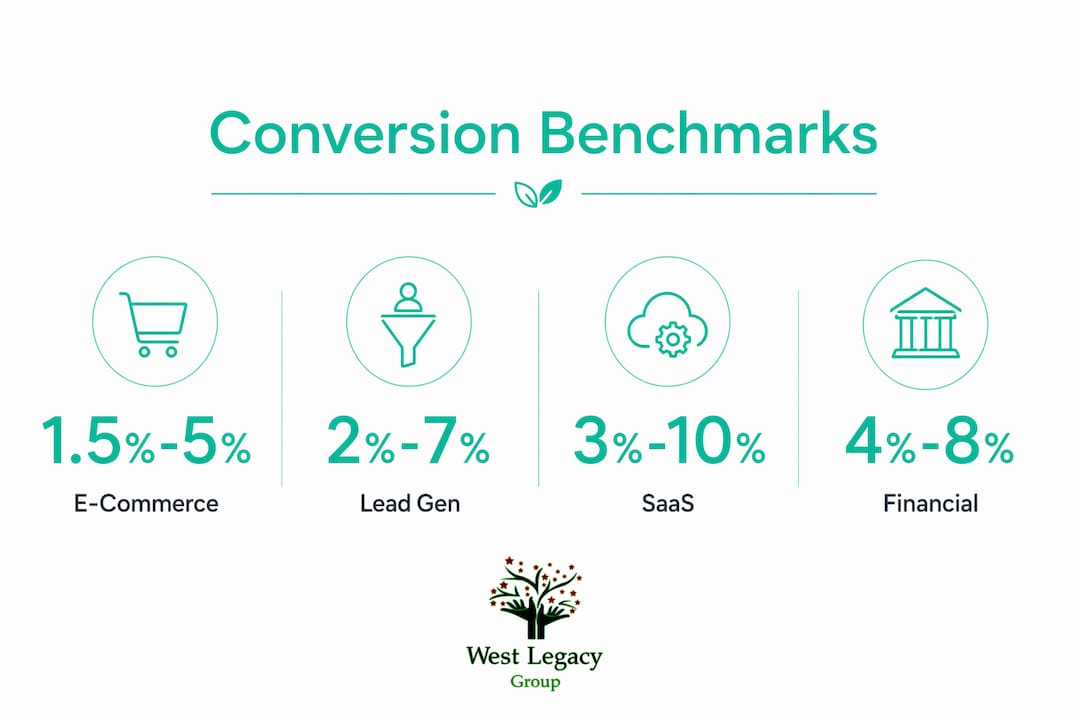
Understanding ecommerce conversion benchmarks by industry helps you set realistic goals rather than chasing an arbitrary number. A 2% rate in a high-ticket B2B category can represent excellent performance, while the same rate in a low-cost consumer product category might signal a real problem.
Pro Tip: Segment your conversion rate by traffic source. Paid search visitors often convert at a different rate than organic or social traffic, and treating them as one number hides where the real opportunity lies.
Why CRO matters: the key benefits for your business
The most direct benefit of CRO is more revenue from the same traffic. When you improve your conversion rate, each visitor becomes more valuable, which means your existing ad spend, SEO investment, and content efforts all produce a better return.
Here’s what that looks like in practice:
- Lower customer acquisition costs. When more visitors convert, you spend less per new customer, which stretches your marketing budget further.
- Higher lead quality. Focusing on qualified conversions rather than raw volume means your sales team spends time on prospects who are genuinely ready to buy.
- Better user satisfaction. CRO improvements, like faster load times, clearer CTAs, and simpler forms, make the experience better for everyone, not just those who convert.
- Increased marketing ROI. You don’t need more traffic to grow revenue. You need to do more with what you already have.
- Compounding gains. Each improvement builds on the last. A 10% lift in conversion rate this quarter becomes the new baseline for next quarter’s tests.
For Australian small businesses, this matters more than ever in 2026. Traffic acquisition through paid channels is getting more expensive, and organic search is shifting as AI-generated answers reduce the number of clicks that reach your site. CRO is the lever that makes every visitor count, regardless of how they arrived.

What makes a CRO strategy work? The core components and tools
A CRO strategy is only as strong as its components. Getting one element right while neglecting others produces inconsistent results. The most effective programmes combine clear conversion goals, well-designed pages, and the right tools to measure and test everything.
Core strategy components:
- Compelling calls to action (CTAs). Your CTA must be specific, visible, and matched to where the visitor is in their decision process. “Get a free quote” outperforms “Submit” every time.
- Optimised landing pages. Every page that receives traffic should have a single, clear purpose. Cluttered pages with multiple competing goals consistently underperform.
- Conversion funnel clarity. Map the path from first visit to completed action and remove every unnecessary step. Friction kills conversions.
- User experience improvements. Page speed, mobile responsiveness, and intuitive navigation all affect whether visitors stay or leave.
- Data-driven hypothesis generation. Every test should start with a question grounded in real user behaviour, not guesswork.
Tools that support each stage:
The most widely used CRO tools span several categories. Google Analytics 4 provides the foundational traffic and behaviour data. A/B testing platforms let you run controlled experiments on page variants. Heatmap and session recording tools show you exactly where visitors click, scroll, and drop off.
Two platforms worth knowing in depth are FullStory and Contentsquare. FullStory captures detailed session replays and interaction data, letting you see precisely where users hesitate or abandon a flow. Contentsquare goes further with zone-based analytics and experience scoring, giving you a quantified view of which page elements drive engagement and which create friction. Both tools shift CRO from educated guessing to evidence-based decision-making.
For lead tracking specifically, tools that connect form submissions and phone calls to specific traffic sources help you understand which conversions actually matter to your bottom line. If you’re working on tracking website leads for your small business, getting this attribution right is the foundation everything else builds on.
How to run a CRO process that actually produces results
The difference between businesses that see consistent conversion improvements and those that don’t usually comes down to process. Ad hoc testing produces noise. A disciplined, iterative approach produces compounding gains.
Here’s how the cycle works in practice:
- Set clear conversion goals. Define what a conversion means for each page or campaign. Be specific: “complete checkout” is a goal; “engage more” is not.
- Analyse your funnel. Use Google Analytics 4 to identify where visitors drop off. High exit rates on a checkout page or a form tell you exactly where to focus.
- Gather qualitative data. Session recordings in FullStory or Contentsquare reveal the why behind the numbers. A heatmap showing most visitors never scroll to your CTA is a hypothesis waiting to happen.
- Form a testable hypothesis. Structure it clearly: “If we move the CTA above the fold, more visitors will click it because it’s visible without scrolling.” Vague hypotheses produce uninterpretable results.
- Choose the right test type. A/B testing compares two variants of a single element. Multivariate testing examines multiple variables simultaneously, which is useful when you want to understand interactions between elements. Split URL testing compares entirely different page versions, which suits larger structural changes.
- Run the test to statistical significance. Ending a test early because early results look promising is one of the most common mistakes in CRO. Insufficient sample sizes produce unreliable conclusions.
- Analyse and implement. When a variant wins, implement it and document what you learned. When it doesn’t, the data still tells you something useful.
Common pitfalls to avoid:
- Testing without a clear hypothesis leads to results you can’t act on
- Ignoring user behaviour data in favour of personal preference
- Running too many tests at once, which makes it impossible to isolate what caused a change
- Treating a single test as definitive rather than as one data point in an ongoing programme
Pro Tip: Before you run any test, write down your hypothesis, your success metric, and the minimum sample size you’ll need. If you can’t answer all three before the test starts, you’re not ready to run it.
Scaling CRO means building this process into your regular workflow, not treating it as a quarterly project. The businesses that win are the ones running tests continuously, learning from each cycle, and applying those learnings to the next. For e-commerce specifically, product page optimisation is one of the highest-leverage areas to apply this process.
CRO for Australian businesses in 2026: what’s changed and what to do about it
The biggest shift in CRO strategy right now is the move away from chasing more traffic toward extracting more value from existing visitors. AI-driven search is reducing traditional organic click-through rates as more queries get answered directly on the search results page. For Australian small businesses, this means the visitors who do reach your site are more valuable than ever, and converting them is the priority.
This shift has practical implications:
- User-centric design is no longer optional. Visitors who arrive from AI-assisted search are often further along in their decision process. Your site needs to meet them with clarity and confidence, not generic content.
- Micro-conversions matter more. Getting a visitor to subscribe, download, or book a call builds a relationship you own, independent of search algorithm changes.
- Data quality is the foundation. Without accurate tracking, you’re optimising blind. Google Analytics 4, paired with proper event tracking, gives you the visibility to make decisions that hold up.
- Mobile performance is a conversion issue, not just a design issue. Australian mobile usage is high, and a slow or awkward mobile experience will cost you conversions regardless of how good your desktop site is.
The businesses seeing the strongest results in 2026 are those treating CRO as a core business function, not a marketing add-on. They run regular tests, review session data monthly, and connect their conversion metrics directly to revenue outcomes.
At West Legacy Group, we work with Australian small businesses on exactly this kind of disciplined, data-driven approach. From setting up proper tracking to identifying the friction points costing you conversions, the process is the same whether you’re running a local service business in Bendigo or an e-commerce store shipping nationally. The small business website content checklist we’ve put together for 2026 is a practical starting point for auditing whether your site is set up to convert.
Ready to improve your website’s conversion rate?
West Legacy Group helps Australian small businesses build websites and digital strategies that convert. From conversion-focused web design packages to ongoing SEO and analytics support, our services are built to be affordable and practical for businesses at every stage. If your website is getting traffic but not generating enough enquiries or sales, that’s a conversion problem we can help you solve.
Key takeaways
Conversion rate optimisation works because it extracts more revenue from existing traffic, reduces acquisition costs, and compounds over time through disciplined, iterative testing.
| Point | Details |
|---|---|
| CRO formula | Divide total conversions by total visitors and multiply by 100 to get your conversion rate percentage. |
| Industry benchmarks | Conversion rates of 1.5%–5% are typical across most industries; above 5% is considered strong performance. |
| Core tools | Google Analytics 4, FullStory, and Contentsquare give you the data needed to identify friction and test improvements. |
| Testing discipline | Always define your hypothesis, success metric, and minimum sample size before running any test. |
| 2026 priority | AI-driven search is reducing organic traffic, making conversion improvement from existing visitors the highest-return focus for Australian businesses. |