

The Google Local Pack is the map-based block of three business listings that appears at the top of Google’s search results when someone searches with local intent. Think “plumber Fitzroy” or “café near me” — that cluster of listings with a map, star ratings, phone numbers and directions links is the Local Pack. For small businesses, appearing there can be the difference between a phone ringing and a competitor’s phone ringing instead.
Here is what you need to do first:
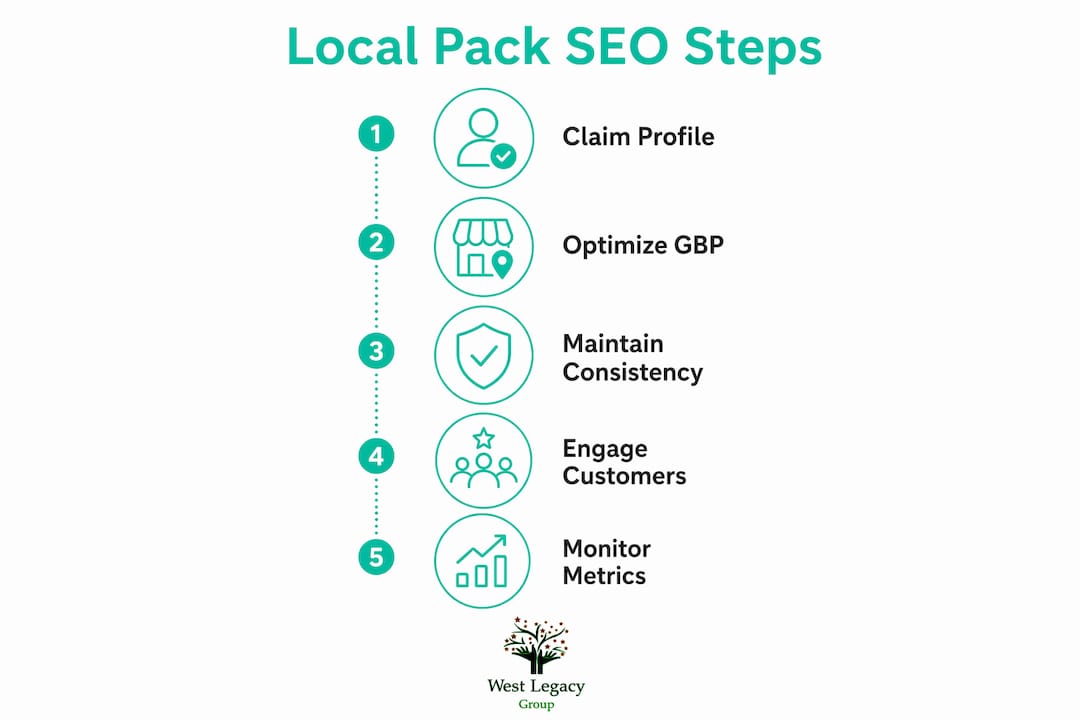
- Claim and verify your Google Business Profile (GBP) — this is the primary data source Google uses to populate Local Pack entries.
- Check your NAP consistency — your business name, address and phone number must match across every directory, including Google Maps.
- Start collecting recent reviews — review quantity, recency and your response rate all feed directly into your Local Pack ranking.
West Legacy Group works with small Australian businesses on exactly these steps, from GBP setup through to ongoing local SEO support.
Table of Contents
- What does the Local Pack look like and when does Google show it?
- How Google selects which businesses appear in the Local Pack
- What ranking factors actually move the needle in the Local Pack?
- Why appearing in the Local Pack matters for your business
- How to get your business into the Local Pack: a step-by-step checklist
- How long does Local Pack improvement take and what does it cost?
- Common Local Pack mistakes and how to fix them
- Australia-specific signals and directories that affect your Local Pack ranking
- Key takeaways
- Why I think most small businesses are approaching this backwards
- West Legacy Group can help you get into the Local Pack
What does the Local Pack look like and when does Google show it?
The Local Pack typically shows a map with location pins and three business listings beneath it. Each listing displays the business name, star rating, review count, address, phone number, and links to call, get directions or visit the website. At the bottom sits a “More places” link that opens the Local Finder, an expanded list of local businesses beyond the top three.
The feature goes by several names in the industry:
- Local Pack — the standard term used by most SEO professionals.
- Map Pack — named for the map element that anchors the block.
- Local 3-Pack — reflects the three-listing format introduced in 2015 (previously seven listings were shown).
- Snack Pack — an older informal name still used occasionally.
Google shows the Local Pack for queries with clear local intent: searches containing “near me,” a suburb name, or a service category where location is implied. On mobile, the pack dominates the screen. On desktop, it sits prominently above organic results. If the pack heading reads “Businesses” rather than “Places,” clicking “More businesses” takes users to Google’s Local Service Ads programme rather than the Local Finder — a paid lead-generation product that requires separate enrolment.

How Google selects which businesses appear in the Local Pack
Google uses three core pillars to rank businesses in the Local Pack. SEMrush describes them as relevance, distance and prominence — often abbreviated to RDP.
- Relevance measures how well your GBP matches the searcher’s query. Your chosen categories, business description, services listed and keywords in your profile all contribute.
- Distance is the physical gap between your business location (or service area) and the searcher’s current position. You cannot change where you are, but you can make sure your address and service area are accurate in GBP.
- Prominence reflects how well-known and trusted your business is, both online and offline. Reviews, local backlinks, citation volume, and user engagement signals (calls, direction requests, website clicks) all feed into this pillar.
The pack is dynamic. Results change based on the searcher’s precise location — someone searching from the next suburb may see an entirely different set of three businesses. There is no single permanent #1 position in local search, which means chasing a fixed ranking is less useful than building consistent signals across all three pillars.
Google pulls data from GBP fields, NAP citations across directories, on-site signals, and user behaviour inside Google Maps and the Local Finder. Every click, call and direction request feeds back into prominence signals, so a well-optimised profile that earns engagement compounds over time.
What ranking factors actually move the needle in the Local Pack?
Understanding the RDP pillars is one thing; knowing which actions to prioritise is another. Here is a ranked order of what matters most, mapped to those pillars.
-
GBP verification and completeness — an unverified profile cannot rank. Beyond verification, fill every field: primary and secondary categories, business hours (including holiday hours), attributes (wheelchair access, outdoor seating, LGBTQ+ friendly), services, product listings and booking links. Google’s own guidance confirms that complete, detailed business information helps match your profile to relevant searches. This is the fastest win available.
-
NAP consistency across citations — your name, address and phone number must be identical on Google Maps, Yellow Pages Australia, True Local, Yelp Australia and every other directory where your business appears. Even minor discrepancies (abbreviated street names, old phone numbers) erode Google’s confidence in your prominence signals.
-
Review quantity, recency and response rate — a steady stream of recent reviews outperforms a large volume of old ones. Responding to every review, including negative ones, signals active management and builds trust. Good online reputation management is not optional for Local Pack performance.
-
Local backlinks and directory citations — links from local newspapers, chambers of commerce, industry associations and suburb-specific directories carry weight. These take longer to build but strengthen prominence sustainably.
-
On-site local signals — local business schema markup, suburb-specific landing pages and locally focused content help Google connect your website to your GBP and confirm your service area.
-
Behavioural signals — clicks, calls and direction requests from your GBP listing feed back into prominence. A profile that earns real engagement ranks better over time.
-
Proximity — you cannot move your business, but you can ensure your service area settings in GBP accurately reflect where you operate.
Pro Tip: Add structured GBP posts (offers, events, updates) at least twice a month. Posts keep your profile active, signal recency to Google, and give searchers a reason to engage before they even reach your website.
Why appearing in the Local Pack matters for your business
The Local Pack sits above organic results and captures a disproportionate share of clicks for local queries. For a small business competing against larger brands with stronger organic authority, the Local Pack is often the most accessible path to page-one visibility.
The core business benefits are direct:
- More phone calls — the click-to-call button is one tap away on mobile, removing friction between a search and a conversation.
- More direction requests — direction clicks correlate strongly with in-store visits and foot traffic.
- Higher web traffic for transactional queries — users searching “electrician Geelong” are ready to hire, not browse.
- Competitive displacement — appearing in the pack pushes organic results further down the page, reducing the click-through rate for competitors who rank organically but not locally.
Industry reporting confirms that businesses visible in Local Packs see materially higher traffic and user action rates compared with those that do not appear. The gap is especially pronounced on mobile, where the Local Pack can occupy the entire above-the-fold screen.
Local SEO also needs to work across channels. BrightLocal notes that customers now expect consistent business details across Google Maps, voice assistants and AI-powered search tools. A business that ranks in the Local Pack but has inconsistent information elsewhere loses trust at the moment of decision. You can read more about growing your local online presence across these channels on the West Legacy Group blog.

How to get your business into the Local Pack: a step-by-step checklist
Follow these steps in order. The first 30 days focus on foundations; the first 90 days build momentum.
First 30 days — foundations:
- Claim and verify your Google Business Profile at business.google.com. Postcard verification is standard; some businesses qualify for instant verification.
- Choose your primary category carefully — this is the single most influential GBP field for relevance. Add secondary categories for additional services.
- Complete every GBP field — hours, phone, website, description, attributes, services and products.
- Add at least 10 high-quality photos — exterior, interior, team and product shots. Profiles with photos receive more direction requests and website clicks.
- List your business on Yellow Pages Australia and confirm your NAP matches GBP exactly.
- Add local business schema to your website’s homepage and contact page.
First 90 days — building signals:
- Publish GBP posts weekly — offers, updates and events keep the profile active.
- Request reviews from recent customers — send a direct link to your GBP review form. Respond to every review within 48 hours.
- Audit NAP consistency across True Local, Yelp Australia, local chambers and industry directories. Use a tool like BrightLocal to identify discrepancies.
- Create locally focused content on your website — suburb-specific service pages, local case studies and blog posts targeting long-tail local phrases. Local keyword research using Google Autocomplete and SEMrush helps you find the exact phrases your customers use.
- Build local citations and backlinks — approach local business associations, sponsor community events and seek mentions in local media.
- Monitor GBP Insights weekly — track search queries, profile views, direction requests and call clicks to measure progress.
If organic Local Pack visibility is constrained by intense competition, consider Google Local Service Ads as a paid complement. These appear above the standard Local Pack and charge per lead rather than per click.
The West Legacy Group local SEO checklist expands on each of these steps with specific micro-tasks and measurement benchmarks.
How long does Local Pack improvement take and what does it cost?
Setting realistic expectations saves frustration. GBP updates and review accumulation can show effects within weeks. Noticeable ranking movement for competitive terms typically takes 2–3 months for incremental gains and 6 months or more for sustained prominence in a crowded market. Local Pack results are dynamic and shift with competition, so ongoing effort is required rather than a one-time setup.
Effort breakdown:
- Initial setup: 4–8 hours for GBP completion, citation audit and schema implementation.
- Ongoing maintenance: 1–2 hours per week for review responses, GBP posts and monitoring.
- Content and link building: 4–8 hours per month depending on your market’s competitiveness.
Cost ranges in Australia (approximate, highly variable by market):
- DIY: Your time plus optional tools (BrightLocal citation management, SEMrush for keyword research) — roughly $50–$150 per month in tool costs.
- Freelance or project-based: $500–$2,000 for an initial local SEO audit and setup.
- Ongoing agency support: varies significantly based on market competitiveness and scope.
Track progress through GBP Insights (search impressions, direction requests, call clicks) and Google Analytics (organic local traffic, goal completions from local landing pages). If you want structured reporting, West Legacy Group’s reporting services can automate this tracking for you.
Common Local Pack mistakes and how to fix them
Most businesses that struggle with Local Pack visibility are making one or more of these errors.
- Unverified GBP listing — an unverified profile is invisible to the Local Pack algorithm. Check verification status in your GBP dashboard immediately.
- Duplicate listings — multiple GBP entries for the same location confuse Google and split your signals. Search Google Maps for your business name and address to detect duplicates, then request removal through GBP support.
- Inconsistent NAP — even a difference between “St” and “Street” across directories can weaken prominence signals. Audit every directory listing and standardise to one format.
- Ignoring reviews — not responding to reviews (positive or negative) signals an inactive business. Set a goal to respond within 48 hours.
- Wrong or missing primary category — choosing a broad category like “Business” instead of “Electrician” or “Café” dramatically reduces relevance. Review your primary category against your top competitors.
- Missing attributes and services — attributes like “women-led,” “outdoor seating” or “free Wi-Fi” appear in filtered searches. Leaving them blank means missing those queries entirely.
- Over-relying on one tactic — businesses that focus only on reviews while neglecting citations, or only on GBP while ignoring their website’s local signals, plateau quickly. The RDP pillars require balanced effort.
After fixing any of these issues, allow 4–6 weeks before assessing the impact. Monitor GBP Insights weekly during that period.
Australia-specific signals and directories that affect your Local Pack ranking
Australian search behaviour has some distinct characteristics worth building your strategy around.
- “Near me” and suburb-based searches are dominant — Australians frequently search using suburb names rather than city names (e.g., “accountant Northcote” rather than “accountant Melbourne”). Your GBP description, service listings and website content should reflect the specific suburbs you serve.
- Mobile-first search patterns — mobile search share in Australia is high, and the Local Pack is the primary result format on mobile. A mobile-optimised website with fast load times is a prerequisite, not a bonus.
- High-value Australian citation sources — beyond Yellow Pages Australia, prioritise: True Local, Yelp Australia, local chamber of commerce directories, industry-specific directories (HiPages for tradies, HealthEngine for health practitioners, Houzz for home services) and state government business directories.
- Review expectations — Australian consumers read reviews carefully before contacting a local business. A rating below 4.0 stars with few recent reviews is a conversion barrier even if you rank in the pack.
- E-E-A-T signals — use your website to demonstrate local expertise: publish suburb-specific case studies, display your Australian Business Number (ABN), and ensure your physical address is verifiable and consistent with ASIC records.
Pro Tip: State-level and industry-specific directories often carry more local authority than generic national ones. If you are a tradie in Victoria, a listing in the Master Builders Association of Victoria directory or the HIA directory carries genuine weight with Google’s prominence signals. Check the local SEO guide for tradies for sector-specific citation sources.
Social media also amplifies local presence in Australia — consistent business information across Facebook, Instagram and LinkedIn reinforces NAP signals and generates additional review opportunities.
Key takeaways
The Local Pack rewards businesses that build consistent, accurate signals across GBP, citations and their own website — not those who chase shortcuts.
| Point | Details |
|---|---|
| Claim and verify GBP first | An unverified Google Business Profile cannot appear in the Local Pack, regardless of other efforts. |
| RDP pillars guide every action | Relevance, distance and prominence are the three ranking factors; every tactic maps to one of them. |
| NAP consistency is non-negotiable | Inconsistent name, address or phone across directories weakens prominence signals and stalls rankings. |
| Reviews and responses drive prominence | Recent reviews with active owner responses signal trust to Google and to potential customers. |
| West Legacy Group supports the full process | West Legacy Group helps small Australian businesses with GBP setup, local content and citation management. |
Why I think most small businesses are approaching this backwards
Most of the small businesses I see struggling with Local Pack visibility have made the same mistake: they have treated local SEO as a one-time task rather than an ongoing signal-building process. They claim their GBP, fill in the basics, and then wait. Six months later, nothing has moved.
The reason is straightforward. Google’s local algorithm does not reward effort at a point in time — it rewards consistent, compounding signals. A business that collects two reviews a month for a year will outrank one that collected twenty reviews in January and then stopped. A profile with weekly posts and updated photos will outperform a static one, even if the static profile has more citations.
There is also a widespread misconception that local SEO and standard organic SEO are the same discipline. They are not. Local pack ranking uses a different algorithm than organic blue-link ranking, and treating them identically is one of the most common errors I see. You can have a technically excellent website with strong domain authority and still be invisible in the Local Pack because your GBP is incomplete or your NAP is inconsistent across directories.
The businesses that win in the Local Pack are not necessarily the biggest or the best-resourced. They are the ones that show up consistently: responding to reviews, publishing GBP posts, keeping their information accurate, and building local citations steadily over time. That is a process any small business can follow, regardless of budget.
West Legacy Group can help you get into the Local Pack
Getting your business into the Local Pack takes the right setup and consistent follow-through. West Legacy Group has been supporting small Australian businesses with affordable, practical digital services for over 20 years — from GBP setup and local citation management through to locally focused website content and performance reporting.
If your website needs suburb-specific landing pages or a local SEO-ready redesign, the small business website packages are built for exactly that. If you prefer a guided, self-paced approach, the build-your-own SEO plan walks you through the steps at your own pace and budget. For businesses in regional Victoria, the Bendigo digital marketing services offer hands-on local support. Reach out through the West Legacy Group website to discuss a Local Pack audit for your business.
Useful sources and further reading
- What Is Local SEO? — Search Engine Land — authoritative overview of local SEO fundamentals, GBP technical steps and Local Pack mechanics.
- What is local SEO? — BrightLocal — practical guidance on citation management, review monitoring and integrated local strategy.
- SERP Features: Local Pack — SEMrush — technical breakdown of Local Pack ranking factors and GBP optimisation.
- What is local SEO? — SEMrush blog — local keyword research methodology and long-tail phrase discovery.
- Local Pack — Seobility wiki — clear visual and structural explanation of Local Pack elements and click behaviour.
- Local SEO strategies — West Legacy Group — tactical guide for Australian small businesses integrating Local Pack with broader local presence.
- Improve local search rankings — West Legacy Group — practical examples and introductory material for small businesses new to local SEO.