

Organic search drives a large share of ecommerce traffic, making it one of the highest-return channels for most online stores. Paid ads deliver clicks while the budget runs, then stop completely. Organic search compounds. The three foundations that move the needle fastest are focused keyword research, well-optimised product and category pages, and a steady backlink-building programme. Layer on technical SEO, content marketing, social SEO, and mobile performance, and you have a strategy that keeps working long after you’ve stopped paying per click.
For Australian ecommerce owners, the 2026 landscape adds a sixth dimension: AI discovery. ChatGPT, Perplexity, and Google AI Overviews are now genuine traffic surfaces, not future speculation. West Legacy Group works with small and growing Australian businesses on exactly this kind of multi-front organic strategy, and the playbook below reflects what actually moves results.
Your top strategic priorities:
- Conduct keyword research focused on long-tail, buyer-intent phrases
- Optimise every product and category page title, meta description, and image alt text
- Fix technical SEO issues: site speed, Core Web Vitals, and redirect chains
- Build an internal linking structure that passes authority to revenue-driving pages
- Publish consistent blog content that answers real customer questions
- Earn high-quality backlinks through digital PR, guest posts, and podcasts
- Optimise for AI discovery by adding product schema and an
llms.txtfile - Claim and maintain your Google Business Profile for local search visibility
- Grow social SEO presence on Instagram and TikTok with search-optimised captions
How keyword research and on-page SEO grow ecommerce organic traffic
Long-tail keywords show clearer buyer intent and face far less competition than broad terms. A phrase like “soy-free beeswax candles” will outperform “candles” for a small store every time, because the searcher already knows what they want. For new ecommerce sites, a realistic keyword mix is roughly 70% long-tail phrases (10–100 monthly searches each), 20% mid-tail, and 10% short-tail once the site has built authority.
On product pages, every element counts. Title tags should sit in the 50–60 character range, structured as keyword plus differentiator plus brand. Meta descriptions need to be human-written, not auto-generated. Image alt text should describe the product’s purpose, not the filename. These four fixes alone, applied across your top ten pages, will move click-through rates without requiring any ranking improvement.

Internal linking structured as a topic cluster sends strong topical authority signals to Google. The model is straightforward: one pillar page covering a broad topic, several cluster pages each answering a specific sub-question, and internal links running between them in both directions. Prioritise links that point toward your revenue-driving product pages rather than your homepage.
Schema markup on product pages tells Google and AI systems exactly what the page is about: name, price, availability, and review rating. Pages with valid product schema become eligible for rich results in search, including star ratings and price ranges shown before the click. That visibility lift happens without any improvement in ranking position.
On-page SEO checklist for product and category pages:
- Target one primary long-tail keyword per page, matched to buyer intent
- Write unique title tags (50–60 characters) and meta descriptions for every page
- Add descriptive image alt text on every product image
- Implement Product, Offer, AggregateRating, and BreadcrumbList schema
- Place 400–800 words of genuinely useful content on each category page
- Link cluster pages to the pillar page and back again
- Use descriptive anchor text, never “click here”
Pro Tip: Use your site’s internal search data to find content gaps. Zero-result searches reveal exactly what customers want but can’t find, giving you a direct brief for new pages that will rank because real demand already exists.
What technical SEO issues are silently killing your rankings?
Site speed is the most common silent killer in ecommerce. Every 100ms of additional load time costs roughly 1% of conversions, and slow pages also get penalised in Google’s Core Web Vitals assessment. Interaction to Next Paint (INP), which replaced First Input Delay as a Core Web Vital in March 2024, measures how quickly your page responds to every user interaction throughout a session. A good INP score sits under 200ms. Shopify stores frequently fail this because of heavy theme JavaScript, unused apps, and large image sliders.

Mobile commerce accounts for over 60% of ecommerce traffic and nearly 55% of online sales. Google indexes your mobile site first. If your mobile experience is slow or hard to navigate, you are losing the majority of potential customers before they ever reach a product page.
Redirect chains are another common problem. Every redirect hop costs crawl budget and loses link equity. Changing URL structures without proper 301 redirects can cost 5–20% of organic traffic during the transition period. Stable URL architecture, with each old URL redirected directly to its final destination in a single hop, preserves the authority you’ve built.
Large image files bloat page load times significantly. Optimising images to be substantially smaller has rapid impact on both SEO and user experience, improving rankings and reducing bounce rates. Tools like Screaming Frog can surface redirect chains, broken links, and crawl issues in a single audit.
Technical SEO priorities for ecommerce sites:
- Audit Core Web Vitals, particularly INP, using Google Search Console
- Defer non-critical JavaScript and remove unused apps
- Compress and properly size all product images
- Consolidate redirect chains to single-hop 301 redirects
- Submit an XML sitemap and manage your
robots.txtfile - Keep every product and category page within three clicks of the homepage
- Allow AI crawlers (GPTBot, PerplexityBot, ClaudeBot) in your
robots.txt
Statistic: Organic search generates 43% of ecommerce traffic and delivers superior long-term ROI compared to paid advertising, which stops the moment budget pauses.
Content marketing and social SEO strategies that support organic growth
Brands that blog consistently see roughly 13 times more positive ROI than sporadic publishers. The blog is no longer just for human readers. It is the long-form trust layer that AI discovery systems quote from. Your customer service team is your best content brief: ask them for the top three questions they field every week, then write a proper 1,200-word answer to each. Three articles a month compounds into a content engine that quietly builds authority across dozens of topics.
Video content is one of the most underused organic surfaces in ecommerce. YouTube is the second-largest search engine on the planet, and product demonstration videos with keyword-optimised titles, real descriptions, and chapter timestamps drive both discovery and trust. One video per month, consistently published, builds a channel that works in the background long after you’ve moved on to other tasks.
Social SEO has shifted the game for younger audiences. Search now happens inside Instagram and TikTok at rates that rival Google for Gen-Z users. Captions, hashtags, and bios are now search assets. Audit your Instagram bio and your last 30 captions: are you using the words customers actually type into a search bar, or branded language nobody searches for? Treat the caption like a meta description and the bio like a homepage title tag.
Customer reviews and user-generated content (UGC) are free, keyword-rich content that updates your product pages automatically. Tools like Yotpo Product Reviews help ecommerce businesses collect and showcase authentic customer feedback at scale. Reviews add fresh text, long-tail phrases customers actually use, and trust signals that improve both rankings and conversion rates. Platforms like BuzzSumo can help you identify which content topics are gaining traction in your niche, so you can create content that earns shares and links rather than publishing into a void.
Content and social SEO actions to prioritise:
- Publish one blog post per week answering a specific customer question
- Add FAQPage schema to every blog post and product FAQ section
- Create one YouTube product demonstration video per month
- Optimise Instagram and TikTok bios and captions for search terms
- Collect and display customer reviews using a platform like Yotpo
- Use BuzzSumo to identify trending topics and content gaps in your category
- Link every blog post to two or three relevant product or category pages
How do you build high-quality backlinks for an ecommerce store?
Brand search volume correlates three times more strongly with citation in large language model answers than backlinks do. That changes the framing. The question is no longer just “how do I get more links?” It is “how many people are searching for my brand name?” Digital PR activities that build brand awareness, such as podcast appearances, press coverage, and founder authority content, serve both goals simultaneously.
Guest posts on relevant industry blogs remain one of the most reliable link-building methods for ecommerce. Identify sites in your niche that publish buying guides or product roundups, then pitch a genuinely useful contribution. Broken link building is another high-conversion tactic: find dead links on relevant sites and suggest your content as a replacement. The conversion rate on a well-targeted broken link pitch is higher than most outreach methods.
Maintaining a natural, relevant backlink profile matters as much as volume. A handful of links from authoritative, topically relevant sites outperforms dozens of links from unrelated directories. Adding Person schema to your About page, with founder bio, photo, and LinkedIn URL, strengthens E-E-A-T signals and supports your brand’s authority in AI-assisted search results.
For more on building a credible link profile, the backlinks and credibility guide from West Legacy Group covers the practical outreach process in detail.
Backlink and digital PR tactics that work:
- Pitch guest posts to topically relevant blogs and industry publications
- Appear on podcasts in your product niche as a founder or expert
- Write genuinely useful replies in active Reddit threads and Facebook groups
- Identify broken links on relevant sites and offer your content as a replacement
- Add Person schema to your About page to strengthen E-E-A-T signals
- Track brand search volume as a key indicator of digital PR effectiveness
- Monitor your backlink profile monthly using Ahrefs or Moz
Which tools actually help you grow online store traffic?
The right tools make the difference between guessing and knowing. For keyword research, Ahrefs and Semrush are the industry standards. Both let you filter keywords by cost-per-click, which is a reliable proxy for commercial intent. Keywords with higher CPC tend to convert better organically because advertisers have already validated the demand.
Moz offers a suite of SEO tools well-suited to ecommerce businesses, particularly for tracking domain authority, identifying link opportunities, and auditing product page optimisation. Its interface is accessible for business owners who are not full-time SEO practitioners, which makes it a practical choice for smaller Australian stores.
For content planning and performance tracking, Google Search Console and Google Analytics 4 (GA4) are non-negotiable baselines. GA4’s data-driven attribution model gives a more accurate picture of organic search’s contribution than the default last-click model, which tends to undercount SEO’s role at the top of the funnel. For a fuller view of content performance across channels, content planning and reporting tools like MyContentLab help you manage multi-channel organic strategies without juggling five separate dashboards.
Screaming Frog is the go-to tool for technical SEO audits: crawl analysis, redirect chain identification, broken link detection, and schema validation. For tracking conversion rates alongside organic traffic growth, understanding what a good ecommerce conversion rate looks like helps you set realistic benchmarks and identify where traffic gains are not translating into revenue.
Core tools for ecommerce SEO and traffic growth:
- Keyword research: Ahrefs, Semrush (filter by CPC for commercial intent)
- SEO audits: Screaming Frog, Moz, Google Search Console
- Analytics and attribution: GA4 with data-driven attribution model
- Content planning: BuzzSumo for topic research, MyContentLab for multi-channel reporting
- Reviews and UGC: Yotpo Product Reviews for collecting and displaying customer feedback
- Schema validation: Google’s Rich Results Test
Advanced ecommerce SEO insights and tactics for 2026 in Australia
The biggest shift in ecommerce SEO for 2026 is the move from one organic surface to six. Most stores are only competing on Google SEO. The six surfaces where organic traffic now lives are: AI discovery, site SEO, blog and content, YouTube, social SEO, and digital PR. Stores fighting on only one of these are losing five battles they don’t know they’re in.
78% of consumers used a large language model for product research in the past year, and 64% plan to use AI chatbots for shopping decisions in 2026. AI discovery is no longer a future consideration. To appear in AI-generated answers, your site needs complete product schema (Product, Offer, AggregateRating, MerchantReturnPolicy, and OfferShippingDetails), fresh content updated regularly, and an llms.txt file in your root domain that tells AI crawlers what your site is about.
Adding genuinely useful content to category pages combined with structured data can lift organic traffic 20–40% within a quarter for most ecommerce sites. That is one of the highest-return tactics available, and it requires no new pages or link building. The content needs to be real: who the products are for, what makes them different, and what a buyer should know before purchasing.
AI crawlers behave differently from Google’s bots, and many site owners are unknowingly blocking them. Check your robots.txt file to confirm that GPTBot, PerplexityBot, and ClaudeBot are allowed to crawl. Blocking them by default means your store is invisible in a channel that is growing fast. For a practical guide to creating content that earns AI citations, West Legacy Group’s resource on content cited by AI search covers the specific signals these systems look for.
Expert insights and E-E-A-T signals on product pages improve trustworthiness to both search engines and users. This means adding real expertise to product descriptions: material sourcing, care instructions, use-case guidance, and genuine recommendations. It is the kind of content that thin product pages never include, and it is exactly what Google and AI systems reward in 2026.
How to build a coherent ecommerce organic traffic strategy
Start with a technical audit before anything else. You cannot build reliable organic growth on a site that Google struggles to crawl. Use Screaming Frog and Google Search Console to identify indexing gaps, broken links, slow pages, and redirect chains. Fix the technical foundation first, then layer content and links on top.
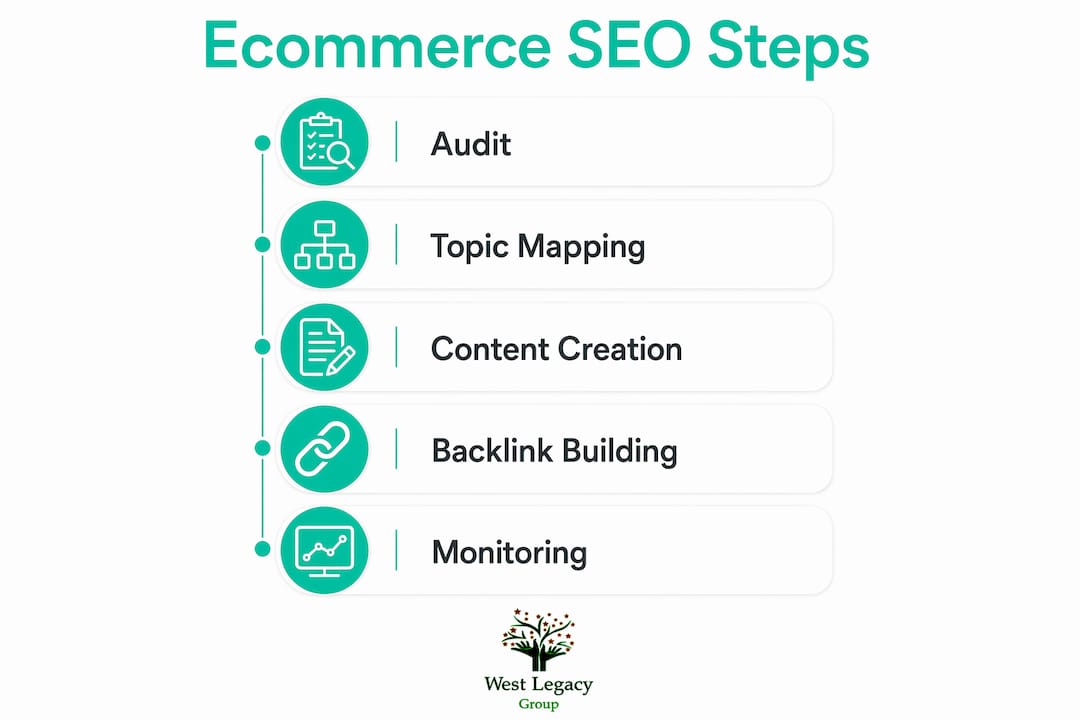
Map your topic clusters before you publish anything new. Identify the five or six core topics your store should own, then plan a pillar page and four to six cluster pages for each. Every new piece of content should connect to existing pages through internal links, and every existing page should link out to new content when it goes live. This is not a quarterly audit task. Make it part of your publishing checklist.
Backlink outreach works best when it is incremental and consistent rather than done in bursts. One podcast pitch per month, one guest post per quarter, and regular participation in relevant online communities builds a natural link profile that compounds over time. Avoid any agency promising fast AI search citations for a large monthly fee. As Matt Edmundson notes, nobody yet knows with certainty what reliably drives AI citation, and the pattern of agencies overpromising in new SEO channels has repeated itself before.
For a structured look at the common ecommerce SEO mistakes that undermine these efforts, West Legacy Group’s 2026 guide covers the pitfalls that most stores hit before they get traction.
Strategic steps to organise and execute your organic plan:
- Run a full technical audit: speed, mobile, indexing, redirects, broken links
- Map topic clusters for your five core product or category themes
- Fix title tags and meta descriptions on your top 20 existing pages
- Publish the pillar page for your first cluster, then add cluster pages over the following weeks
- Link new content to three or four existing pages on publication day
- Start one digital PR outreach effort per month: podcast, guest post, or community contribution
- Review Search Console monthly for impression-to-click gaps and adjust accordingly
Local SEO strategies specific to the Australian market
Local SEO is often overlooked by ecommerce businesses, but it drives real revenue for stores with physical locations, local delivery areas, or region-specific product ranges. Your Google Business Profile is the starting point. Keep it complete and current: business hours, product categories, photos, and a description that includes the suburbs or regions you serve. Customers searching “online homewares store Melbourne” or “organic skincare delivery Brisbane” are high-intent buyers, and a well-maintained profile captures them.
Location-specific landing pages work well for Australian ecommerce stores serving multiple cities or states. A page targeting “handmade ceramics Sydney” with genuine local content, including references to local markets, stockists, or delivery areas, will rank for searches that a generic product page never will. Keep the content real rather than templated: Google can identify thin localisation pages quickly.
Australian shoppers also use Google Maps and local search for product discovery more than many ecommerce owners realise. Encouraging customers to leave Google reviews, and responding to them, signals to Google that your business is active and trustworthy. Yotpo’s review collection tools can feed into this process by making it easy for customers to leave feedback across multiple platforms after purchase.
For a deeper look at applying local SEO to an ecommerce context, West Legacy Group’s guide on local SEO for ecommerce covers the Australian-specific tactics in detail, including Google Business Profile optimisation and location page structure.
How does voice search affect your ecommerce store’s visibility?
Voice search queries are longer and more conversational than typed searches. Someone typing might enter “running shoes flat feet.” The same person using voice search asks “what are the best running shoes for flat feet and shin splints?” That difference in phrasing means your content needs to answer complete questions, not just target keyword fragments.
Structuring content with question-based subheadings and direct answers underneath is the most reliable way to capture voice search traffic. AI systems and voice assistants look for question-and-answer pairs to extract and read aloud. If your FAQ sections and blog posts are written this way, they become candidates for both voice results and AI Overviews. Adding FAQPage schema reinforces this signal technically.
Natural language in product descriptions and category page content also helps. Write the way your customers speak, not the way a product catalogue reads. For Australian ecommerce stores, this means using local terminology and phrasing that reflects how Australians actually search, including colloquial product names and region-specific terms where relevant.
Key takeaways
Combining targeted keyword research, strong on-page SEO, and consistent backlink building is the fastest path to sustainable ecommerce organic traffic growth in 2026.
| Point | Details |
|---|---|
| Organic traffic share | Organic search drives 43% of ecommerce traffic, making it the highest-return channel for most online stores. |
| Six organic surfaces | AI discovery, site SEO, blog content, YouTube, social SEO, and digital PR all drive organic traffic in 2026. |
| Mobile commerce priority | Mobile accounts for over 60% of ecommerce traffic and nearly 55% of online sales, so mobile performance directly affects rankings and revenue. |
| Content ROI | Consistent blogging generates roughly 13 times more positive ROI than sporadic publishing. |
| AI discovery readiness | 78% of consumers used a large language model for product research last year; product schema and an llms.txt file are now baseline requirements. |
The organic strategy most ecommerce stores get wrong
The most common mistake Australian ecommerce owners make is treating SEO as a one-time project rather than a compounding system. They do a technical audit, fix a few title tags, publish three blog posts, and then wait. When results don’t arrive in six weeks, they conclude that SEO doesn’t work for their store. What they’ve actually done is plant seeds and then pulled them up to check the roots.
The stores that win organic search in 2026 are the ones that started building eighteen months ago and kept going when nothing seemed to be happening. The curve is flat for months, then it tips. That is not a flaw in the strategy. It is how compounding works.
What I’d push back on is the idea that you need to do everything at once. The six-surface framework is real and worth understanding, but for most small Australian ecommerce businesses, the priority order is clear: fix your technical foundation, optimise your top twenty pages, build your first topic cluster, then expand. Trying to run AI discovery, YouTube, and social SEO simultaneously before your product pages are properly indexed is a distraction.
The other thing worth saying plainly: brand search volume matters more than most people realise. Getting cited in AI answers, ranking in Google, and appearing in social search all correlate with how many people are actively searching for your brand name. Digital PR, podcast appearances, and community engagement build that volume. They feel less measurable than keyword rankings, but they are the upstream cause of the rankings you want.
West Legacy Group has supported Australian small businesses through exactly this kind of long-term organic strategy development, from affordable SEO plans to full website builds designed for search performance. The businesses that grow are the ones that treat organic as infrastructure, not a campaign.
Ready to build organic traffic that lasts? West Legacy Group offers affordable SEO and small business website design packages built specifically for Australian ecommerce owners. Whether you need a technical audit, a content strategy, or a full site rebuild optimised for 2026 search, the team at West Legacy Group can help you get there without the agency price tag.